The rapid pace of urban development in China is giving rise to innovative solutions that seek to reconcile large-scale construction activity with the quality of life of residents and businesses. Among the most striking of these innovations is the use of giant inflatable domes that fully enclose construction sites, dramatically reducing dust, noise, and weather-related delays. This emerging model offers a compelling example of how urban growth can be managed through technology in a more sustainable, efficient, and citizen-centered way
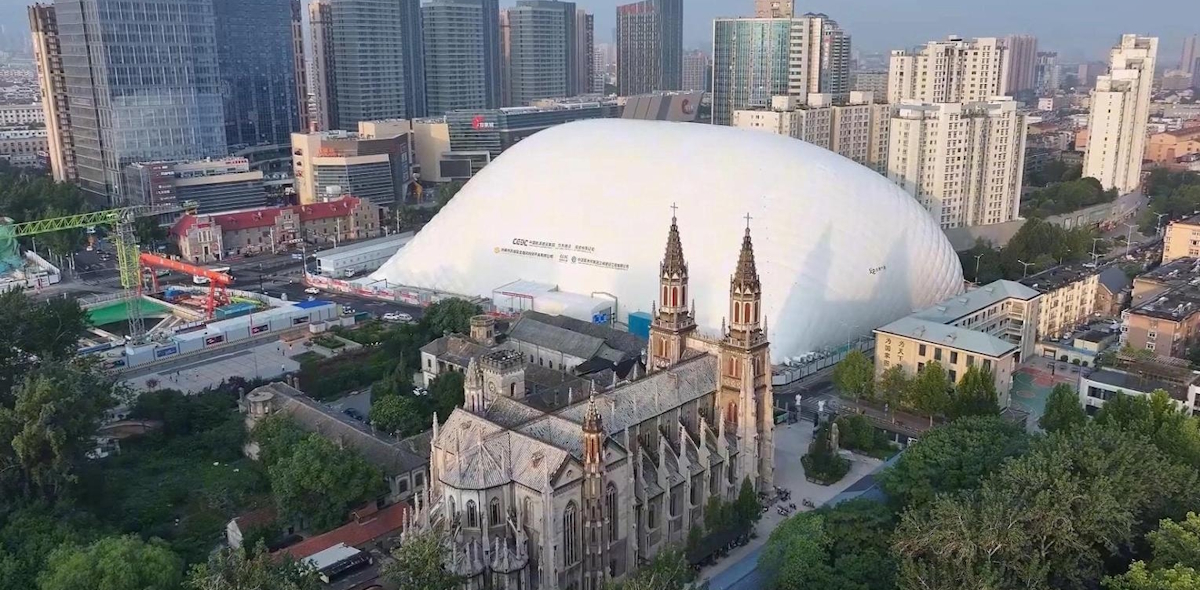
China’s accelerated urban transformation over the last three decades has created one of the most intense construction environments in modern history, as the expansion of transport infrastructure, commercial districts, residential complexes, cultural facilities, and urban renewal projects has become a permanent feature of everyday life in many of its major metropolitan areas. In cities such as Beijing, Shanghai, Shenzhen, and Jinan, construction activity is no longer an occasional phase of development but an almost continuous urban condition, deeply intertwined with economic growth, population density, and the strategic modernization of city centers. Within this context, one of the most persistent tensions has emerged between the need to sustain rapid urban development and the equally important necessity of preserving acceptable living conditions for residents, workers, tourists, and local businesses.
Traditionally, construction sites in dense urban areas have generated two major externalities: airborne particulate pollution and excessive noise levels. These effects become particularly problematic in mixed-use neighborhoods where commercial activity, tourism, pedestrian mobility, and residential life coexist within the same streetscape. In many central districts, prolonged exposure to dust emissions and continuous construction noise has resulted in complaints from citizens, economic losses for retail businesses, and growing pressure on municipal authorities to adopt new mitigation strategies. It is precisely in response to this urban challenge that China has begun to implement one of the most innovative construction management solutions currently being tested at scale: giant inflatable domes or sealed membrane enclosures that completely encapsulate construction sites.
The Technology Behind the Inflatable Construction Domes
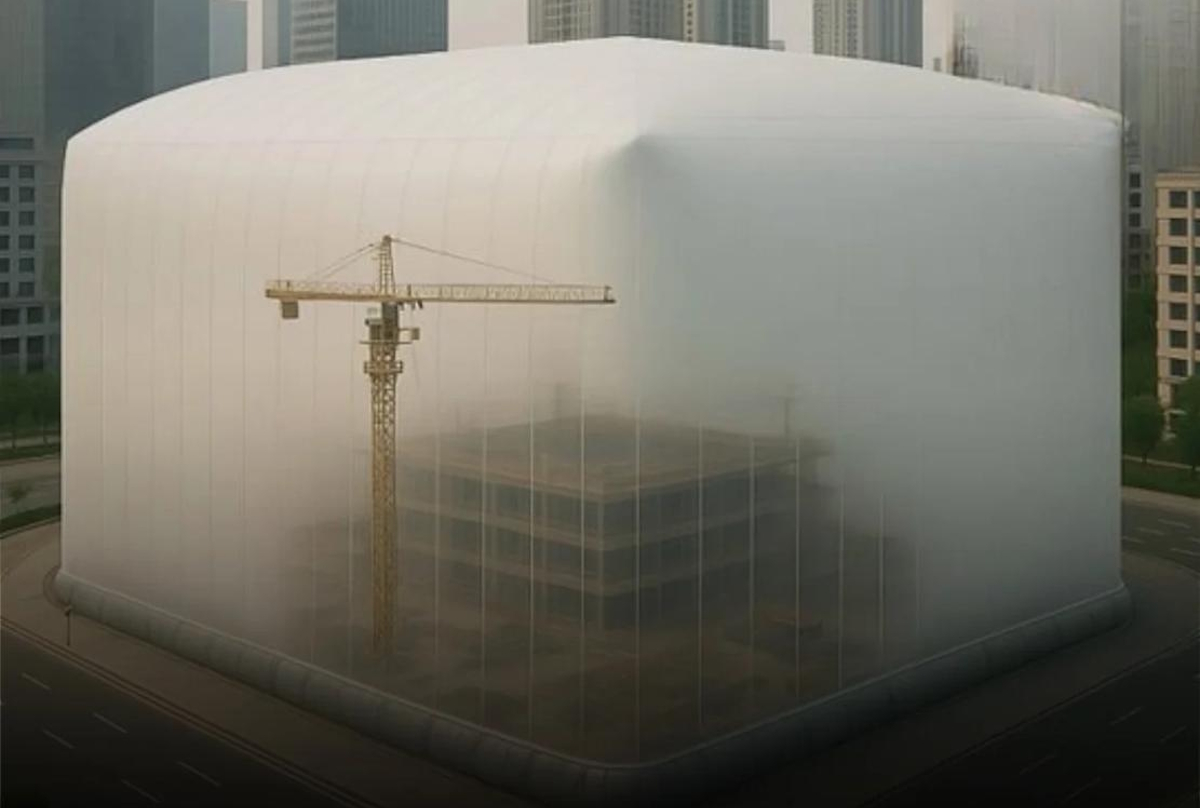
These structures function as large-scale enclosed environmental control systems designed to isolate the construction process from the surrounding urban environment. Unlike conventional perimeter fencing or temporary scaffolding screens, these domes create a fully enclosed and semi-hermetic workspace in which dust, noise, and even certain climatic variables can be actively managed. The membrane itself is typically composed of high-resistance polymer materials, often engineered to be flame-retardant, weather-resistant, and partially capable of filtering ultraviolet radiation.
The engineering principle behind these systems resembles that of controlled-environment industrial enclosures. Internal air pressure is carefully regulated through continuous ventilation systems, allowing the dome to maintain its shape and structural stability. At the same time, the airflow is designed to retain suspended particles generated by demolition, drilling, cutting, or concrete works, preventing them from dispersing into adjacent streets and buildings. According to data reported by local district authorities in several pilot projects, these systems have demonstrated the capacity to contain more than 95% of dust particles, which represents a significant improvement compared to conventional open-air construction sites.
Equally important is the acoustic performance of these structures. Construction machinery, heavy vehicles, demolition equipment, and drilling systems can often generate sound levels exceeding 80 to 100 decibels, which in central urban areas creates serious disturbances for both residents and commercial operators. Under the sealed dome model, noise levels in surrounding streets have reportedly been reduced to below 50 decibels, a threshold generally considered compatible with commercial activity, pedestrian circulation, and residential comfort.
The Beijing Wangfujing Case: A Practical Urban Example
One of the most emblematic examples of this innovation can be found in Beijing’s Wangfujing district, one of the city’s most iconic commercial and tourist corridors. This area, characterized by high pedestrian density, retail concentration, and continuous visitor flows, presented a particularly complex challenge when a major bookstore renovation project was launched.
Rather than relying on traditional construction barriers, authorities and project managers opted to install a large sealed membrane enclosure over the entire site. The result was not merely a technical improvement but a profound transformation in the way construction activity interacted with the urban fabric. Dust emissions, which in such areas would normally affect shopfronts, public sidewalks, and nearby indoor spaces, were dramatically reduced. Equally significant was the mitigation of construction noise, which allowed surrounding businesses to continue operating with minimal disruption.
This case is especially relevant because it illustrates how construction management itself is becoming part of smart urban governance, where infrastructure delivery is no longer evaluated only in terms of speed and cost, but also in terms of citizen impact, urban livability, and economic continuity.
Operational Efficiency and Reduced Weather Dependency
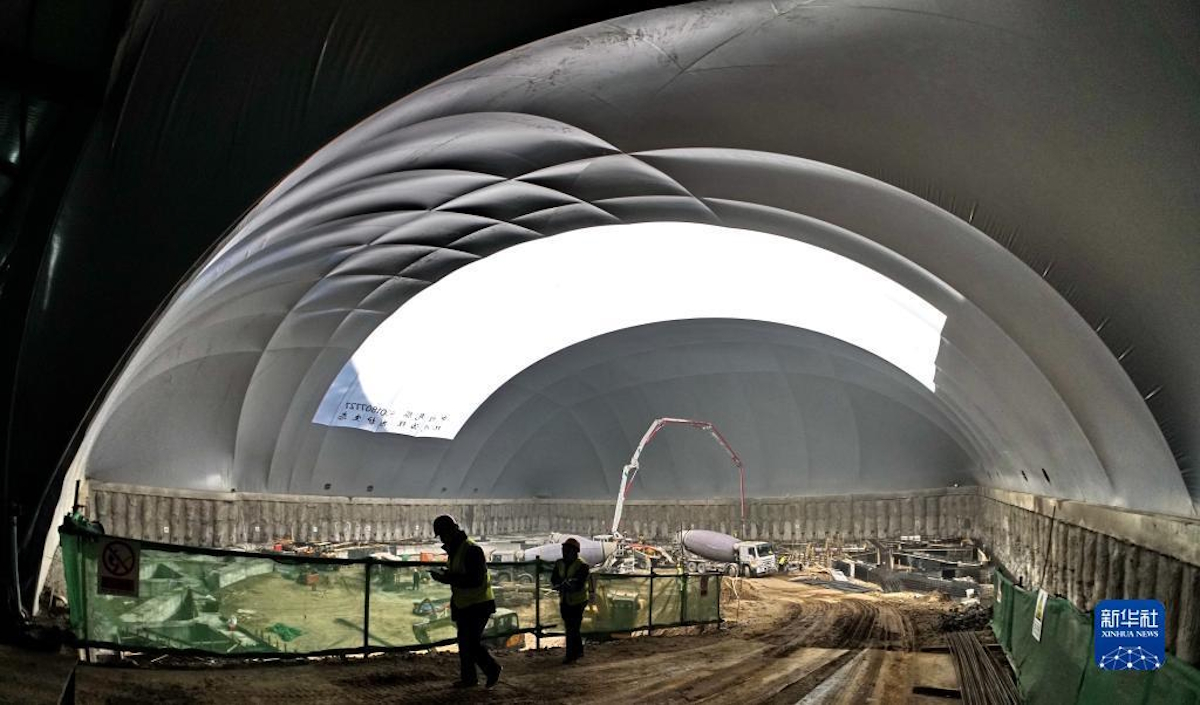
Beyond environmental protection, one of the most strategically important benefits of these domes lies in the operational continuity they provide. In traditional open-air construction environments, work schedules are highly vulnerable to weather conditions, including rain, strong winds, extreme heat, or seasonal air quality events. Such interruptions can significantly delay project timelines and increase costs.
By contrast, enclosed construction environments allow project teams to maintain a far more stable workflow. Official estimates from pilot projects suggest that weather-related interruptions may be reduced by up to 90%, which has direct implications for productivity, labor efficiency, and overall project economics. In practical terms, this means shorter execution periods, more predictable delivery schedules, and reduced disruption for nearby residents.
This aspect is particularly important in China, where large-scale infrastructure and redevelopment projects are often subject to strict timelines linked to broader urban transformation strategies. Maintaining continuity under variable climatic conditions provides a major advantage in project planning and risk management.
The Jinan Large-Scale Dome: Urban Visibility and Engineering Scale
Another remarkable case can be found in Jinan, where this technology has been applied to a major urban project using an inflatable dome reaching approximately 50 meters in height and covering close to 20,000 square meters. At this scale, the enclosure becomes not only a construction management tool but also an urban landmark in itself, visible from multiple points across the city.
The significance of this example lies in its demonstration that the model is scalable beyond medium-sized commercial renovations and can be applied to major infrastructure and urban redevelopment projects. This opens the possibility of integrating such systems into metro station construction, public facility upgrades, mixed-use redevelopment zones, and even transportation hubs.
From an urban innovation perspective, this evolution reflects a broader trend in which cities are seeking to reduce the negative externalities of growth without slowing down the pace of transformation.
Challenges: Energy Consumption, Sustainability, and Worker Health
Despite its evident advantages, the widespread use of inflatable construction domes also raises important questions regarding long-term sustainability and operational viability. One of the most frequently cited concerns is energy consumption. Because these systems require continuous ventilation, pressure regulation, air filtration, and environmental monitoring, they inevitably increase the project’s energy demand.
This creates a potential paradox: while the technology improves local environmental quality, it may also increase the project’s carbon footprint unless renewable energy sources or energy-efficient ventilation systems are incorporated. In the context of sustainable urban development, this trade-off must be carefully evaluated.
Another crucial issue concerns internal air quality for workers. While dust is retained within the enclosure, this also means that effective extraction and filtration systems are essential to avoid occupational health risks. Temperature control, humidity regulation, and air renewal become critical factors in ensuring safe working conditions, particularly during large-scale demolition or material handling operations.
A New Model for Human-Centered Urban Construction
More broadly, this Chinese innovation may be understood as part of the evolution from traditional construction management toward a more human-centered model of urban development. In rapidly growing cities, the challenge is no longer simply to build faster, but to build in ways that preserve urban functionality, commercial vitality, and citizen well-being.
The use of giant inflatable domes suggests a shift in how cities conceptualize infrastructure delivery: not as an isolated technical process, but as an integrated component of urban life that must coexist with mobility systems, retail ecosystems, tourism flows, and residential quality. In this sense, the model may become an important reference for other global cities facing similar tensions between growth and livability.
As urban populations continue to rise and city centers become denser, solutions of this kind may increasingly form part of the future toolkit of smart and sustainable urban development.