Traffic is far more than a mobility and emissions issue; it is also an increasingly important driver of urban warming. It is clear that vehicular heat contributes to the urban heat island effect, raising local temperatures and intensifying thermal stress in dense city environment, which is why traffic-generated heat must become a central variable in climate resilience and Smart City planning.
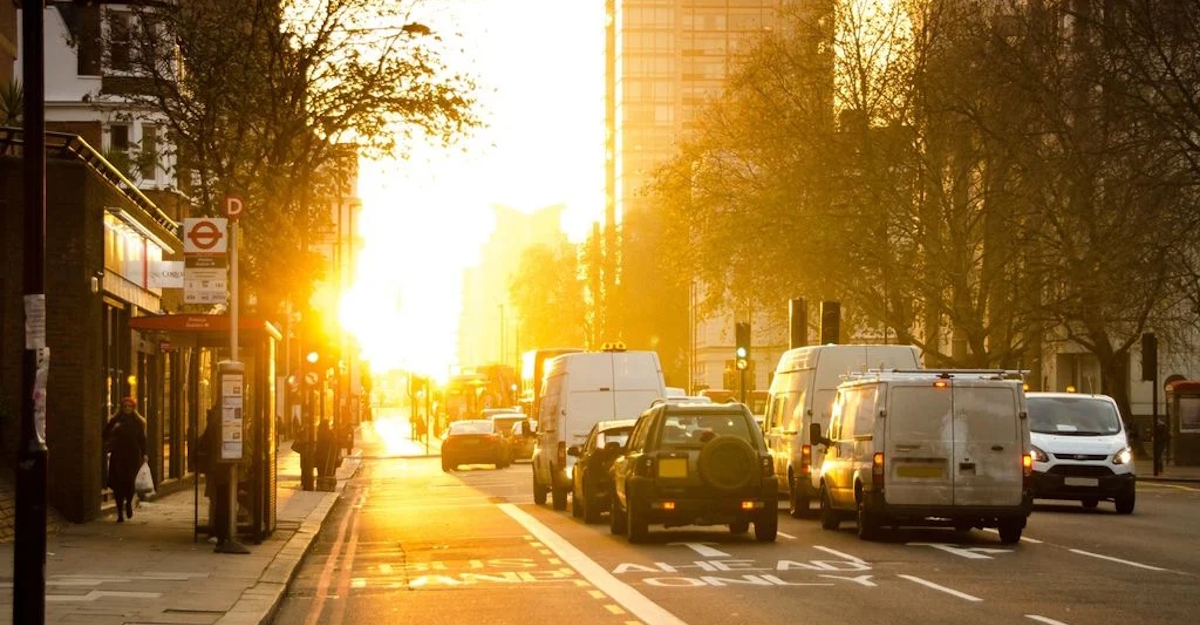
The warming of contemporary cities cannot be understood solely through the traditional lens of solar radiation absorbed by concrete, asphalt, and glass surfaces; rather, it must also be interpreted through the growing contribution of anthropogenic heat generated by everyday human activity, among which vehicular traffic occupies an increasingly significant place. Recent research developed by scientists at the University of Manchester has brought renewed attention to this often underestimated dimension of urban climate dynamics, demonstrating that the daily circulation of vehicles through dense urban corridors produces a measurable thermal load capable of intensifying the urban heat island effect and altering the microclimatic balance of entire districts.
For decades, most urban climate studies have focused primarily on the thermal properties of the built environment: materials, building density, street canyons, reduced vegetation, and surface albedo, while the direct heat released by traffic, through engines, exhaust systems, braking systems, and friction between tires and pavement, remained comparatively underrepresented in large-scale climate models. This new research changes that perspective by integrating a physics-based traffic heat module into the Community Earth System Model (CESM), one of the most widely used climate simulation frameworks in the world, thereby enabling a much more realistic representation of how urban mobility systems contribute to localized warming.
Urban areas are already structurally predisposed to retain heat due to their morphology and material composition. Dense street canyons trap longwave radiation, impervious surfaces store solar energy during the day, and reduced vegetation limits evaporative cooling. However, what this study highlights with particular clarity is that traffic acts as an active and continuous heat source, injecting additional sensible heat directly into the urban canopy layer.
This additional heat, technically referred to as traffic heat flux (Qtraffic), is not static. It varies dynamically according to traffic volume, the distribution of vehicle types, road morphology, speed patterns, and even weather conditions. In practical terms, a congested avenue during rush hour in winter may produce a very different thermal footprint from a mixed-use boulevard with electric vehicles and fluid circulation during spring.
The Manchester team employed a bottom-up modelling approach, which represents a major methodological improvement over previous inventory-based estimations. Instead of relying on generalized energy statistics, the model calculates heat emissions directly from variables such as lane numbers, vehicle flow per hour, vehicle speed, road width, and the energy release rate associated with different propulsion technologies, including gasoline, diesel, hybrid, and electric vehicles.
This is especially important because the urban climate impact of mobility cannot be separated from transport transitions. A city dominated by diesel buses and private combustion vehicles will generate a very different heat profile from a city moving toward electrified fleets, shared mobility, and reduced congestion strategies.
Measured Temperature Increases in Real Urban Environments
One of the most compelling aspects of the study lies in its validation through real-world urban data collected from Toulouse, France, and Manchester, United Kingdom, which transforms the research from a theoretical exercise into an operationally relevant planning tool.
At the Capitole district in Toulouse, the annual average traffic heat flux reached 22.23 W/m², which translated into a simulated increase of 0.4 °C in mean annual canopy air temperature. While this figure may initially appear modest, in urban climatology such an increase is highly significant, especially when layered on top of already elevated summer temperatures and recurrent heatwave conditions.
In Manchester, where the annual mean Qtraffic was measured at 16.27 W/m², the simulations showed an average air temperature increase of 0.25 °C in 2022, with even stronger localized effects during winter nights and high-traffic periods. Some simulation scenarios suggest winter nighttime increments closer to 0.35 °C, revealing that traffic-related warming can be amplified when atmospheric dispersion conditions are weaker.
From an urban planning perspective, these values are far from negligible. A quarter or half degree increase in city-center temperatures can intensify heat stress, worsen thermal discomfort for pedestrians, and increase the likelihood of heat-related health incidents among vulnerable populations.
A Practical Urban Example: High-Traffic Corridors and Heat Stress
To understand the practical implications, one can imagine a central urban avenue in a metropolitan district such as Barcelona’s Eixample, central Manchester, or inner Madrid, where traffic flows remain intense throughout the day and where street canyons formed by mid-rise buildings already reduce natural ventilation.
In such an environment, traffic-generated heat does not dissipate immediately. Instead, it accumulates in the lower atmospheric layer between buildings, particularly during evening hours, when surface cooling should normally begin. This means that streets remain warmer for longer, façades continue radiating heat into adjacent indoor spaces, and nighttime cooling, crucial for human physiological recovery during summer, is delayed.
This phenomenon becomes especially critical during heatwaves. If the baseline nocturnal temperature is already, for example, 29 °C, an additional 0.25–0.40 °C induced by traffic may be enough to push nighttime thermal conditions beyond thresholds associated with elevated cardiovascular and respiratory risk.
Moreover, the study also demonstrates that traffic-induced canopy warming affects indoor thermal conditions, increasing cooling demand during summer while slightly reducing heating demand during winter.
This creates a secondary feedback loop: more cooling demand leads to higher electricity consumption, which may itself generate additional anthropogenic heat through building systems and energy infrastructure.
Implications for Smart City and Climate Planning
For Smart City strategies, this research is profoundly relevant because it reframes mobility not only as a congestion or emissions issue, but as a microclimatic and public health variable.
Traditionally, urban mobility plans focus on reducing CO₂ emissions, travel times, and particulate pollution. However, this new evidence suggests that traffic must also be incorporated into urban thermal resilience strategies, especially in cities increasingly exposed to climate extremes.
This has direct implications for interventions such as low-emission zones, congestion pricing, modal shifts toward public transport, electrification of fleets, cool pavement design, and street greening. For instance, reducing traffic density in central districts may not only improve air quality but also produce measurable reductions in local ambient temperatures.
In practical terms, this means that traffic management systems powered by AI and real-time urban data platforms could become instruments not only for mobility optimization but also for dynamic heat mitigation policies, particularly during heat alerts and summer peak periods.
The broader significance of the Manchester study lies precisely in showing that urban traffic is not merely a mobility phenomenon but an active thermal agent in the climate metabolism of the city, and therefore must be fully integrated into future urban climate models, digital twins, and resilience planning frameworks.