
The history of technological progress is often told through stories of invention. New machines are developed, scientific breakthroughs are announced and innovative products capture public attention by demonstrating capabilities that previously appeared impossible. While these moments undoubtedly deserve their place in the history of innovation, they rarely represent the point at which technology begins to transform society on a large scale. Far more often, the decisive change occurs later, when the technology in question becomes sufficiently affordable, reliable and accessible that it can be adopted far beyond the relatively small community of its earliest users. In many cases, the true revolution begins not with invention itself, but with the gradual disappearance of scarcity.
This pattern has repeated itself throughout successive technological eras. Computing was once available only to governments and major research institutions before becoming accessible to businesses and eventually to individuals through personal computers. Digital storage evolved from an expensive engineering constraint into an almost invisible commodity capable of supporting entire digital economies. Internet connectivity followed a similar trajectory, expanding from limited academic networks to become a global infrastructure upon which commerce, communication and scientific collaboration now routinely depend. In each of these cases, falling costs did not merely increase consumption of an existing technology; they fundamentally altered the range of activities that became economically and socially possible.
Artificial intelligence now appears to be entering a comparable stage of development. During the first years of the current generative AI revolution, access to the most capable models often involved significant financial costs associated with both training and inference. Building advanced applications required careful consideration of computational budgets, while many potential use cases remained economically impractical despite their technical feasibility. Recent developments within the industry, including the emergence of increasingly efficient model architectures and more aggressive pricing strategies, suggest that this situation may be changing rapidly. High-quality artificial intelligence is becoming progressively more affordable, allowing capabilities that were once considered premium resources to move steadily towards widespread availability.
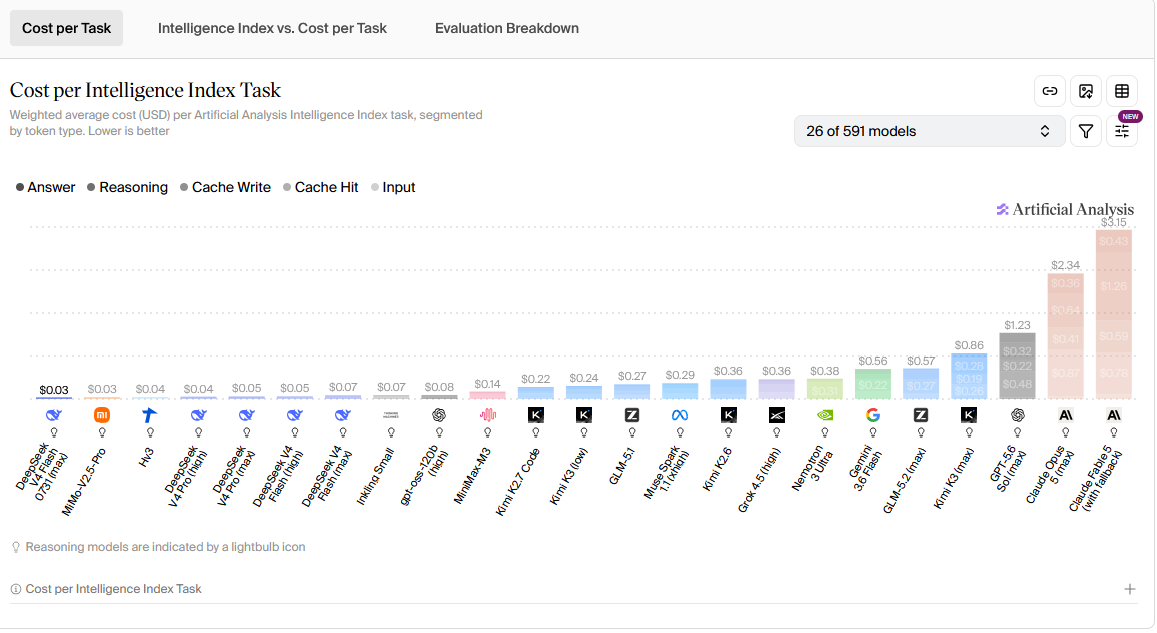
Understanding the significance of this transition requires looking beyond individual product announcements or temporary price competition between technology companies. The central question is not whether one model is less expensive than another, but what happens when advanced artificial intelligence itself ceases to be an economically scarce resource. If history offers any guidance, the consequences may extend far beyond the AI industry, influencing the structure of software development, scientific research, public services and countless other domains whose future increasingly depends upon access to intelligent computational systems. It is this broader economic transformation, rather than the launch of any particular model, that deserves careful attention.
From Scarcity to Abundance: A Familiar Pattern in Technological History
Throughout modern economic history, transformative technologies have rarely remained scarce for long. Their earliest stages are typically characterised by high costs, limited availability and intense competition among a relatively small number of organisations capable of developing or operating them. During this period, technological capability itself constitutes the principal source of competitive advantage. Over time, however, continuous improvements in engineering, manufacturing, infrastructure and operational efficiency gradually reduce costs, expand accessibility and encourage broader adoption. As this process unfolds, the technology begins to shift from being an exceptional resource towards becoming an increasingly ordinary component of economic life, allowing innovation to migrate from the technology itself towards the countless applications built upon it.
The evolution of digital computing offers a particularly instructive example. The earliest electronic computers required enormous financial investment and occupied entire buildings, placing them far beyond the reach of most organisations. Yet advances in semiconductor technology, manufacturing efficiency and software development progressively reduced costs while increasing performance, eventually transforming computing into a universally available resource. Today, computational power is so abundant that billions of people routinely carry devices in their pockets whose capabilities surpass those of the world’s most advanced supercomputers from only a few decades ago. Similar transitions occurred with internet bandwidth, cloud storage and data processing, each following a trajectory in which declining costs fundamentally expanded the range of activities that could be supported economically.
Artificial intelligence now appears to be entering the earliest stages of an analogous transition. During the initial wave of large language models, access to advanced AI capabilities remained relatively expensive, reflecting the enormous computational requirements associated with both model training and inference. These costs naturally limited experimentation, particularly for smaller organisations and independent developers. As model architectures become more efficient, specialised hardware continues to improve and competitive pressures intensify across the industry, however, the economics of artificial intelligence are beginning to change. Increasingly capable models are becoming available at substantially lower prices, suggesting that the cost of intelligence itself may decline far more rapidly than many observers anticipated only a short time ago.
This shift is important because abundance changes the nature of innovation. When a technological capability remains scarce, considerable effort is devoted to obtaining access to it as efficiently as possible. Once that capability becomes inexpensive and widely available, attention naturally shifts towards discovering new ways of applying it. Economic value begins to migrate away from the underlying infrastructure and towards the products, services and organisational models that become possible because the infrastructure exists. If artificial intelligence follows this historical trajectory, its most transformative period may not coincide with the creation of the first highly capable models, but rather with the moment when those capabilities become sufficiently abundant to disappear into the background of everyday technological life.
Why AI Is Becoming Dramatically Less Expensive
The rapid reduction in the cost of artificial intelligence is not the result of a single technological breakthrough, nor can it be explained solely by increasingly aggressive commercial competition between AI providers. Rather, it reflects the convergence of several independent developments that have matured simultaneously over recent years, each contributing to a broader improvement in the efficiency with which advanced models are trained, deployed and operated. Understanding these underlying mechanisms is important because they suggest that the current decline in costs is unlikely to represent a temporary anomaly. Instead, it may signal the beginning of a long-term structural transformation in the economics of artificial intelligence.
One of the most important contributors has been the continuous evolution of model architecture. Early generations of large language models relied upon relatively uniform computational strategies in which every parameter participated in processing every request. More recent approaches increasingly employ architectures designed to activate only those computational components that are relevant to a particular task, allowing comparable levels of performance to be achieved while consuming substantially fewer computational resources during inference. At the same time, improvements in model compression, quantisation techniques, memory management and inference optimisation have made it possible to deliver sophisticated capabilities using significantly less hardware than would previously have been required.
Equally important has been the rapid development of the computational infrastructure supporting artificial intelligence. Specialised processors designed specifically for machine learning workloads continue to improve in both performance and energy efficiency, while advances in distributed computing allow increasingly large workloads to be executed more economically across highly optimised data centre environments. Software engineering has evolved alongside these hardware improvements, producing increasingly sophisticated methods for scheduling computations, reducing latency and making more efficient use of available computational resources. Individually, each improvement may appear incremental, yet together they produce substantial reductions in the overall cost of delivering advanced AI services.
Competition has further accelerated this technological evolution. As new organisations enter the AI market with increasingly capable open and proprietary models, providers are encouraged to optimise both performance and cost in order to remain commercially attractive. What initially appeared to be a race focused primarily on achieving the highest benchmark scores is gradually becoming a broader competition centred upon efficiency, accessibility and scalability. This change in emphasis reflects a maturing industry in which technical excellence alone is no longer sufficient; long-term success increasingly depends upon the ability to provide advanced intelligence at prices that enable widespread adoption. The recent emergence of highly capable low-cost models should therefore be understood not as an isolated commercial event, but as part of a much larger movement towards making artificial intelligence progressively more abundant.
When Intelligence Becomes Infrastructure

Technological revolutions often reach a point at which the technology itself gradually disappears from public attention, not because it has become less important, but because it has become so deeply integrated into everyday life that it is increasingly regarded as basic infrastructure rather than a remarkable innovation. Electricity offers perhaps the clearest historical example. During its earliest decades, access to electrical power represented a technological achievement in its own right, attracting widespread attention and requiring substantial investment. Today, electricity remains one of the most important foundations of modern civilisation, yet few people regard it primarily as an innovation. Instead, it functions as an invisible infrastructure upon which countless other activities depend.
Artificial intelligence may be beginning to follow a comparable trajectory. As access to advanced models becomes progressively more affordable, organisations are likely to spend less time selecting between individual models and more time designing the products, services and institutional processes that those models enable. The intelligence itself gradually recedes into the background, becoming an increasingly standard component of digital infrastructure rather than the principal focus of innovation. Users may no longer ask which model powers a particular application, just as few internet users today concern themselves with the precise architecture of the servers delivering the websites they visit. What matters increasingly becomes the quality of the experience and the value created through the intelligent capabilities embedded within it.
This transition has profound economic implications because infrastructure tends to redistribute rather than eliminate value. When computing became inexpensive, enormous new industries emerged around software. When internet connectivity became ubiquitous, innovation shifted towards digital platforms, electronic commerce and online services. Similarly, if artificial intelligence becomes widely available at relatively low cost, competitive differentiation is likely to move away from the foundation models themselves and towards the countless ways in which intelligent capabilities are integrated into scientific research, healthcare, education, engineering, manufacturing, public administration and everyday digital products. Intelligence becomes less a destination and more an enabling layer supporting innovation elsewhere.
From this perspective, the decreasing cost of AI should not be interpreted as reducing the importance of artificial intelligence. On the contrary, it may substantially increase its overall influence by making advanced computational intelligence accessible to organisations and individuals that previously lacked the resources to employ it at meaningful scale. Technologies generally exert their greatest societal impact not when they remain scarce and exceptional, but when they become sufficiently abundant to support entirely new forms of economic and institutional activity. Artificial intelligence appears increasingly likely to follow precisely this historical pattern.
Where Will the Value Move?
Whenever a technology undergoes rapid commoditisation, an important economic question inevitably emerges: if the underlying capability becomes inexpensive and widely available, where does competitive advantage subsequently reside? History consistently suggests that value rarely disappears during such transitions. Instead, it migrates towards new layers of the technological ecosystem where scarcity continues to exist. Understanding this process is essential for interpreting the future evolution of artificial intelligence, because the decreasing cost of foundation models is unlikely to diminish the overall economic importance of AI. Rather, it is likely to redefine where that importance is created.
For much of the recent development of generative AI, considerable attention has understandably focused on the models themselves. Improvements in reasoning, language understanding, multimodal capabilities and benchmark performance have represented the principal indicators through which technological leadership has been assessed. As performance differences gradually narrow and access costs continue to decline, however, the models themselves may increasingly resemble foundational infrastructure rather than the final products through which users experience artificial intelligence. In such an environment, the greatest opportunities for differentiation are likely to emerge elsewhere within the broader AI ecosystem.
One increasingly important area concerns the development of intelligent applications capable of solving highly specific problems within particular professional or organisational contexts. Rather than simply providing access to a general-purpose language model, future systems are expected to integrate artificial intelligence with domain knowledge, enterprise data, regulatory requirements, specialised workflows and human expertise in ways that produce genuinely useful outcomes. Similarly, autonomous or semi-autonomous AI agents, capable of coordinating multiple tasks across digital environments, may become an increasingly significant source of value precisely because they depend upon much more than the capabilities of the underlying language model alone. Integration, orchestration and contextual understanding may therefore become more commercially important than raw model performance.
A comparable shift is likely to occur within scientific research and public institutions. As access to advanced AI becomes progressively less expensive, the principal challenge will no longer consist of obtaining computational intelligence itself, but of designing organisational processes capable of using that intelligence responsibly, effectively and at scale. Questions concerning governance, interoperability, trust, security and institutional adaptation may therefore become increasingly significant determinants of long-term success. In this sense, the commoditisation of artificial intelligence does not reduce the strategic importance of AI; it simply moves attention towards the human, organisational and institutional capabilities required to transform abundant computational intelligence into meaningful societal value.
A More Competitive AI Ecosystem
The gradual reduction in the cost of artificial intelligence is likely to have consequences that extend well beyond the commercial strategies of individual technology companies. As advanced models become increasingly affordable, the structure of the AI industry itself may begin to evolve in ways that encourage greater diversity, broader participation and more rapid experimentation. During the earliest stages of the current generative AI revolution, the substantial computational resources required to train and deploy frontier models naturally concentrated technological leadership within a relatively small number of organisations possessing access to extraordinary financial, engineering and infrastructural capabilities. While these organisations continue to play a central role in advancing the state of the art, declining operational costs have the potential to widen participation throughout the broader ecosystem.
Lower barriers to access allow a far greater range of actors to experiment with advanced artificial intelligence. Universities, research laboratories, start-ups, public institutions and small businesses can begin exploring applications that might previously have been economically impractical, while software developers gain the freedom to integrate increasingly sophisticated AI capabilities into products without assuming prohibitive operational costs. This expansion of participation is particularly significant because many of the most transformative applications of technology have historically emerged not from the organisations that created the underlying infrastructure, but from those that discovered novel ways of applying it to previously unaddressed problems. The widespread availability of affordable artificial intelligence may therefore accelerate innovation by multiplying the number of individuals and institutions capable of contributing to its development.
Competition is also likely to become increasingly multidimensional. Rather than focusing exclusively upon benchmark performance or the release of progressively larger models, providers may differentiate themselves through efficiency, reliability, transparency, security, domain specialisation, regulatory compliance and the quality of the ecosystems that develop around their technologies. In many respects, this reflects the natural maturation of a technological industry. As foundational capabilities become more widely shared, sustainable competitive advantage increasingly depends upon factors that extend beyond raw technical performance alone, including user experience, interoperability, institutional trust and the capacity to address specific real-world needs.
This evolution may ultimately benefit the development of artificial intelligence itself. A more diverse ecosystem encourages methodological experimentation, reduces excessive dependence upon any single technological approach and stimulates healthy competition across multiple dimensions of innovation. Rather than slowing progress, the commoditisation of core AI capabilities may accelerate it by enabling a much broader community of researchers, developers and organisations to participate in shaping the future of intelligent systems. The history of technological development repeatedly demonstrates that widespread accessibility often becomes one of the most powerful catalysts for creativity, and artificial intelligence increasingly appears to be entering precisely such a phase.
Beyond the Model Economy
One of the most interesting consequences of this transition is that it invites a reconsideration of how value is created within the artificial intelligence industry. During the first wave of generative AI, public attention naturally focused upon the models themselves. Every new release was evaluated according to benchmark performance, reasoning ability, parameter count or multimodal capability, creating the impression that the future of AI would be determined primarily by continuous competition among increasingly powerful foundation models. While these advances remain important, the gradual reduction in costs suggests that the centre of gravity may slowly be shifting towards a different layer of the technological ecosystem.
As foundation models become progressively more abundant, attention increasingly turns towards the environments in which intelligence is applied rather than the mechanisms through which it is generated. Organisations are beginning to ask how AI can be integrated into scientific research, healthcare, manufacturing, education, finance or public administration, rather than simply which language model performs best under laboratory conditions. This distinction is significant because practical value rarely emerges from computational capability alone. It arises through the interaction between technology, domain expertise, institutional processes and human decision-making. Artificial intelligence therefore becomes one component within a much broader architecture whose effectiveness depends upon thoughtful integration rather than isolated technical excellence.
This transition may also influence the way future AI systems are designed. Instead of relying upon a single increasingly general-purpose model, many organisations are likely to combine multiple specialised systems, domain-specific knowledge bases, autonomous agents and conventional software within integrated environments capable of addressing highly complex tasks. In such architectures, the foundation model functions much like an operating layer supporting a larger cognitive ecosystem rather than serving as the final product itself. The intelligence remains essential, but its value increasingly derives from the broader systems that surround it and the practical outcomes those systems enable.
Viewed from this perspective, the commoditisation of artificial intelligence should not be interpreted as the end of innovation within the field. Quite the opposite may prove true. As access to computational intelligence becomes less expensive, innovation is likely to migrate towards higher layers of abstraction where creativity, organisational design and interdisciplinary collaboration play progressively larger roles. The future of artificial intelligence may therefore depend less upon building ever larger models and more upon learning how to embed abundant intelligence meaningfully within the countless activities that shape modern societies.
Conclusion
The rapid decline in the cost of artificial intelligence represents far more than an episode of intensified commercial competition or an isolated technological achievement. It reflects a broader historical transition through which one of the most significant innovations of the twenty-first century is gradually moving from scarcity towards abundance, following a pattern that has characterised many previous technological revolutions. As increasingly capable models become more affordable and widely available, the economic foundations of the AI industry are beginning to evolve in ways that may ultimately prove as important as the technical advances that first captured global attention.
Perhaps the most significant implication of this transformation is that artificial intelligence is progressively becoming less of a specialised product and more of a foundational capability. Throughout the history of technology, infrastructures have consistently exerted their greatest influence not when they remained expensive and exclusive, but when they became sufficiently accessible to support entirely new forms of innovation. Computing, electricity, digital communications and cloud infrastructure all followed this trajectory, enabling countless applications whose creators often had little involvement in the development of the underlying technologies themselves. Artificial intelligence increasingly appears to be approaching a similar stage, where its future impact may depend less upon the continued pursuit of marginal improvements in model performance and more upon the extraordinary diversity of applications that widespread access makes possible.
This evolution also invites a broader reconsideration of where intelligence itself creates value. As computational capability becomes increasingly abundant, competitive advantage is likely to shift towards those organisations capable of integrating AI effectively within scientific research, institutional processes, professional expertise and everyday human activity. The models remain indispensable, but they become part of a much larger ecosystem in which governance, interoperability, trust, creativity and practical problem-solving assume growing importance. In this sense, the commoditisation of artificial intelligence does not diminish its strategic significance; rather, it expands the range of contexts in which that significance can be realised.
Whether recent developments ultimately mark the beginning of a lasting transformation will become clear only with time. Technological history, however, offers a consistent lesson. The moments that reshape society most profoundly are rarely those in which a technology first becomes possible; they are the moments when it becomes sufficiently accessible that millions of people begin using it in ways that its original creators could scarcely have imagined. Artificial intelligence may now be approaching precisely such a moment. If so, the defining story of the coming decade will not simply concern the creation of more powerful models, but the emergence of a world in which advanced intelligence becomes an increasingly ordinary resource supporting extraordinary new forms of human innovation.