
 The IDHUS Institute is a private and independent research organisation dedicated to developing the emerging discipline of AI for Institutional Cognition and applying its principles to governance, public administration, public policy, and the future evolution of intelligent public institutions.
To accomplish that, the IDHUS research ecosystem has been intentionally designed with an architecture in which each foundational document performs a distinct role within the long-term development of Institutional Cognition. Rather than producing independent publications that gradually accumulate over time, the ecosystem has been organised as a coherent sequence of complementary constitutional layers. Each document answers a different research question while simultaneously preparing the intellectual foundations upon which the next layer of development can emerge.
The Complete Research Architecture
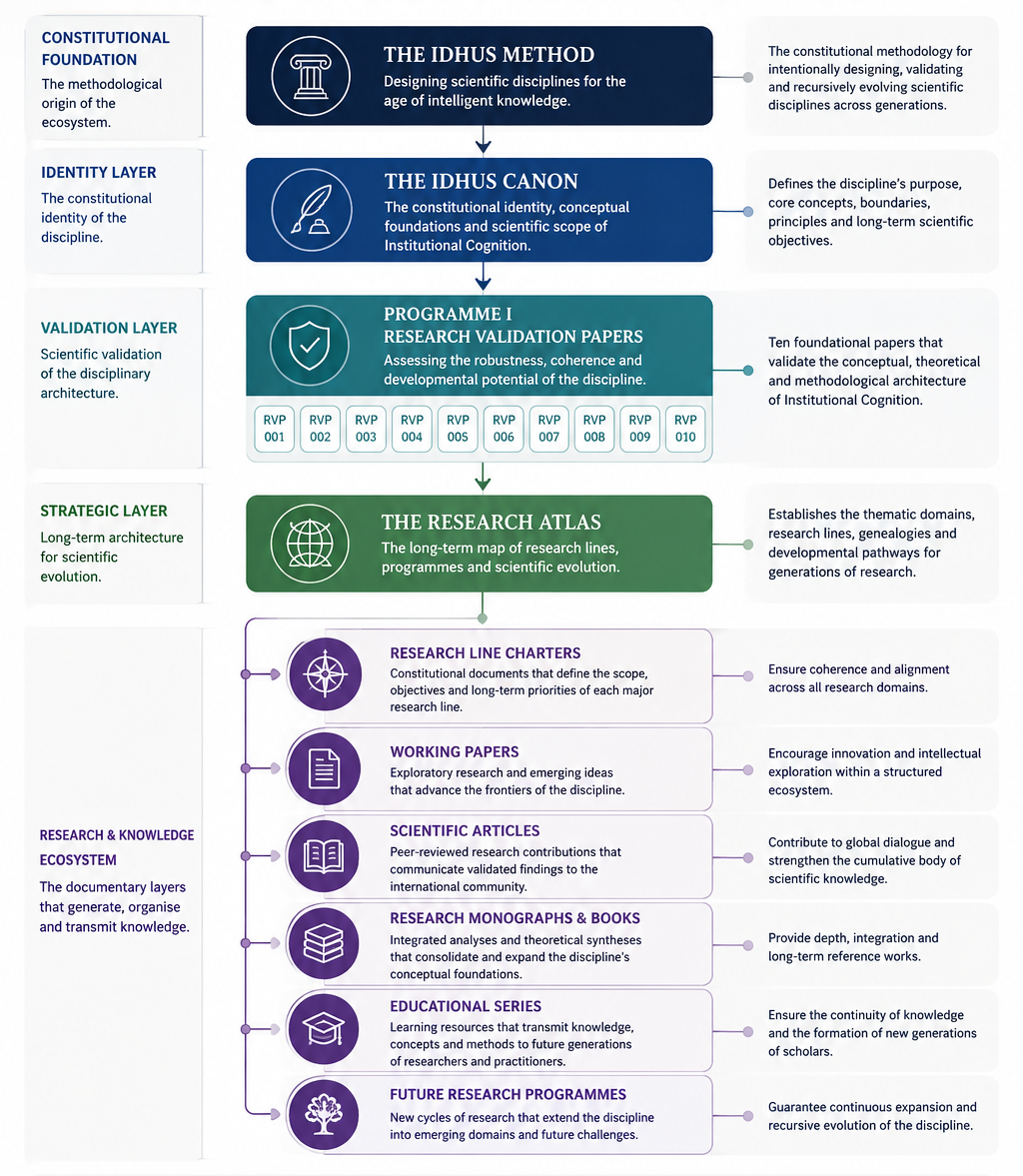
The overall architecture of the IDHUS scientific ecosystem can be understood as a progressive sequence of constitutional, scientific and educational layers. Together, they define our identity, methodology, validation and long-term evolution of the discipline we are developing.
The IDHUS Method
 The IDHUS Method provides the methodological foundation of the entire ecosystem. It explains the constitutional philosophy through which scientific disciplines can be consciously designed, organised, validated and recursively evolved across generations of research. Rather than focusing on Institutional Cognition itself, we start by developing a general methodology for constructing coherent scientific ecosystems capable of sustaining long-term intellectual development.
The Method therefore occupies the highest level of abstraction within the IDHUS architecture. It explains the principles through which every other constitutional document has been conceived.
The IDHUS Canon
 The Canon establishes the constitutional identity of the discipline we are studying. It defines its conceptual foundations, intellectual scope, scientific objectives and organising principles of AI for Institutional Cognition, providing the stable constitutional framework upon which all future research remains recursively connected. Where the Method explains how disciplines are designed, the Canon explains the specific identity of the discipline that the IDHUS ecosystem has been created to develop.
As Layer 0 of the IDHUS Knowledge Architecture, the Canon serves as the permanent methodological reference for our work. Every Research Validation Paper, Working Paper, article, book, educational programme and institutional collaboration developed within the IDHUS ecosystem ultimately derives its methodological continuity from the constitutional principles established in this document.
Research Validation Papers
 Programme I constitutes the first organised cycle of scientific validation within Institutional Cognition. Through ten Research Validation Papers, the programme examines the conceptual robustness, internal coherence and developmental potential of the discipline’s foundational architecture before large-scale theoretical expansion begins. Validation therefore functions as the bridge between constitutional definition and scientific development.
The collection follows the IDHUS Method, a cumulative research methodology in which every concept is progressively reconstructed through architectural continuity. Earlier conclusions are never replaced but extended into higher organisational levels, producing a coherent framework that evolves from individual cognition to institutional intelligence and finally to self-evolving democratic systems.
Explore the Research Validations Papers from Programme I
The Research Atlas
 The Research Atlas establishes the long-term architecture of evolution of our programs and activities. It organises future research programmes, thematic research lines, documentary ecosystems, conceptual genealogies and recursive development across multiple generations of scientific and research work.
Developed across seven interconnected volumes, it reconstructs a new constitutional framework for understanding how increasingly complex societies organise research, knowledge, institutions, governance, learning and technological evolution as components of a single adaptive cognitive architecture. Rather than presenting a collection of independent studies, the Atlas has been conceived as one continuous intellectual work in which every volume progressively expands the constitutional horizon established by the previous one, ultimately culminating in the General Theory of Planetary Cognitive Civilisation.
Explore the IDHUS Research Atlas
Operational Research Programme
 The Operational Research Programme defines the scientific architecture through which the constitutional framework of the IDHUS Institute becomes a living programme of research.
It establishes the complete operational framework for the IDHUS Working Papers Programme, describing how research questions are generated, how investigations evolve, how computational models, validation processes and scientific publications emerge, and how institutional knowledge is continuously refined through recursive learning. More than a methodological guide, it presents a comprehensive architecture for the long-term governance of research, designed to support the evolution of the IDHUS Institute as a living cognitive ecosystem capable of producing organised scientific knowledge for decades to come.
Explore the IDHUS Operational Research Program
From Constitutional Foundations to Scientific Development
The remaining documentary layers of the IDHUS ecosystem have been designed to support the continuous expansion of Institutional Cognition while preserving the constitutional coherence established by its foundational pillars. Each layer fulfils a specific developmental function within the lifecycle of scientific knowledge, allowing the discipline to evolve through organised cycles of exploration, validation, publication, synthesis and education. The principal documentary layers that follow the constitutional foundation include:
 Working Papers: Working Papers constitute the exploratory layer of the ecosystem. They provide an organised environment for investigating emerging ideas, interdisciplinary connections and innovative theoretical developments whose long-term significance is still evolving. This layer encourages intellectual experimentation while maintaining clear architectural relationships with the constitutional foundations of the discipline.
Research Articles: Scientific and Research Articles represent the principal interface between the IDHUS ecosystem and the international community. They communicate mature research emerging from the discipline’s programmes and documentary architecture, contributing to broader scholarly dialogue while simultaneously strengthening the cumulative development of Institutional Cognition.
Research Monographs and Books: Monographs and books integrate multiple research trajectories into comprehensive conceptual syntheses. They provide the broader theoretical perspectives through which specialised investigations become organised bodies of knowledge, supporting both advanced research and interdisciplinary understanding.
Future Research Programmes: As Institutional Cognition continues to mature, new research programmes will progressively extend the discipline into additional thematic domains while remaining recursively connected to the constitutional architecture established by the foundational ecosystem. Scientific expansion is therefore organised as a continuous process of constitutional growth rather than an unstructured accumulation of independent initiatives.
Together, these documentary layers transform the IDHUS ecosystem into a living scientific infrastructure capable of continuously generating, organising and transmitting knowledge across successive generations of research. Every publication occupies a clearly defined architectural position, contributing not only to immediate scientific inquiry but also to the long-term resilience and coherence of the discipline as a whole.