
SK hynix's SC26 demonstrations highlight an essential part of AI infrastructure: keeping processors supplied with the right data. Memory capacity, bandwidth and placement help determine how effectively a system can handle long conversations and many users at once.
The most visible component of an AI system is often its accelerator. GPU counts and arithmetic performance dominate announcements, yet an accelerator cannot work on data that has not arrived. A system may have considerable computing capacity and still spend valuable time moving information, waiting for memory or repeating work it could have retained. Understanding this dependence changes the way the AI infrastructure chain looks. Memory is not simply an accessory purchased after the processor. Its capacity, bandwidth, placement and management help determine how much useful work the rest of the system can perform.
SK hynix’s 20 November account of its Supercomputing 2026 exhibition illustrates this shift. The company described demonstrations of its memory-centric MARS rack architecture, including shared key-value caches and tiering across different memory and storage resources. It also presented computing-in-memory concepts. These are demonstrations and supplier-reported validation, not evidence that every design is commercially deployed or that every AI workload will achieve the same benefit. Their significance is the problem they address: how to keep computing resources supplied with useful information as AI services handle longer histories and more simultaneous work.
Capacity, bandwidth and waiting time are different constraints
Three properties are easy to confuse. Capacity describes how much information a resource can hold. Bandwidth describes how much can be transferred in a given time. Latency describes how long an individual access takes. A larger memory pool can solve a capacity problem without supplying data quickly enough for a particular task. A high-bandwidth connection can move substantial volumes while still introducing a delay that matters for small, frequent accesses. The right design depends on the pattern of work. It cannot be inferred from one impressive number on a memory module or accelerator specification.
High-bandwidth memory, or HBM, places stacked DRAM close to the processor in an advanced package. As Micron’s HBM description explains, integration alongside a CPU or GPU shortens the distance data travels. That physical arrangement links memory manufacturing to packaging and processor design. Providing enough memory bandwidth is therefore not merely a matter of adding ordinary server modules. It involves the way chips are connected and assembled. Meanwhile, server DRAM and solid-state storage serve other parts of the system, where different combinations of capacity, access time and cost may be appropriate.
An analogy can help without being mistaken for a specification. A worker might keep the most frequently used material on a desk, less urgent files in a nearby cabinet and the archive elsewhere. More archive space does not make the desk larger, and repeatedly fetching distant files can interrupt the task. AI memory hierarchies face a related placement problem, although their behaviour is governed by hardware and software rather than human convenience. The useful question is which information must be immediately accessible, which can wait and how reliably the system can anticipate the next request.
An AI conversation creates working state
A language model’s stored weights are not the only information needed during inference. When a model generates text using attention, it can retain intermediate representations of previously processed tokens in a key-value, or KV, cache. Hugging Face’s explanation of caching describes how this avoids repeatedly recomputing the same keys and values. Caching exchanges computation for memory. It is not a transcript stored as ordinary text, nor does it mean that the model has permanently learned the conversation. It is working state associated with processing a sequence.
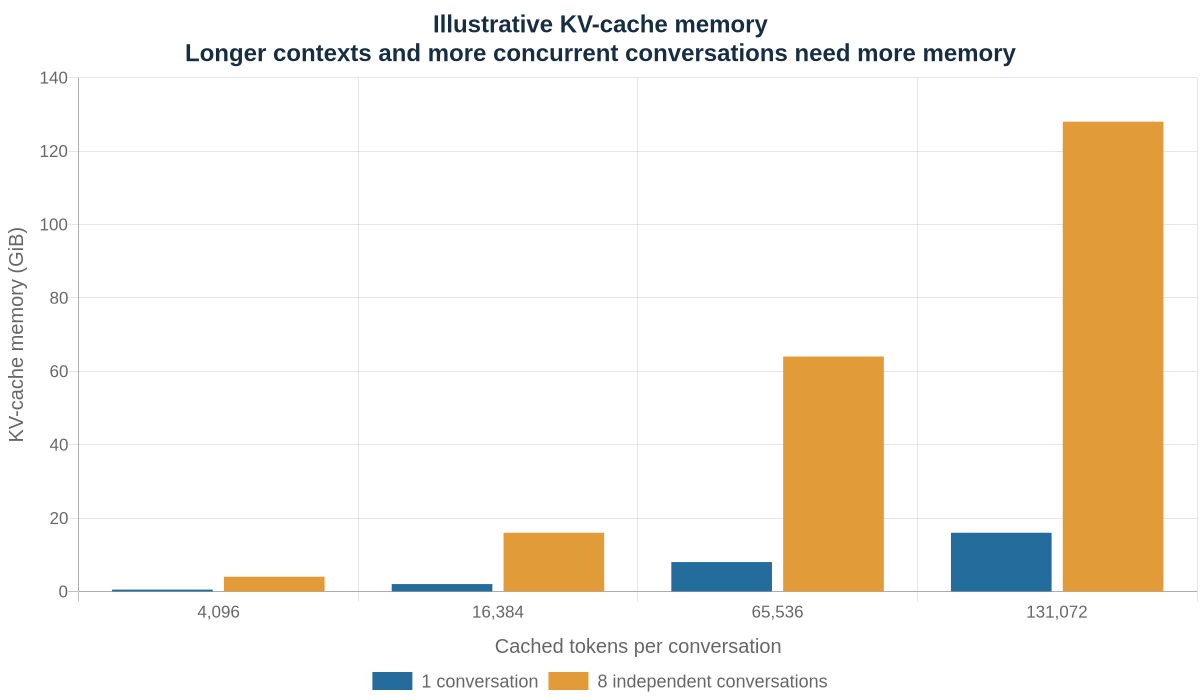
This helps explain why a service’s memory requirement depends on how it is used. A short request and a long conversation with the same model can require different amounts of cache. Serving many independent conversations can add further demand. The exact relationship depends on the model architecture, cache representation and implementation; some designs compress, limit or otherwise organise their state differently. For a conventional full cache with fixed dimensions, however, retaining more tokens requires proportionally more storage. A claim about the longest supported context is therefore incomplete without asking how many such requests can be served together and with what responsiveness.
The illustrative calculation below makes the relationship visible. It assumes 32 layers, eight key-value heads per layer, a head dimension of 128 and two bytes per stored value. Using the cache-size formula documented by Hugging Face, the storage is two times layers times KV heads times head dimension times bytes per value times cached tokens times independent sequences. Under these assumptions, 65,536 cached tokens require 8 GiB for one sequence, or 64 GiB for eight. These are calculated examples, not specifications for MARS or a particular commercial model, and they exclude weights, temporary buffers and management overhead.
Putting the right state in the right place
SK hynix describes a demonstration in which CXL-based hybrid memory combines DRAM and SSD resources for KV-cache storage and reuse. Another part of its presentation places soon-needed caches in HBM or DRAM and less immediately needed state in a CXL memory pool. The principle is to allocate scarce fast capacity according to use, rather than assume all retained information must occupy the same tier. The company’s account reports verification with SK Telecom in an LLM inference environment, but does not supply enough public comparative detail to calculate a general performance or cost improvement. That limit should remain visible.
Compute Express Link, or CXL, is a connection technology relevant to this wider design space. The CXL Consortium’s explanation of memory pooling illustrates how memory can be organised for allocation across hosts, while also showing that capabilities and sharing rules depend on the specification generation. A pool should not be pictured as an unlimited store that every processor can access with identical behaviour. Device support, switching, addressing and software must agree on how the resource is used. This is why a system demonstration needs to be understood as an integration of components, not merely a new category of memory.
Moving cache out of the fastest tier creates a trade-off. It may free capacity for active work, but the state has to be available again when it is needed. A poor placement decision can replace a memory shortage with transfer delays. Reuse may avoid computation, but only if the retained state is valid for the relevant request. These are engineering questions to measure under representative workloads. Longer conversations, bursts of simultaneous demand and changing access patterns can all affect the balance. The value of tiering lies in managing those patterns well, not in treating a slower tier as an interchangeable substitute for HBM.
The value chain extends beyond the memory chip
A memory-centric system still depends on processors, networks, storage and software. Requests need preparation before they reach the accelerator, and results need to move through the service afterwards. A bottleneck at one stage can reduce the utilisation of another. Adding faster accelerators may expose a limitation in data delivery that was previously less obvious. Conversely, improving data placement can make existing arithmetic capacity more useful. This is an analytical relationship, not a guarantee that memory is always the limiting resource. Different phases of training and inference can stress different parts of the machine.
Manufacturing and packaging enter the picture because the physical arrangement sets constraints on density, connectivity and heat. The data centre then has to provide power, cooling and reliable operation for the assembled system. Software determines how requests are scheduled and whether resources are used effectively. A claimed improvement in one component should therefore be distinguished from an improvement in the complete service. Lower energy for one transfer does not automatically establish lower energy per completed answer if the system spends longer elsewhere. The appropriate boundary of measurement matters as much as the unit displayed in the result.
For a rigorous comparison, an operator would identify the model, context lengths, number of simultaneous sequences, numerical formats, cache policy and hardware arrangement. It would measure throughput and delays under comparable conditions, including the slower responses that users notice during busy periods. It would also establish how much memory and energy the whole serving system consumes. Without those conditions, a demonstration can establish technical possibility while leaving commercial suitability unresolved. That is still useful progress, but it supports a narrower conclusion than a claim that a new architecture has solved the infrastructure problem for AI in general.
Why this matters beyond the data centre
Most SMEs will not buy pooled-memory racks or negotiate HBM packaging capacity. They encounter these choices through cloud services and AI applications: the number of requests supported, how long a task waits, which context sizes are practical and what the service costs. An advertised model capability depends on infrastructure that can deliver it under real demand. Memory engineering is one reason the same model can behave differently across serving configurations. Understanding that connection helps a business ask better questions without turning its managers into hardware specialists.
The SC26 demonstrations point towards a more useful picture of AI progress. Better models and more powerful chips matter, but the system also has to retain, locate and move the information that makes each computation useful. Memory tiering and pooling are attempts to manage that work more deliberately, with benefits that still need to be established for particular implementations and workloads. The infrastructure chain is valuable because its components cooperate. A GPU’s potential becomes an actual service only when memory, storage, connections, power and software allow it to keep working on the right data at the right time.
Image: Franck V., SODIMM RAM stick, via Unsplash, under the Unsplash Licence. Illustrative photograph of conventional memory, not HBM or the MARS system; resized for web display.