
A New Milestone in the Global AI Race
The announcement of Kimi K3, the latest large language model developed by the Chinese start-up Moonshot AI, has attracted immediate international attention because of its impressive technical performance. Early benchmark results suggest that the model is capable of competing with some of the most advanced systems developed in the United States, including those produced by OpenAI and Anthropic, while simultaneously embracing a development philosophy centred on openness and broad accessibility. Yet the true significance of Kimi K3 extends far beyond the release of another powerful language model. Its arrival represents a visible milestone within a much larger historical transformation that has been unfolding over the past several years: the emergence of China as a fully mature and highly competitive ecosystem for frontier artificial intelligence.
Only a few years ago, the global landscape of foundation models appeared relatively straightforward. The overwhelming majority of breakthrough systems originated from a small number of American organisations, supported by the world’s largest technology companies and research laboratories. OpenAI, Google DeepMind, Anthropic and Meta dominated both public attention and technical innovation, establishing an impression that leadership in generative artificial intelligence would remain firmly concentrated within the United States for the foreseeable future. Although Chinese companies were already investing heavily in machine learning, they were often perceived internationally as capable followers rather than pioneers, adapting innovations that had first appeared elsewhere rather than defining new directions for the field.
That perception has changed with remarkable speed. The publication of DeepSeek V1 at the end of 2024 marked the beginning of a new phase in which Chinese developers demonstrated that they could produce highly competitive large language models while pursuing an economic and technological strategy that differed fundamentally from the dominant Western approach. Rather than relying primarily upon proprietary, subscription-based systems protected by tightly controlled commercial ecosystems, several Chinese companies began releasing increasingly capable open-weight models, allowing researchers, businesses and developers to download, modify and deploy the models themselves. This approach immediately challenged long-standing assumptions regarding how frontier artificial intelligence should be commercialised, distributed and improved.
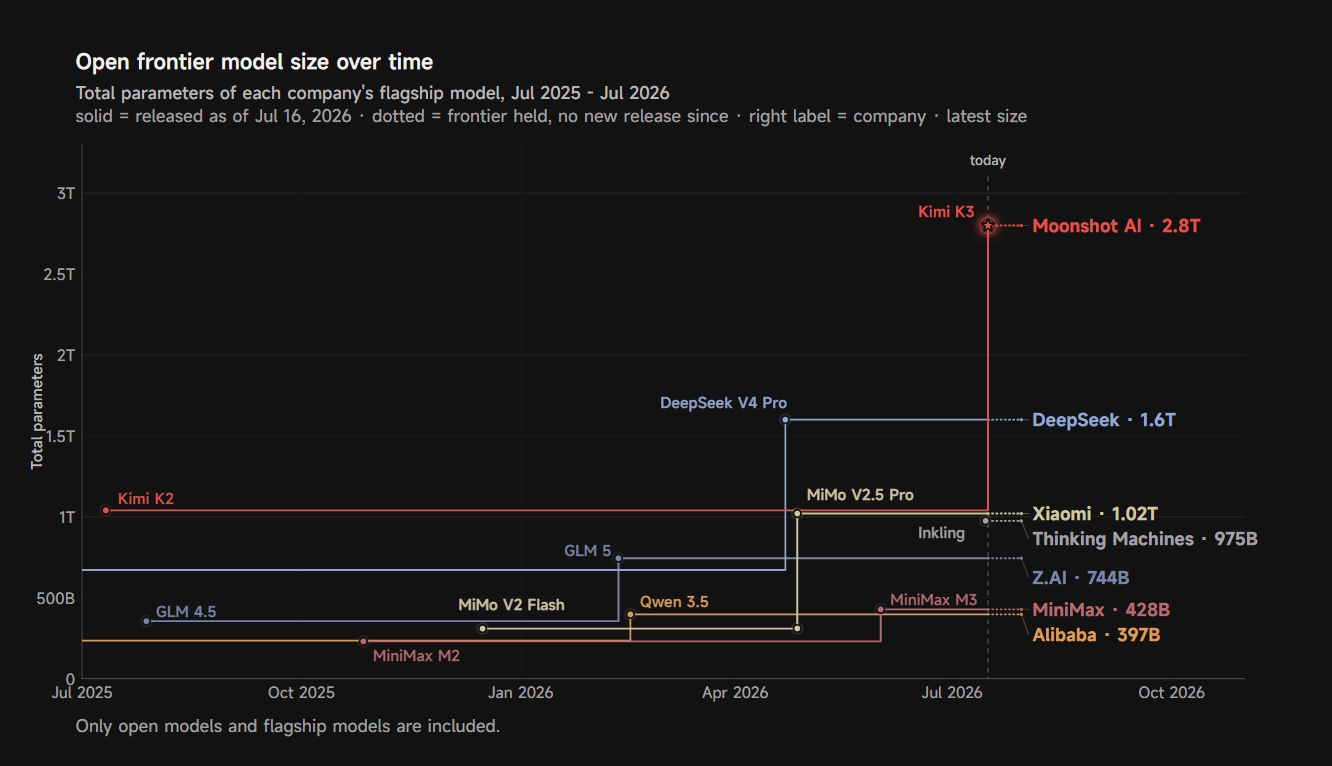
Kimi K3 should therefore be understood not simply as another entry in the rapidly expanding catalogue of large language models, but as evidence that the Chinese ecosystem has reached a new level of maturity. The model reportedly incorporates approximately 2.8 trillion parameters, making it one of the largest openly available language models ever created and almost doubling the scale of the previous generation of leading Chinese systems. More importantly, independent benchmark comparisons suggested that its performance approached that of the strongest proprietary American models across a wide variety of reasoning, programming and language tasks. Such results reinforce the growing impression that the technological gap separating Chinese and American frontier AI has narrowed considerably and may, in certain specialised domains, have disappeared altogether.
For historians of technology, this development represents more than a competition between individual companies. It illustrates the beginning of a structural transformation in the geography of artificial intelligence innovation. Throughout much of the digital revolution, technological leadership tended to emerge from relatively concentrated centres of research and investment, particularly within Silicon Valley and a small number of Western academic institutions. The current generation of AI, however, appears increasingly characterised by multiple innovation ecosystems developing simultaneously, each pursuing distinct technical priorities, commercial models and regulatory philosophies. As a consequence, the future of artificial intelligence is becoming progressively more multipolar, reflecting broader geopolitical shifts that extend well beyond the boundaries of computer science.
This transition also marks an important evolution in the nature of international technological competition. Earlier phases of the AI revolution were largely driven by advances in algorithmic research and improvements in computational scale. Today, competition increasingly revolves around entire ecosystems encompassing hardware infrastructure, semiconductor supply chains, cloud computing capacity, talent development, regulatory frameworks, open-source communities and industrial adoption. Success therefore depends not merely upon building a more capable model but upon creating an environment capable of sustaining continuous innovation across every layer of the technological stack. In this broader context, Kimi K3 represents not only the achievement of a single research laboratory but also the growing maturity of China’s national artificial intelligence ecosystem.
Perhaps most importantly, the emergence of models such as Kimi K3 challenges one of the assumptions that shaped the first years of the generative AI revolution: that the future would inevitably be defined by increasingly powerful proprietary systems accessible only through commercial platforms controlled by a handful of companies. The rapid rise of high-performance open-weight models suggests an alternative trajectory in which advanced artificial intelligence becomes more widely distributed, more easily adapted to local needs and more deeply integrated into diverse technological environments. Whether this model ultimately proves economically sustainable remains an open question, but its growing influence is already reshaping strategic discussions within governments, universities, research laboratories and technology companies across the world.
The significance of Kimi K3, therefore, lies not only in what it is, but in what it represents. It symbolises the transition from an era in which China was widely regarded as an emerging participant in frontier AI to one in which it has become an essential contributor to the global evolution of intelligent systems. Understanding this transformation is essential for anyone seeking to understand the future direction of artificial intelligence, because it demonstrates that the next phase of the AI revolution will almost certainly be shaped not by a single technological superpower, but by an increasingly dynamic interaction between competing ecosystems pursuing different visions of how intelligent technologies should be developed, governed and shared.
From DeepSeek to Kimi K3: The Rapid Rise of China’s Foundation Models
The emergence of Kimi K3 did not occur in isolation, nor should it be interpreted as the unexpected success of a single company that happened to produce an unusually capable language model. Rather, it represents the latest chapter in a broader technological evolution that has transformed China’s position within the global artificial intelligence landscape in an extraordinarily short period of time. While international attention initially focused almost exclusively on American organisations such as OpenAI, Anthropic and Google DeepMind, a parallel ecosystem of Chinese research laboratories and technology companies was quietly developing its own generation of increasingly sophisticated foundation models. What appeared at first to be incremental progress has gradually revealed itself to be the construction of an independent and highly competitive innovation ecosystem capable of advancing at remarkable speed.
The turning point for many international observers came with the release of DeepSeek, whose early models demonstrated that frontier-level performance could be achieved using significantly fewer financial resources than many analysts had previously believed possible. Beyond its technical achievements, DeepSeek challenged prevailing assumptions about the economics of artificial intelligence by showing that careful optimisation, efficient training strategies and open distribution could produce systems capable of competing with substantially more expensive proprietary models. The international reaction was immediate because the implications extended far beyond the success of a single company. If frontier AI could be developed and distributed at lower cost through open-weight models, then many of the commercial assumptions underpinning the Western AI industry would require careful re-evaluation.
Since that moment, the pace of Chinese AI development has accelerated dramatically. Rather than depending upon one dominant organisation, China has cultivated a remarkably diverse ecosystem in which multiple companies pursue complementary strategies while collectively advancing the country’s overall capabilities. Organisations such as Alibaba’s Qwen, Zhipu AI, Baichuan, MiniMax, 01.AI, SenseTime, Tencent Hunyuan and Moonshot AI have each contributed new models, architectures and technical innovations, creating an environment characterised by rapid iteration and intense domestic competition. This diversity contrasts with the more concentrated structure of the American frontier AI ecosystem, where a relatively small number of companies continue to dominate public attention and investment.
Moonshot AI occupies an increasingly important position within this expanding landscape. Founded with the ambition of developing general-purpose artificial intelligence capable of supporting complex reasoning and knowledge-intensive tasks, the company initially attracted attention through its conversational assistant Kimi, which became widely adopted in the Chinese market for research, document analysis and productivity applications. Unlike many consumer-oriented chatbots, Kimi rapidly gained a reputation for handling exceptionally long contexts and complex document processing, capabilities that proved particularly valuable for professional and academic users. These strengths provided the technological foundation upon which the company subsequently developed the K3 model, significantly expanding both its reasoning capabilities and its competitiveness against leading international systems.
One of the most remarkable aspects of this progression has been the extraordinary speed with which Chinese foundation models have evolved. During previous technological revolutions, narrowing the gap between established leaders and emerging competitors often required many years or even decades. In artificial intelligence, however, advances in open scientific publication, global research collaboration and rapidly improving computational infrastructure have compressed innovation cycles to an unprecedented degree. Architectural improvements developed in one part of the world are rapidly analysed, adapted and refined elsewhere, allowing capable research teams to build upon existing discoveries rather than repeatedly solving the same foundational problems. The result is an environment in which technological leadership has become increasingly dynamic, with new models frequently reshaping international benchmark rankings within a matter of months.
Kimi K3 illustrates this acceleration particularly clearly. With approximately 2.8 trillion parameters, the model represents one of the largest open-weight language models publicly announced, reflecting both the scale of China’s computational resources and the confidence of its developers in pursuing frontier architectures. Yet raw size alone no longer defines success in artificial intelligence. Modern evaluation increasingly depends upon performance across diverse benchmarks measuring reasoning, scientific knowledge, software engineering, multilingual capability, mathematical problem solving and long-context understanding. It is in these comparisons that Kimi K3 attracted widespread attention, with independent evaluations placing it alongside or, in certain specialised domains, ahead of some of the most advanced proprietary systems available internationally.
This rapid evolution reflects a broader strategic transformation within China’s AI ecosystem. Rather than attempting merely to replicate American technologies, Chinese companies are increasingly pursuing distinct research trajectories that combine large-scale engineering with open distribution models and aggressive optimisation of computational efficiency. The result is an ecosystem that no longer functions as a technological follower but as an independent centre of innovation capable of influencing the global direction of artificial intelligence. For historians of technology, this transition may ultimately prove more significant than any individual benchmark result, because it marks the moment at which the development of frontier AI became genuinely multipolar, with several competing centres of excellence shaping the future of one of the most consequential technologies of the twenty-first century.
Open Models and Closed Models: Two Competing Visions for the Future of Artificial Intelligence
One of the most important lessons that can be drawn from the emergence of Kimi K3 is that the contemporary competition in artificial intelligence is no longer confined to technical performance alone. While benchmark scores, reasoning capabilities and coding proficiency continue to attract considerable attention, a deeper and arguably more consequential debate has gradually taken shape beneath these visible indicators of progress. Increasingly, the global AI ecosystem is becoming divided between two fundamentally different philosophies regarding how frontier artificial intelligence should be developed, distributed and governed. On one side stand the proponents of highly capable proprietary systems whose internal architecture, training data and optimisation techniques remain closely guarded commercial assets. On the other stands a rapidly expanding movement advocating increasingly powerful open-weight models, designed to be downloaded, inspected, modified and adapted by researchers, companies and public institutions around the world.
This distinction should not be confused with the traditional debate surrounding open-source software, although the two share important similarities. Most contemporary frontier language models remain only partially open in comparison with classical open-source projects, since training datasets, optimisation pipelines and certain components of the development process often remain proprietary. Nevertheless, the release of model weights represents a significant degree of openness because it enables external organisations to deploy the system independently, fine-tune it for specialised purposes and integrate it into their own technological infrastructure without remaining permanently dependent upon the original developer. In practical terms, this transforms artificial intelligence from a remotely accessed commercial service into a technological asset that can become part of an organisation’s own computational ecosystem.
The United States has largely pursued a strategy centred upon proprietary frontier models delivered through cloud-based services. Companies such as OpenAI and Anthropic have invested enormous financial resources in developing increasingly capable systems while protecting many aspects of their architectures and training methodologies as commercial intellectual property. This model offers several important advantages. Continuous control over deployment allows developers to update models rapidly, implement safety improvements, monitor misuse and generate recurring revenue capable of financing future research. It also enables centralised quality assurance, ensuring that users interact with versions of the system that reflect the developer’s most recent safety standards and technical improvements.
China, while certainly not abandoning proprietary development altogether, has increasingly encouraged an alternative strategy in which powerful open-weight models play a central role within the national innovation ecosystem. Companies such as DeepSeek, Moonshot AI and several other leading laboratories have demonstrated a willingness to release increasingly sophisticated models under licences that permit broad experimentation and adaptation. This approach reflects not only technical preferences but also a broader economic strategy. By lowering barriers to adoption, open-weight models encourage rapid diffusion throughout universities, research institutes, start-ups, industrial enterprises and public organisations, creating a large and diverse community of users capable of contributing improvements, specialised applications and complementary innovations.
The consequences of these contrasting philosophies extend well beyond software engineering. They influence the pace of innovation, the distribution of technical expertise and even the geopolitical balance of technological power. An open-weight ecosystem tends to accelerate experimentation because thousands of independent organisations can simultaneously explore new applications without waiting for permission from the original developer. Universities can conduct interpretability research, healthcare institutions can develop specialised diagnostic systems, governments can build secure national deployments and small technology companies can create products that would otherwise require prohibitively expensive licensing agreements. Innovation becomes increasingly decentralised, allowing unexpected breakthroughs to emerge from many different directions rather than from a relatively small number of dominant commercial laboratories.
At the same time, openness inevitably introduces new challenges. Models that can be downloaded and modified are also more difficult to control once released into the public domain. Questions concerning safety, misuse, intellectual property and national security become considerably more complex because responsibility is distributed across a much larger community of developers and users. Proprietary systems, despite attracting criticism for their commercial concentration, offer the advantage of centralised governance, enabling developers to implement safeguards, monitor usage patterns and respond rapidly when vulnerabilities are discovered. Consequently, the debate between open and closed models should not be understood simply as a competition between freedom and control. Rather, it reflects two different approaches to balancing innovation, accessibility, commercial sustainability and societal responsibility within an increasingly complex technological landscape.
Kimi K3 therefore symbolises something far more significant than the release of another capable language model. It represents the continued maturation of an alternative philosophy of AI development that increasingly challenges assumptions established during the first phase of the generative AI revolution. As Chinese open-weight models approach parity with the strongest proprietary systems, the question facing governments, research institutions and private companies is no longer whether open models can compete technically, but whether they may ultimately reshape the economic structure of the global AI industry itself. If frontier capabilities become widely available through increasingly sophisticated open ecosystems, the competitive advantage of proprietary platforms may gradually shift away from the models themselves towards complementary services such as specialised infrastructure, enterprise integration, domain expertise and advanced safety engineering.
The emergence of these two parallel ecosystems also raises broader questions concerning the future governance of artificial intelligence. Historically, transformative technologies have often oscillated between periods of openness and concentration before reaching a relatively stable equilibrium. The Internet itself developed through largely open technical standards while simultaneously giving rise to highly concentrated commercial platforms. Personal computing followed a similar trajectory, combining open software ecosystems with proprietary operating systems and hardware manufacturers. Artificial intelligence may ultimately evolve along a comparable path, with open-weight and proprietary models coexisting within an increasingly interconnected global ecosystem. Yet regardless of the precise balance eventually achieved, the success of systems such as Kimi K3 demonstrates that the future of AI will almost certainly not be defined by a single development philosophy but by the continuing interaction between competing models of technological innovation.
Why Code Generation Has Become the Strategic Battlefield of Modern AI

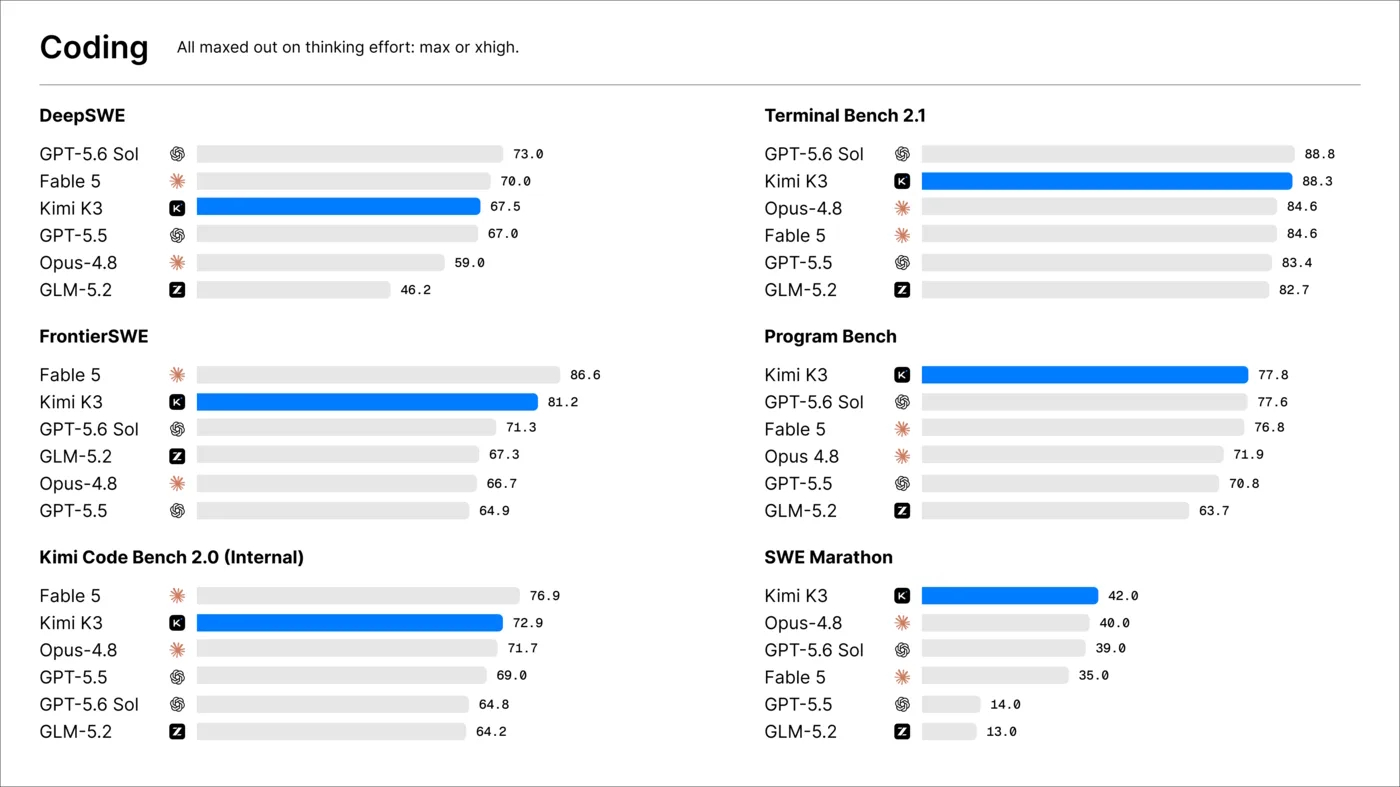
Among the numerous benchmark categories used to evaluate contemporary language models, none has acquired greater strategic importance than software engineering. While conversational ability initially captured public imagination during the early years of generative artificial intelligence, the capacity to write, understand, debug and optimise computer code has rapidly become the principal commercial application of frontier AI systems. It is therefore unsurprising that much of the attention surrounding Kimi K3 focused on its exceptional performance in programming-related evaluations, where independent benchmarking platforms placed it alongside, and in some cases ahead of, several of the strongest proprietary American models.
This development reflects a profound transformation in the relationship between artificial intelligence and the digital economy. Software has become the fundamental infrastructure upon which virtually every modern institution depends. Governments administer public services through increasingly sophisticated digital platforms; hospitals rely upon complex information systems; financial institutions operate global payment networks; scientific research depends upon computational tools; and industrial production is coordinated through highly automated software environments. As a consequence, any technology capable of dramatically accelerating software development has the potential to influence productivity across almost every sector of the global economy. Unlike many specialised AI applications, improvements in code generation generate cascading effects because software itself functions as the enabling technology for countless other forms of innovation.
The remarkable progress achieved by large language models in software engineering is closely linked to the nature of programming itself. Computer code, despite its technical complexity, shares many characteristics with natural language. Both rely upon hierarchical structures, contextual relationships and long-range dependencies that transformer architectures are particularly well suited to learning. During training, modern language models are exposed to enormous repositories of publicly available software projects alongside traditional textual data, allowing them to internalise programming patterns, software design principles and common problem-solving strategies across multiple programming languages. The resulting systems are capable not merely of completing isolated lines of code but of generating entire software components, identifying logical errors, explaining algorithms and assisting developers throughout the software engineering process.
This capability has transformed the economics of software development. Tasks that previously required hours of routine programming can often be completed within minutes through collaboration between experienced developers and advanced AI assistants. Rather than replacing software engineers, these systems increasingly function as highly capable collaborators capable of accelerating implementation, reducing repetitive work and allowing human experts to focus upon higher-level architectural decisions. Consequently, competition among frontier AI companies has shifted towards establishing leadership in programming assistance, recognising that whoever dominates this domain may gain access to one of the largest and most economically valuable markets created by the current generation of artificial intelligence.
It is within this context that Kimi K3’s benchmark results assume particular significance. According to evaluations conducted by platforms such as Arena AI, formerly known as LMArena, one of the most widely respected independent benchmarking communities, the model demonstrated exceptional competence in software engineering tasks, including application development, website generation and code reasoning. Such performance immediately attracted international attention because programming assistance has become one of the primary competitive advantages of systems such as Anthropic’s Claude and OpenAI’s GPT family. A Chinese open-weight model approaching or exceeding these capabilities therefore represents not simply another technical achievement but a direct challenge within one of the most commercially important segments of the global AI market.
Beyond commercial competition, advances in AI-assisted programming also create powerful feedback loops that accelerate the development of artificial intelligence itself. As language models become increasingly capable of writing high-quality software, they assist engineers in building better AI infrastructure, improving optimisation techniques, designing new algorithms and managing increasingly complex research environments. In effect, artificial intelligence contributes to the development of the next generation of artificial intelligence, shortening innovation cycles and increasing the overall pace of technological progress. This recursive relationship explains why improvements in software engineering capabilities are regarded by many researchers as strategically more significant than incremental gains in conversational performance or general knowledge benchmarks.
The growing importance of code generation also helps explain why competition between Chinese and American AI companies has intensified so rapidly. Leadership in software engineering no longer concerns only the developer tools market; it increasingly influences the entire technological ecosystem surrounding artificial intelligence. Organisations capable of providing superior coding assistants are likely to accelerate innovation across cloud computing, robotics, cybersecurity, scientific simulation, autonomous systems and countless other domains that depend upon sophisticated software infrastructure. Consequently, benchmark victories in programming should not be interpreted merely as symbolic achievements but as indicators of broader technological competitiveness.
For this reason, Kimi K3’s success in software engineering evaluations represents much more than an isolated benchmark result. It illustrates how the centre of gravity within generative artificial intelligence has shifted from conversational novelty towards practical economic productivity. The models that shape the next phase of the AI revolution will not necessarily be those that produce the most engaging dialogue, but those that most effectively amplify human capacity to design, build and maintain the increasingly complex digital systems upon which modern societies depend. In that respect, the competition over code generation has become one of the defining strategic frontiers of contemporary artificial intelligence, with implications extending far beyond the software industry itself.
The Economics of Open Artificial Intelligence: From Premium Products to Digital Commodities
One of the most profound consequences of the emergence of models such as Kimi K3 concerns not their technical architecture but the economic assumptions that underpin the contemporary artificial intelligence industry. During the first phase of the generative AI revolution, the prevailing business model appeared relatively clear. Developing frontier language models required extraordinary financial investment, access to cutting-edge semiconductor technology, enormous computational infrastructure and highly specialised research teams. These factors naturally favoured a small number of organisations capable of raising billions of dollars in private capital while recovering those investments through subscription services, enterprise licensing and tightly controlled commercial platforms. Under this model, frontier artificial intelligence was treated as a premium technological product whose value derived from scarcity, proprietary ownership and restricted access.
For a period, this approach appeared almost inevitable. The remarkable capabilities demonstrated by the first generation of advanced language models reinforced the belief that only a handful of companies possessed the resources necessary to sustain progress at the frontier of AI research. Many observers therefore assumed that the future would resemble other highly concentrated technology sectors, with a relatively small number of firms controlling the world’s most capable models while licensing access to businesses, governments and individual users through cloud-based services. Artificial intelligence seemed destined to become another example of a platform economy in which technological leadership translated directly into long-term commercial dominance.
The rapid rise of China’s open-weight ecosystem has complicated this narrative considerably. By releasing increasingly capable models under licences that permit broad experimentation and adaptation, companies such as DeepSeek and Moonshot AI have challenged the assumption that frontier AI must necessarily remain an exclusive commercial asset. Their strategy suggests an alternative economic logic in which the model itself gradually becomes a widely available technological resource while commercial value shifts towards the surrounding ecosystem of infrastructure, services, specialised applications and domain expertise. Rather than competing primarily through exclusive ownership of the underlying model, organisations compete through the quality of the solutions they build upon it.
This distinction reflects a familiar pattern observed throughout the history of technological innovation. Many foundational technologies initially emerge as scarce and highly profitable products before gradually evolving into widely available infrastructure upon which new industries are constructed. Electricity, telecommunications, internet connectivity and cloud computing all followed similar trajectories. During their early stages, access to these technologies represented a major competitive advantage, but as they became more accessible, commercial differentiation increasingly depended upon the services enabled by the infrastructure rather than upon the infrastructure itself. Artificial intelligence may now be entering a comparable phase in which the model gradually becomes less valuable as an isolated product and more valuable as a platform for creating entirely new categories of economic activity.
Some analysts have therefore argued that frontier AI may eventually evolve into what economists describe as a commodity technology. This concept does not imply that artificial intelligence will become inexpensive or technologically simple. Rather, it suggests that highly capable models may become sufficiently widespread that access to advanced AI ceases to be the principal source of competitive advantage. Instead, value creation shifts towards integration, customisation, security, specialised knowledge and the ability to combine AI effectively with existing organisational processes. Under such circumstances, owning the most powerful model may become less important than understanding how to deploy it responsibly within healthcare, manufacturing, education, finance, scientific research or public administration.
This possibility has generated considerable debate within the investment community. Supporters of proprietary frontier models argue that continuous research requires enormous financial resources and that sustainable commercial returns remain essential for funding future innovation. If increasingly capable open-weight models reduce the willingness of customers to pay premium prices for proprietary alternatives, private investment in frontier AI research could become more difficult to sustain. From this perspective, unrestricted openness risks weakening precisely the economic incentives that have driven much of the extraordinary progress witnessed during the past decade.
Others, however, interpret the situation very differently. They argue that widespread access to powerful foundation models could stimulate innovation by dramatically lowering barriers to entry for entrepreneurs, universities and smaller technology companies. Instead of concentrating AI development within a relatively small number of well-funded corporations, open-weight ecosystems encourage thousands of independent organisations to explore specialised applications that larger firms might never consider commercially viable. History offers numerous examples in which open technological standards generated greater long-term economic value than tightly controlled proprietary systems because they enabled broader participation and accelerated experimentation across entire industries.
Kimi K3 therefore occupies an important position within this evolving economic landscape. Its significance lies not only in its benchmark performance but also in its contribution to an emerging debate concerning the future structure of the artificial intelligence economy. Whether the coming decades will be dominated by proprietary platforms, open ecosystems or some hybrid combination of both remains uncertain. What is already becoming clear, however, is that the release of increasingly capable open-weight models has permanently expanded the range of possible futures. Artificial intelligence is no longer developing according to a single commercial blueprint but through competing economic philosophies that reflect different assumptions about innovation, accessibility and the distribution of technological power.
For governments and public institutions, this transformation carries particularly important implications. If frontier AI becomes progressively more accessible through open ecosystems, national strategies may increasingly prioritise the development of local expertise, computational infrastructure and specialised applications rather than dependence upon a limited number of external providers. Conversely, if proprietary systems continue to dominate the highest levels of capability, questions concerning technological sovereignty, strategic dependence and equitable access will become increasingly prominent. In either scenario, the economics of artificial intelligence will influence not only private markets but also the future organisation of scientific research, industrial competitiveness and public governance itself.
Artificial Intelligence as a Geopolitical Competition
The growing international attention surrounding Kimi K3 cannot be understood solely through the lens of technological innovation or commercial competition. Its release immediately generated political reactions in Washington, discussions among national security analysts and renewed debate concerning the strategic balance between the world’s two largest technological powers. Such responses illustrate a broader transformation that has taken place during the past decade: artificial intelligence has evolved from a scientific discipline and commercial industry into one of the principal arenas of geopolitical competition in the twenty-first century. Increasingly, breakthroughs in frontier AI are interpreted not simply as achievements of individual companies but as indicators of national technological capacity and long-term strategic influence.
This evolution reflects the unique nature of artificial intelligence as a general-purpose technology. Unlike innovations confined to a single industrial sector, advanced AI possesses applications across virtually every domain of economic, military and governmental activity. It contributes to scientific discovery, industrial automation, cybersecurity, logistics, healthcare, education, financial services and national defence, while simultaneously enhancing productivity throughout the broader digital economy. Consequently, leadership in artificial intelligence influences far more than the commercial success of technology companies; it increasingly shapes national competitiveness, economic resilience and strategic autonomy. Governments therefore view advances in frontier AI not merely as private achievements but as assets with profound implications for national power.
The reactions provoked by Kimi K3 illustrate this new geopolitical reality. Several American commentators interpreted the model’s strong benchmark performance as evidence that China’s AI ecosystem had reached a level of maturity capable of challenging the long-standing technological leadership of the United States. Among them was David Sacks, former White House adviser on artificial intelligence and a continuing adviser to President Donald Trump, who argued that the rapid acceleration of Chinese AI development should serve as a warning against excessive regulatory constraints that might slow innovation within the United States. His remarks reflected a broader concern increasingly expressed by American policymakers: that strategic competition with China requires maintaining not only scientific excellence but also the infrastructure and regulatory environment necessary to sustain rapid technological progress.
Such arguments highlight an emerging tension that many advanced economies now face. Democratic societies must simultaneously encourage innovation, protect public interests and manage the risks associated with increasingly capable artificial intelligence. Achieving these objectives requires balancing investments in research and infrastructure with appropriate regulatory oversight, cybersecurity measures and ethical safeguards. China and the United States have adopted markedly different approaches to this balance, reflecting broader differences in political institutions, economic organisation and national strategic priorities. Consequently, competition between the two countries increasingly encompasses not only technical capability but also contrasting models of technological governance.
The geopolitical significance of artificial intelligence extends beyond questions of regulation. Modern frontier models depend upon vast computational infrastructure, advanced semiconductor manufacturing, specialised networking technologies, cloud computing capacity and highly skilled scientific talent. Each of these components has become the subject of intense strategic competition. Restrictions on the export of advanced semiconductor technologies, investments in domestic chip production, national programmes supporting AI research and initiatives designed to attract international talent all illustrate how governments increasingly regard artificial intelligence as critical infrastructure comparable to energy systems or telecommunications networks. Within this context, the release of a highly capable language model such as Kimi K3 becomes one visible expression of much broader national investments extending across multiple sectors of the economy.
At the same time, the internationalisation of artificial intelligence complicates traditional geopolitical assumptions. Unlike many strategic technologies of previous eras, AI research remains highly interconnected at the scientific level. Researchers publish openly, international conferences facilitate rapid exchange of ideas and many technical innovations are quickly adopted by laboratories around the world. Even open-weight models released by Chinese organisations may be downloaded, studied and improved by researchers working in Europe, North America or elsewhere. This global circulation of knowledge creates a paradox in which artificial intelligence functions simultaneously as a field of international scientific collaboration and as an increasingly competitive domain of geopolitical rivalry. Managing this tension will almost certainly become one of the defining challenges of global technology governance during the coming decades.
Some observers have therefore suggested that the AI competition between China and the United States increasingly resembles earlier technological races, such as those surrounding nuclear energy, space exploration or semiconductor manufacturing. While such comparisons capture certain aspects of strategic rivalry, they also overlook important differences. Artificial intelligence develops far more rapidly, diffuses much more widely and depends upon global networks of researchers, companies and institutions whose interactions frequently transcend national boundaries. Rather than a simple bilateral contest, the emerging AI landscape is gradually becoming a complex ecosystem in which cooperation and competition coexist simultaneously, creating new forms of strategic interdependence that have few historical precedents.
Kimi K3 thus represents more than another successful language model entering an increasingly crowded marketplace. It serves as a reminder that artificial intelligence has become deeply embedded within the geopolitical architecture of the twenty-first century. Every significant advance now carries implications not only for technology companies and software developers but also for national innovation strategies, international economic relations and the future balance of global technological leadership. Understanding these broader dynamics is essential because the AI revolution will ultimately be shaped not only by algorithms and computational power but also by the political, economic and institutional environments within which those technologies continue to evolve.
Compute, Infrastructure and the Hidden Foundations of the AI Revolution

Although public attention is often drawn to benchmark rankings, conversational abilities or the release of increasingly sophisticated language models, these visible achievements represent only the surface of a much larger technological transformation. Every frontier AI model rests upon an immense physical and industrial infrastructure that remains largely invisible to ordinary users but has become one of the decisive factors shaping the future of artificial intelligence. The emergence of systems such as Kimi K3 therefore serves as a reminder that the global AI race is not determined solely by algorithms or scientific creativity, but equally by access to computational resources, energy production, semiconductor manufacturing, cloud infrastructure and large-scale engineering capabilities. In many respects, the competition over artificial intelligence is gradually becoming a competition over the industrial capacity required to sustain continuous computational growth.
Training a modern foundation model represents one of the most computationally demanding activities ever undertaken in civilian scientific research. The largest language models require vast clusters of advanced graphics processing units (GPUs) or specialised AI accelerators operating continuously for weeks or months while processing trillions of words drawn from multilingual datasets. These training processes consume enormous quantities of electricity, depend upon sophisticated cooling systems and require highly optimised networking architectures capable of coordinating thousands of processors simultaneously. Once training has been completed, the computational challenge does not disappear. Every interaction between users and the model requires inference, and as language models become more capable, generate longer responses and incorporate increasingly sophisticated reasoning processes, the computational cost of serving millions of users simultaneously continues to grow.
This distinction between training and inference has become increasingly important within discussions concerning the economics of artificial intelligence. During the early years of large language models, public debate focused primarily on the extraordinary expense associated with training frontier systems. Today, however, many researchers argue that inference may ultimately represent an even greater long-term challenge. As AI assistants evolve into autonomous agents capable of performing complex sequences of reasoning, planning and interaction, the amount of computation required for each individual task increases substantially. A simple conversational exchange consumes relatively modest computational resources, whereas an intelligent agent that writes software, analyses extensive documentation, performs internet research, evaluates alternative strategies and repeatedly revises its own outputs may require many times more processing power before completing a single assignment. Consequently, the emergence of AI agents is transforming computational demand from a problem measured in model training cycles into one embedded within the routine operation of everyday digital services.
This reality provides important context for some of the more cautious reactions that followed the release of Kimi K3. Although the model achieved impressive benchmark results, several analysts noted that early evaluations suggested relatively high computational requirements during inference. Investors such as Gavin Baker, among others, observed that exceptional performance alone does not necessarily guarantee commercial efficiency. A model that requires substantially greater computational resources to deliver comparable outputs may become expensive to deploy at large scale, particularly if offered under an open-weight distribution model where developers themselves bear the operational costs of running the system. These observations illustrate an increasingly important principle within frontier AI: raw intelligence and economic efficiency are no longer identical objectives. The most influential models of the coming decade are likely to be those capable of balancing high performance with computational sustainability.
This growing emphasis on efficiency explains why infrastructure has become one of the central strategic concerns for governments and technology companies alike. Building frontier AI now requires more than talented researchers or innovative algorithms. It depends upon access to advanced semiconductor manufacturing, resilient supply chains, hyperscale data centres, abundant energy generation and highly specialised engineering expertise. The geographical distribution of these resources increasingly influences where frontier models can be developed and deployed. Consequently, investments in computational infrastructure have become a defining feature of national AI strategies, with countries around the world expanding data centre capacity, supporting domestic semiconductor industries and strengthening high-performance computing capabilities in recognition that artificial intelligence has become a critical component of long-term economic competitiveness.
The importance of infrastructure also helps explain the growing political sensitivity surrounding AI supply chains. Export restrictions affecting advanced chips, international competition over semiconductor manufacturing and strategic investments in domestic computational capacity all reflect a shared recognition that future leadership in artificial intelligence cannot be secured through software innovation alone. Models such as Kimi K3 emerge from an ecosystem that combines scientific research with industrial capability on an unprecedented scale. As a result, the AI revolution increasingly resembles earlier technological transformations in which advances in scientific understanding became inseparable from the industrial systems capable of transforming knowledge into practical capability.
Seen from this broader historical perspective, the competition surrounding frontier language models represents only one dimension of a much larger transformation. The true foundations of the AI revolution lie in the global networks of computation, energy, manufacturing and engineering that make these models possible. Understanding this hidden infrastructure is essential because it reminds us that artificial intelligence is not merely a software phenomenon but the product of an increasingly complex technological civilisation whose development depends upon the coordinated evolution of scientific research, industrial production and national strategic investment. The future balance of AI leadership will therefore be determined not only by which organisations build the most capable models, but also by which societies succeed in constructing the resilient computational ecosystems upon which those models ultimately depend.
Kimi K3 and the Emergence of a Multipolar AI World
Viewed in isolation, the release of Kimi K3 might easily be interpreted as another step in the rapid succession of increasingly capable language models that has characterised the recent evolution of artificial intelligence. Every few months a new system appears, benchmark rankings are updated, technical comparisons are published and public attention briefly shifts towards the latest frontier achievement before moving on to the next technological milestone. Yet history rarely remembers individual technological products for their specifications alone. Instead, it remembers the moments at which those products revealed that a deeper structural transformation had already taken place. In this respect, Kimi K3 should be understood less as the beginning of a new story than as one of the clearest indicators that the global landscape of artificial intelligence has entered a fundamentally different phase of its development.
Perhaps the most significant lesson emerging from the rise of Kimi K3 is that frontier artificial intelligence is no longer the exclusive domain of a single national ecosystem. During the earliest years of the generative AI revolution, leadership appeared overwhelmingly concentrated within a relatively small number of American research organisations whose scientific achievements shaped both public expectations and industrial strategy across the world. That concentration has now given way to a far more dynamic environment in which multiple centres of innovation are simultaneously advancing the frontier of machine intelligence. China has demonstrated not only its ability to reproduce existing approaches but also its capacity to develop distinctive technological strategies centred upon open-weight models, rapid iteration and large-scale deployment across an expanding domestic ecosystem. This transformation marks the emergence of a genuinely multipolar AI landscape in which future advances will increasingly result from interactions between several competing yet interconnected centres of technological excellence.
Equally important is the challenge that Chinese open-weight models pose to the economic assumptions that dominated the first generation of commercial artificial intelligence. The success of systems such as DeepSeek and Kimi K3 suggests that frontier capabilities need not remain confined within proprietary platforms controlled by a handful of organisations. Instead, powerful foundation models may gradually become widely accessible technological infrastructure upon which countless specialised applications can be built. Whether this ultimately leads to a more decentralised and innovative AI economy or reinforces new forms of competition centred upon infrastructure, services and computational resources remains uncertain. What is already evident, however, is that the relationship between openness, commercial sustainability and technological leadership will become one of the defining questions of the coming decade.
This also illustrates how deeply artificial intelligence has become intertwined with broader geopolitical dynamics. Competition between China and the United States increasingly extends beyond commercial success towards issues of technological sovereignty, industrial capacity, semiconductor production, computational infrastructure and national strategic resilience. Yet unlike many previous technological rivalries, the AI revolution unfolds within a globally interconnected scientific community where knowledge circulates rapidly across institutional and national boundaries. This creates an unusual combination of cooperation and competition in which countries simultaneously depend upon shared scientific progress while seeking to maintain strategic advantages within increasingly critical technological domains. Managing this balance will require new forms of international dialogue capable of reconciling legitimate national interests with the global character of scientific innovation.
At the same time, Kimi K3 reminds us that artificial intelligence cannot be understood solely through the capabilities of individual models. Every frontier system represents the visible expression of a much larger ecosystem involving researchers, universities, technology companies, semiconductor manufacturers, cloud infrastructure providers, energy networks, regulatory institutions and investment strategies. The future evolution of AI will therefore depend not only upon breakthroughs in machine learning but also upon the capacity of societies to develop the educational, industrial and institutional foundations necessary to sustain continuous innovation. In this sense, the history of artificial intelligence increasingly resembles the history of earlier industrial revolutions, where technological progress emerged from the interaction of scientific discovery, economic organisation and public policy rather than from isolated inventions alone.
For the IDHUS Institute, the significance of Kimi K3 lies precisely in this broader perspective. Future readers may remember neither the precise benchmark scores achieved by the model nor the exact number of parameters contained within its architecture. Those details will inevitably be surpassed by later generations of AI. What is likely to endure is the historical meaning of the moment itself: the period during which China’s open-model ecosystem demonstrated that it had become a permanent and influential force in the development of frontier artificial intelligence, transforming the global AI race from a predominantly American-led technological revolution into a genuinely international competition between multiple innovation ecosystems.