
New AI reception tools are bringing calls, messages and appointment requests into a shared workflow. For small and medium-sized businesses, their value depends on reliable information, realistic booking rules and a clear route to human help.
For a small business, the front desk is rarely just a desk. It may be the owner’s telephone, a shared inbox, a messaging account checked between appointments and a diary that only one colleague fully understands. A customer asking a simple question can arrive through any of these routes, at precisely the moment when everybody is occupied elsewhere. This is the setting in which AI receptionists deserve to be examined. Their potential value is not that a machine can sustain a conversation. It is that a small team might become easier to reach without dividing its attention into ever smaller pieces.
On 17 November 2026, GoTo announced an expansion of its AI Receptionist from telephone calls to SMS, WhatsApp, webchat and social messaging. It also announced broader call-based appointment scheduling for customers using Microsoft Outlook. Importantly, it placed scheduling through the digital messaging channels on a separate timetable, expected in early 2027. That distinction prevents an attractive product description from becoming an inaccurate account of what a business can use today. For an SME, the announcement provides a useful starting point for a larger question: what must change inside a business before automated reception can make its customer service genuinely better?
The work hidden inside a simple enquiry
Imagine, as an illustrative example, a small repair business whose technicians spend most of the day away from their desks. A prospective customer wants to know whether a particular repair is offered, what information to provide and when somebody can inspect the problem. Answering involves several different kinds of knowledge. The service description may be written on the website; the exception may live in the owner’s memory; availability depends on a diary; the final commitment may require somebody who understands the work. A conversational system can help only if these pieces connect. Otherwise, a quick answer simply moves an unresolved problem further down the process.
This is why the starting point should be the customer’s intended outcome. An enquiry about opening hours has a clear answer. An enquiry about whether an unusual job is suitable may need judgement. A request to change an appointment alters a business record. These interactions may look similar in a chat window, but they carry different consequences. A small firm does not need an elaborate classification exercise to recognise the difference. It does need to decide which questions can be answered from approved information, which actions can be performed within fixed rules and which situations should go directly to a person. That decision gives automation a useful boundary rather than an unrealistic promise.
GoTo describes shared information and routing settings across channels, alongside records showing the knowledge used, details captured and handover to staff. These are supplier-described capabilities, not independent evidence of better service or a measured return. Their practical significance is nevertheless clear: consistency and traceability matter when several entry points lead into one small organisation. If a website message and a telephone call produce incompatible advice, the business inherits the contradiction. The work of maintaining a dependable answer remains with the firm, even when software delivers that answer. Introducing AI therefore creates an opportunity to make previously informal knowledge explicit, but also a responsibility to keep it current.
A booking is a promise about capacity
Appointment scheduling makes this responsibility especially visible. A calendar slot is not always a usable service slot. A member of staff may be free but lack the required skill; a visit may need travel time; a room or piece of equipment may already be occupied. A familiar customer may receive an exception that should never become the default. These are ordinary operational details, yet they determine whether a booking can be honoured. A fluent conversation cannot repair an incomplete capacity model. Before permitting a system to commit time, the business needs to define what an available appointment actually means in its own circumstances.
The issue is illustrated by Microsoft’s documentation of Bookings business rules, which distinguishes lead times, service-level policies and preparation or recovery buffers around appointments. This is contextual documentation, not confirmation of the rules implemented by GoTo’s Outlook integration. It demonstrates the kind of detail that scheduling software can require. A firm evaluating any receptionist should ask which of its own constraints the proposed integration actually enforces. A connection to a calendar proves that information can move between systems; it does not establish that every relevant business rule moves with it.
For a hypothetical maintenance company, a sensible initial scope might be taking a request and offering only a standard consultation, while leaving complex site visits to a coordinator. For a professional practice, it might mean booking an introductory meeting without promising the outcome or price of later work. These are possible adaptations to validate, not reported deployments. Their advantage is that the business can learn within a bounded process. Booking authority can then expand if the records show that appointments are appropriate, confirmations are clear and exceptions reach somebody able to resolve them. The order matters: operational reliability should justify additional autonomy, rather than be assumed because the conversation sounds confident.
Keeping a person within reach
Small firms often compete through familiarity and flexibility. A customer may return because somebody remembers the last job or understands an awkward circumstance. Automating initial contact need not remove that relationship, but it can damage it if the route to a person becomes obscure. A repeated question, uncertainty about what has been promised or an explicit request for human help should be treated as information about the interaction, not merely obstacles to completing it automatically. The business should make clear when AI is involved and provide an understandable alternative. A receptionist that responds continuously but prevents meaningful escalation has solved availability at the expense of service.
Handover quality is therefore part of the product to be tested. A useful transfer gives the colleague enough context to continue: what the customer wanted, which information was supplied, what remains uncertain and whether any action has already been taken. It should avoid asking the customer to start again unnecessarily. At the same time, a concise summary can omit an important qualification, so access to the underlying conversation may matter. A team should decide who receives transfers during busy periods and what happens outside staffed hours. Otherwise, the apparent handover may lead to another unattended queue, with an additional layer of disappointment.
The same practical approach applies to customer information. A small business should establish what the receptionist needs to collect, who can see it and how long it will remain available, then verify the supplier’s arrangements against those needs. Taking a callback number and recording a lengthy personal account are different decisions. More information is not automatically more useful, particularly if staff lack the time or authority to manage it properly. This is an operational point rather than a jurisdiction-specific compliance judgement: a system should collect information for a defined purpose, and somebody inside the business must own the decisions about access, correction and removal.
Measuring the service, including the work it creates
The strongest pilot would begin with a view of the existing service. The firm might record how enquiries currently arrive, how long customers wait, how many appointments need correction and how much staff time goes into resolving misunderstandings. It could then introduce AI for one clearly specified part of that process. Comparing similar periods would still require care: seasonal demand, staffing changes and marketing campaigns can alter the result. Nevertheless, a modest local comparison can be more useful than a broad industry productivity claim. It asks whether this business has improved this service, rather than whether AI adoption in general sounds desirable.
The measure of success should extend beyond the proportion of conversations handled without a transfer. A system could raise that figure by answering too readily or making escalation difficult. Better questions concern whether customers obtained accurate information, whether appointments were suitable and whether staff had to undo commitments. A small sample of reviewed interactions, including failures and ambiguous cases, can reveal more than a reassuring dashboard average. Review itself consumes time, however, and must be included in the assessment. Automation that saves interruptions but creates a large daily checking burden may still be useful, yet its benefit is smaller and differently distributed than the headline suggests.
Costs deserve the same complete view. The subscription is one component; configuration, integration, knowledge maintenance and exception handling are others. The firm should verify current pricing, eligibility, channel coverage and any usage limits directly rather than extrapolate from an announcement. It should also consider the value of a simpler alternative. An improved booking page, clearer service information or a well-organised callback process might address part of the problem with less complexity. AI earns its place when the additional flexibility of conversation helps customers reach outcomes that these alternatives cannot deliver as effectively. The decision should follow the work, not the novelty of the interface.
A better front door, built around a small team
The most interesting implication of the GoTo announcement is that reception is becoming an integrated workflow rather than a collection of separate communication tools. That direction could be valuable for SMEs, but a particular product’s suitability depends on the firm’s channels, calendar, working practices and capacity to maintain it. The announcement does not establish independent gains in revenue, customer satisfaction or staffing efficiency. Those remain questions for a deployment to answer. A sound trial would also preserve a fallback, so that a connection failure or a misunderstood request does not leave the customer without a workable route into the business.
For the owner of a small firm, the opportunity is consequently more practical than the promise of an entirely autonomous organisation. It is the possibility of protecting the team’s attention while making the business easier to contact and more consistent in what it promises. Achieving that requires careful choices about information, booking authority and human involvement. The receptionist may be new, but the standards are familiar: understand the request, make only commitments the business can honour and ensure that somebody takes responsibility when the ordinary process is not enough. AI becomes useful when it strengthens those habits across everyday interactions.
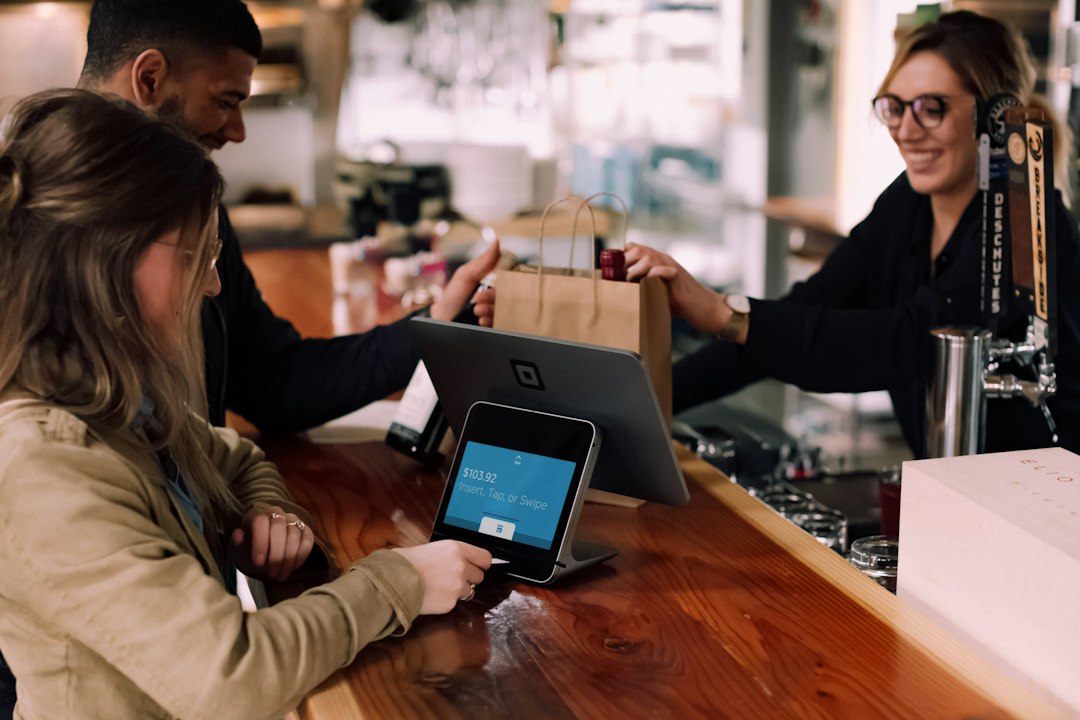
Image: Christiann Koepke, people using devices at a counter, via Unsplash, under the Unsplash Licence. Illustrative photograph, unrelated to GoTo or any customer case; resized for web display.