Urban heat is no longer just an environmental issue but a structural challenge that defines the future of cities, particularly as climate change intensifies the frequency and severity of heatwaves across Europe. We explore how the combined use of white roofs, urban parks, and peri-urban agriculture can reduce temperatures by more than 1.2°C, offering a scientifically proven and immediately applicable strategy
The growing intensity and frequency of heatwaves across Europe, driven by accelerating climate change and the structural characteristics of dense urban environments, has placed the mitigation of urban heat at the center of contemporary urban policy and planning debates, particularly as cities increasingly face the dual challenge of protecting public health while maintaining livability and economic productivity under extreme climatic conditions. Within this context, a comprehensive scientific study conducted over six years in the metropolitan area of Barcelona provides compelling evidence that the coordinated implementation of white roofs, urban parks, and peri-urban agriculture can significantly reduce urban temperatures, achieving reductions of more than 1.2°C during extreme heat events, thereby demonstrating that climate adaptation strategies are most effective when conceived as integrated systems rather than isolated interventions.
The research, which combines high-resolution climate modeling, environmental monitoring, and urban simulation techniques, reveals that the interaction between reflective surfaces, vegetated areas, and productive green belts creates a synergistic effect that enhances cooling capacity beyond the sum of individual measures, fundamentally redefining how cities can approach the mitigation of the urban heat island effect. This shift from fragmented solutions to systemic interventions represents not only a technical evolution but also a conceptual transformation in urban planning, where the city is understood as a dynamic ecological and climatic system.
The Synergistic Effect of Integrated Urban Climate Solutions
One of the most relevant contributions of the study lies in its demonstration that urban heat mitigation strategies achieve their highest level of effectiveness when multiple interventions are applied simultaneously, allowing cities to influence several climatic variables at once, including surface temperature, air circulation, humidity levels, and solar radiation absorption. In practical terms, this means that while a single intervention such as increasing green space may provide localized cooling, its impact becomes significantly amplified when combined with reflective materials and land-use strategies that modify the broader urban microclimate.
The Barcelona case study shows that during peak heatwave conditions, the combined application of these measures can reduce average urban temperatures by up to 1.26°C, a seemingly modest figure that, in reality, represents a critical threshold in terms of public health outcomes, as even small reductions in temperature have been scientifically linked to substantial decreases in heat-related mortality, hospital admissions, and energy demand for cooling. For example, epidemiological studies across European cities have shown that a reduction of just 1°C during extreme heat events can lower mortality rates by several percentage points, particularly among elderly populations and those with pre-existing health conditions.
Furthermore, the integrated approach not only addresses temperature but also contributes to improving air quality, as vegetation and modified urban surfaces reduce the concentration of pollutants such as nitrogen dioxide and particulate matter, thereby mitigating the compound effect of heat and pollution that characterizes many metropolitan environments during summer months.
Cool Roofs and Urban Albedo as Immediate and Scalable Interventions
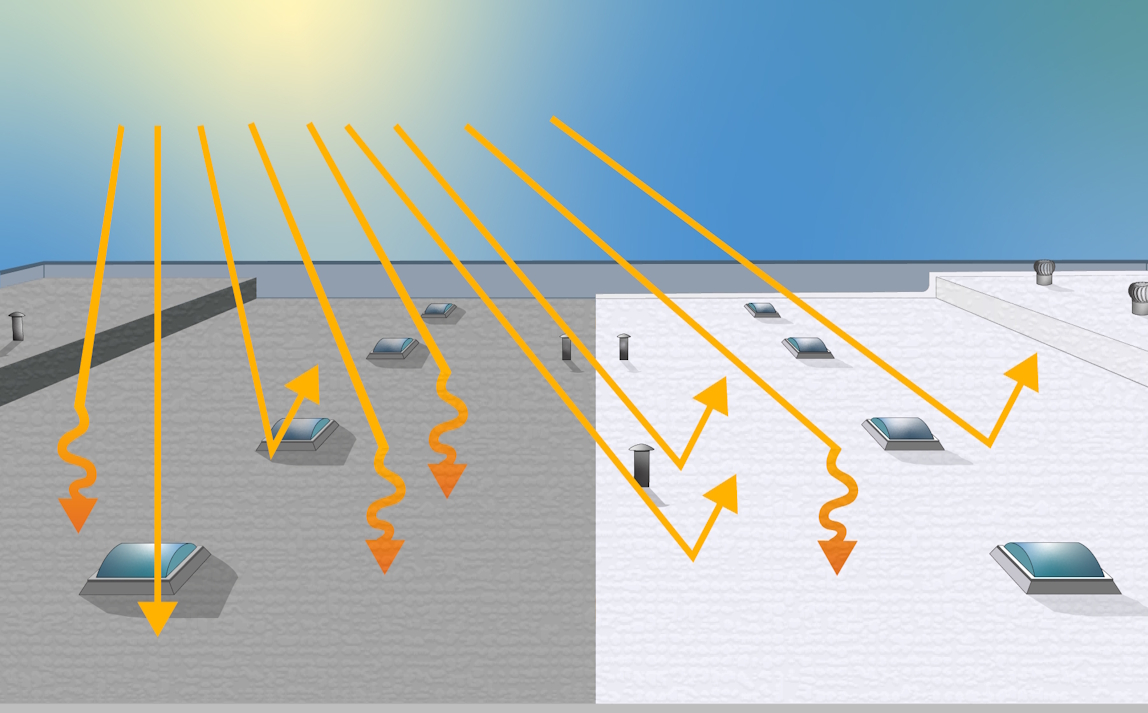
Among the different strategies analyzed, white roofs, or cool roofs, emerge as one of the most immediate, cost-effective, and scalable solutions for reducing urban heat, particularly in dense city centers where space constraints limit the expansion of green infrastructure. The principle behind cool roofs is based on increasing urban albedo, meaning the ability of surfaces to reflect solar radiation rather than absorb it, which significantly reduces heat accumulation in buildings and surrounding areas.
In conventional urban environments dominated by asphalt, concrete, and dark roofing materials, solar radiation is absorbed during the day and released slowly at night, contributing to the persistence of high temperatures even after sunset, a phenomenon that exacerbates thermal stress and prevents nighttime cooling. By contrast, white roofs can reflect up to 80% of incoming solar radiation, compared to less than 20% for traditional dark surfaces, thereby reducing roof surface temperatures by 20 to 30°C and lowering indoor temperatures by several degrees without additional energy consumption.
A practical example of this can be observed in cities such as Athens and Los Angeles, where pilot programs have demonstrated that widespread adoption of cool roofs can lead to measurable reductions in urban air temperature, as well as significant energy savings by decreasing the demand for air conditioning. In the Barcelona study, the implementation of cool roofs across a substantial portion of the metropolitan area contributed decisively to the overall temperature reduction achieved during extreme heat scenarios.
Urban Parks and the Cooling Power of Evapotranspiration
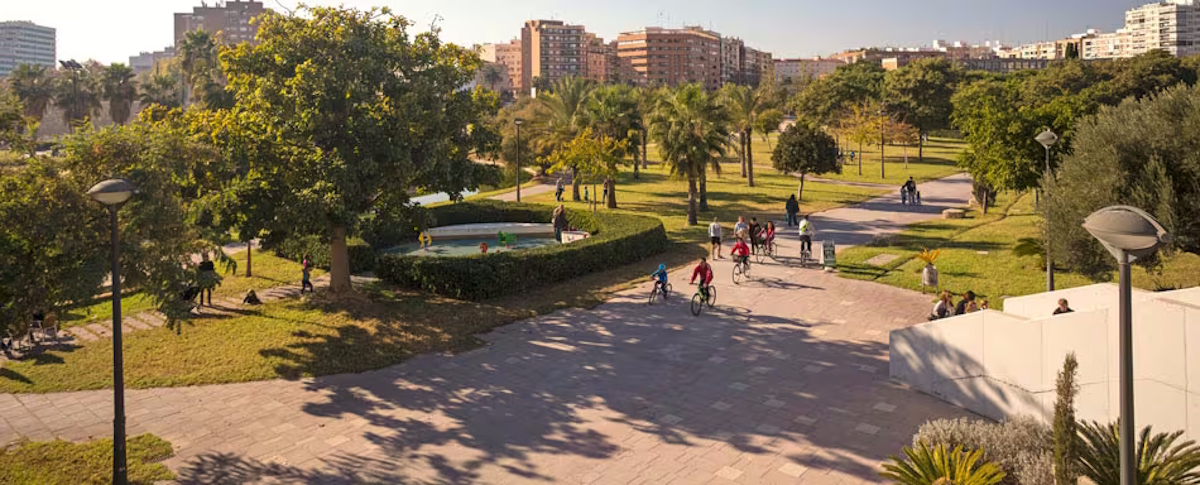
While reflective surfaces address the radiative component of urban heat, urban parks and green spaces play a crucial role in regulating temperature through biological and hydrological processes, particularly evapotranspiration, which involves the release of water vapor from plants and soil into the atmosphere, producing a natural cooling effect that can significantly alter local microclimates.
The study highlights that strategically distributed green spaces can reduce nighttime temperatures by up to 1.2°C, a factor of critical importance given that the absence of nighttime cooling is one of the main drivers of heat-related health risks in urban populations. During heatwaves, the inability of cities to dissipate heat accumulated during the day leads to sustained thermal stress, increasing the likelihood of dehydration, cardiovascular complications, and other health issues.
Beyond temperature regulation, urban parks also function as air quality regulators by absorbing pollutants and producing oxygen, while simultaneously providing social and psychological benefits that enhance overall urban well-being. However, the research emphasizes that the effectiveness of green spaces depends not only on their quantity but also on their spatial configuration, connectivity, and integration within the urban fabric, as poorly planned green areas may fail to deliver optimal cooling or even disrupt urban ventilation patterns.
In this regard, cities such as Copenhagen and Singapore have developed advanced green infrastructure strategies that combine parks, green corridors, and vertical vegetation to maximize climatic benefits while maintaining urban density and functionality.
Peri-Urban Agriculture as a Multifunctional Climate and Environmental Solution
The inclusion of peri-urban agriculture within the set of analyzed strategies introduces an additional dimension to urban climate adaptation, as it combines environmental, economic, and social benefits within a single intervention. Located at the interface between urban and rural areas, peri-urban agricultural zones contribute to cooling by increasing vegetative cover and reducing heat absorption, while also playing a significant role in improving air quality.
According to the study, peri-urban agriculture can reduce tropospheric ozone levels by up to 7%, which is particularly relevant given the role of ozone as a harmful pollutant that increases during high-temperature periods, thereby directly contributing to improved public health outcomes. At the same time, these agricultural systems enhance food security by providing locally produced goods, reducing transportation emissions, and strengthening regional resilience.
A practical example can be found in the metropolitan area of Milan, where the Parco Agricolo Sud integrates agricultural land into the urban system, creating a multifunctional landscape that supports local economies while contributing to environmental sustainability and climate adaptation.
However, the study also notes that the implementation of peri-urban agriculture must be carefully managed to avoid unintended consequences, such as nutrient runoff or water contamination, which underscores the importance of integrating these systems within a broader framework of sustainable land and water management.
Data-Driven Urban Planning and the Future of Climate-Resilient Cities
Underlying all these interventions is the need for a data-driven approach to urban planning, capable of integrating diverse datasets related to temperature, air quality, land use, and social vulnerability in order to design targeted and effective strategies. The URBAG project, which forms the basis of the Barcelona study, demonstrates that the use of advanced modeling and simulation tools allows cities to anticipate the impacts of different interventions and optimize their implementation for maximum efficiency and impact.
This approach is particularly relevant in a future scenario where climate models predict that heatwaves in European cities could intensify by up to 6°C by the end of the century, making it imperative for urban areas to adopt proactive and scientifically informed adaptation strategies. Cities such as Paris, which has implemented its “Plan Canicule,” and Rotterdam, with its climate adaptation strategy, are already moving in this direction by combining data analysis with integrated urban design.
Ultimately, the evidence suggests that the effectiveness of urban climate adaptation does not depend solely on the adoption of individual solutions, but on the ability to combine them intelligently within a coherent and coordinated framework that reflects the complexity of urban systems, thereby enabling cities to transition from reactive responses to structural resilience in the face of climate change.