
The IMD Smart City Index 2026 reveals a decisive shift in how urban intelligence is understood, moving beyond technology toward governance, transparency, and citizen trust as the true drivers of success. By analyzing 148 cities worldwide, the report shows that the most advanced urban systems are not those with the most visible digital infrastructure, but those capable of aligning institutions, services, and public perception. This new paradigm redefines the foundations of smart city strategies, placing citizen experience and institutional credibility at the center of urban transformation.
The 2026 edition of the Smart City Index, developed by the IMD World Competitiveness Center, marks a decisive conceptual shift in the global understanding of what constitutes a “smart city,” moving beyond the long-dominant narrative that equates urban intelligence with the density of sensors, the scale of digital platforms, or the sophistication of technological infrastructure, and instead placing the emphasis on governance quality, institutional coherence, and, above all, the level of trust that cities are able to build with their citizens. This transition is not merely theoretical, but reflects a growing body of empirical evidence derived from the evaluation of 148 cities worldwide, where technical indicators are systematically contrasted with citizen perception surveys, revealing that the cities perceived as most “intelligent” are not necessarily those with the most visible technological ecosystems, but rather those where technology operates as an integrated, almost invisible layer within a broader system of effective governance and social legitimacy.
This reframing occurs in a global context characterized by accelerating urbanization, increasing complexity in service delivery, and a rising demand for transparency and accountability, particularly in advanced economies where citizens are no longer passive recipients of services but active evaluators of institutional performance, thus forcing cities to evolve from technology-driven models toward trust-based governance systems, in which digital tools are not ends in themselves but instruments embedded within a wider social contract.
A Systemic Framework: The Interdependence of Institutions, Trust, and Infrastructure
At the heart of the IMD analysis lies a systemic interpretation of urban performance, structured around the interdependence between institutional strength, citizen trust, and infrastructural capacity, which together form a dynamic equilibrium that determines not only the efficiency of urban systems but also their long-term sustainability and adaptability. The report demonstrates, through both quantitative data and comparative analysis, that cities achieving the highest rankings consistently exhibit a high degree of alignment between these three dimensions, creating reinforcing feedback loops that amplify overall performance, whereas cities with imbalances between them tend to experience fragmentation, inefficiencies, and declining citizen satisfaction.
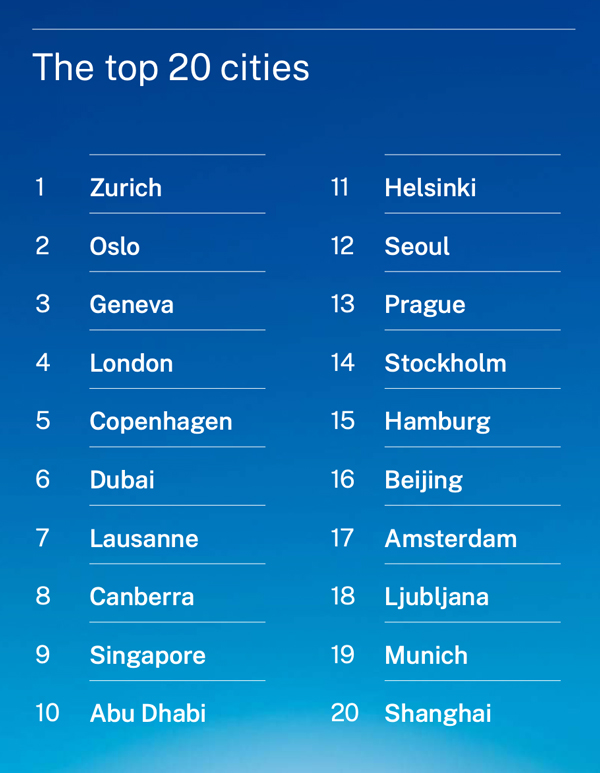
The cases of Zurich, Oslo, and Geneva illustrate this alignment with particular clarity, as these cities do not rely on the visibility of cutting-edge technologies to define their smart city status, but instead prioritize the quality of public services, the accessibility and clarity of information, and the existence of institutional channels that enable meaningful citizen participation, thereby generating high levels of trust that, in turn, facilitate the adoption and acceptance of digital systems. According to the index data, in most top-performing cities, scores related to institutional structures and governance quality exceed those related to technological deployment, a pattern that directly challenges the prevailing assumption that digitalization alone can drive urban success.
Conversely, in lower-ranked cities, the imbalance becomes evident, as technological investments are often not matched by improvements in governance or citizen engagement, resulting in a disconnect between infrastructure and perceived value, which ultimately undermines the effectiveness of smart city initiatives despite significant financial investments.
The Central Role of Trust in Data-Driven Urban Systems
One of the most critical insights of the 2026 index is the identification of trust as a central variable in the functioning of contemporary urban systems, particularly in an era where decision-making processes increasingly depend on data collection, analysis, and real-time monitoring across domains such as mobility, energy, public safety, and environmental management. While the technical capacity to collect and process data has expanded rapidly, the report highlights a growing tension between the needs of urban planners and the expectations of citizens, as the former require extensive datasets to optimize city operations, while the latter demand transparency, control, and ethical guarantees regarding how their data is used.
This tension redefines the fundamental question underlying smart city development, shifting it from a purely technical inquiry, what can be measured, to a normative one, what should be measured and under what conditions—thus introducing ethical, legal, and social considerations into the design of urban infrastructures. In practical terms, this implies that cities must develop robust data governance frameworks, including clear policies on data ownership, privacy protection, and algorithmic accountability, in order to ensure that technological systems are not only efficient but also legitimate in the eyes of the population.
The experience of Singapore provides a compelling example of how this balance can be achieved, as the city-state has developed an integrated approach in which digital services are embedded within a highly structured institutional framework, supported by strong regulatory mechanisms and consistent public communication, resulting in high levels of citizen trust in digital platforms, ranging from e-government services to smart mobility systems. In contrast, cities such as Bangkok, which may exhibit comparable levels of technological deployment, often struggle to achieve similar outcomes due to weaker institutional foundations and lower levels of public trust, illustrating that technology without governance coherence does not translate into perceived urban intelligence.
Redefining Infrastructure: From Physical Assets to Digital Public Goods
Another key contribution of the IMD Smart City Index 2026 is the redefinition of infrastructure as a hybrid system that combines traditional physical assets with an increasingly indispensable digital layer, transforming connectivity into a basic urban service comparable to electricity, water, or transportation networks. This conceptual expansion reflects the reality that modern urban life depends not only on physical mobility but also on the continuous flow of information, which enables the coordination of services, the optimization of resources, and the personalization of user experiences.
However, this transformation also introduces new risks, particularly the potential emergence of digital inequalities if access to connectivity and digital services is not managed as a public good, but rather left to market dynamics that may exclude certain segments of the population. The report implicitly warns that the digitalization of infrastructure, while creating opportunities for efficiency and innovation, can also reproduce or even exacerbate existing social disparities if not accompanied by inclusive policies and targeted investments, particularly in education, digital literacy, and equitable access to technology.
Examples from emerging cities such as Hanoi and Ho Chi Minh City illustrate both the opportunities and challenges associated with rapid digitalization, as these urban centers have achieved technological scores comparable to many European capitals, while simultaneously facing the need to strengthen institutional capacity and human capital in order to fully leverage these advancements. Similarly, the case of India highlights the limitations of technological development in the absence of robust governance structures, as the presence of highly advanced digital hubs does not automatically translate into widespread improvements in urban quality of life.
Cultural and Human Dimensions: The Invisible Foundations of Smart Cities
Beyond technology and infrastructure, the IMD framework incorporates cultural and human dimensions as essential components of urban intelligence, emphasizing that cities are not merely technical systems but complex social environments shaped by historical trajectories, collective identities, and patterns of interaction between citizens and institutions. In this context, cities that successfully integrate innovation while preserving their cultural identity tend to achieve higher levels of social cohesion and acceptance of change, as citizens perceive technological transformation not as an external imposition but as a continuation of their urban narrative.
Cities such as Ljubljana and Vienna exemplify this approach, where the implementation of smart city initiatives is carefully aligned with historical preservation, urban design principles, and participatory governance processes, creating a sense of continuity that reinforces trust and legitimacy. This perspective challenges purely technocratic models of urban development, suggesting that the success of smart city strategies depends not only on technical efficiency but also on their ability to resonate with the social and cultural fabric of the city.
At the same time, the role of human capital emerges as a decisive factor, as the adoption and effective use of digital technologies require not only infrastructure but also skills, education, and institutional capacity, highlighting the need for integrated policies that combine technological investment with long-term strategies for workforce development and knowledge creation.
The Circular Logic of Urban Intelligence: Trust as Both Cause and Outcome
The IMD Smart City Index 2026 ultimately conceptualizes urban intelligence as a circular process, in which trust, infrastructure, and governance interact in a continuous feedback loop that shapes the evolution of the city over time. In this model, trust enables the implementation of new systems and services, which, if they deliver tangible value and operate transparently, reinforce that trust, thereby creating the conditions for further innovation and investment.
This circular logic explains why governance structures are both a starting point and a result of urban performance, as they are continuously shaped by the interactions between institutions and citizens, rather than existing as static frameworks. However, the report also warns that this cycle can be disrupted when imbalances occur, particularly when technological development outpaces institutional capacity, leading to fragmented benefits, or when citizen expectations are not met, resulting in declining trust and reduced willingness to engage with new initiatives.
Examples from cities such as Jakarta and Nairobi demonstrate that high levels of trust in digital services can exist even in contexts with structural weaknesses, although this trust tends to be more transactional and therefore more fragile, while cases such as Athens or Rome illustrate how institutional inefficiencies can erode trust even in highly developed urban environments, highlighting the complexity and context-specific nature of the relationship between technology, governance, and perception.
Global Dynamics and the Persistence of European Leadership
The 2026 ranking confirms the continued dominance of European cities at the top of the index, with Zurich maintaining its leading position, followed by Oslo and Geneva, and with London and Copenhagen completing the top five, reflecting a model of urban development that prioritizes governance quality, social welfare, and institutional stability alongside technological innovation. At the same time, the report identifies significant upward movements in cities such as AlUla and Washington D.C., as well as notable declines in cities like Bordeaux, Lyon, Ottawa, and Shenzhen, illustrating the dynamic nature of urban performance and the influence of changing citizen perceptions.
The consolidation of cities such as Dubai and Abu Dhabi within the top 10 highlights the emergence of alternative models based on strong state-led investment in digital infrastructure combined with high service quality, suggesting that multiple pathways to smart city development can coexist, provided that they achieve a sufficient level of coherence between their constituent elements.
Spanish Cities: Between Stability and Emerging Misalignment
The positioning of Spanish cities within the IMD Smart City Index 2026 reflects a heterogeneous landscape characterized by both stability and emerging challenges, as Bilbao, Madrid, Zaragoza, and Barcelona occupy positions 30, 37, 63, and 94 respectively, revealing different trajectories in terms of alignment between strategy, infrastructure, and citizen perception.
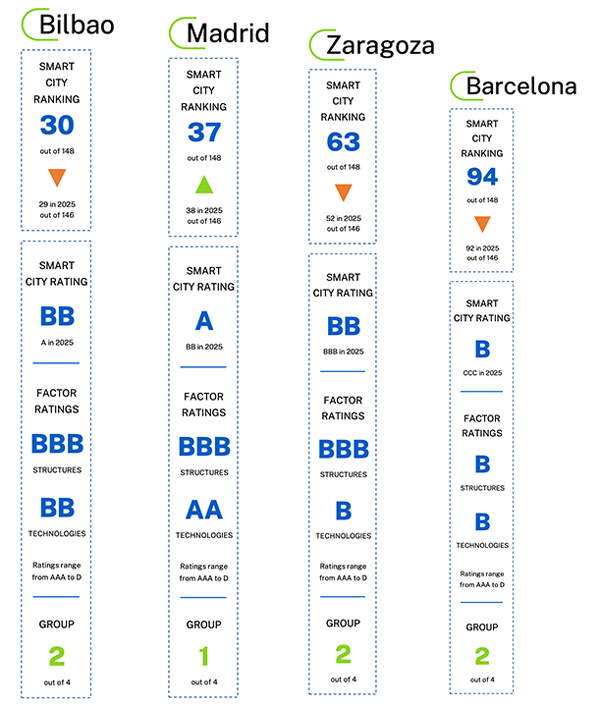
Bilbao continues to stand out as the most consistent performer, maintaining a relatively stable position over time, which suggests a sustained balance between investment, governance, and perceived service quality, while Madrid shows signs of stabilization after a period of fluctuation, indicating a gradual consolidation of its urban model. In contrast, Barcelona’s continued decline, extending a multi-year downward trend, points to a growing disconnect between its strategic positioning as a leading smart city and the perception of its citizens, highlighting the importance of maintaining alignment between innovation and lived experience.
Zaragoza’s reversal of its previous upward trajectory further underscores the volatility of urban performance in a context where citizen expectations are continuously evolving, reinforcing the central message of the report: urban competitiveness is no longer defined by the scale of technological deployment, but by the ability to translate innovation into tangible, perceived value through transparent, inclusive, and well-governed systems.