As cities expand and modernize, they face escalating environmental challenges that threaten both human health and ecological stability. Pollution is no longer a side effect of growth but a systemic risk woven into the fabric of urban life. In this context, artificial intelligence emerges as a transformative force, offering cities the ability to detect, predict, and respond to environmental threats with unprecedented speed and precision
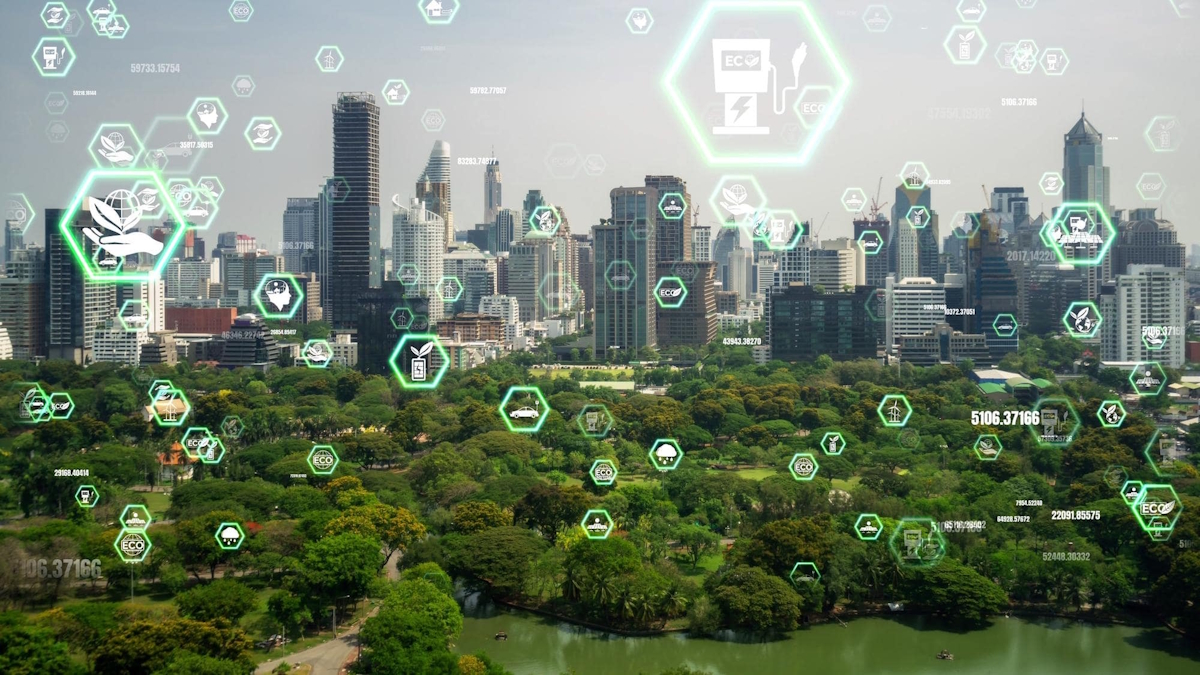
Urban environments, as complex socio-technical systems, are undergoing a fundamental transformation driven by the convergence of data, connectivity, and artificial intelligence (AI). These interconnected, dynamic systems are not merely expanding in size or density; they are evolving in function and form to become smart cities, intelligent urban ecosystems capable of adapting to environmental pressures, optimizing infrastructure, and improving the quality of life for their inhabitants. Central to this transformation is the use of advanced environmental monitoring systems powered by AI, which enable cities to detect and respond to pollution before it escalates into a public health or ecological crisis.
Historically, environmental monitoring relied on periodic sampling, manual reporting, and delayed data analysis, making it reactive and often insufficient for the fast-paced dynamics of modern urban life. Today, however, cities are increasingly equipped with distributed sensor networks that generate continuous streams of environmental data. These include air quality monitors, meteorological stations, noise detectors, water and soil sensors, and even waste tracking systems. The advent of satellite remote sensing, drone-based surveillance, and mobile sensing units further expands the spatial and temporal resolution of data collection. Artificial intelligence serves as the integrative layer that processes these massive datasets, revealing patterns, anomalies, and causal relationships that would be imperceptible through conventional analysis.
The implementation of machine learning and deep learning models allows for real-time assessment and predictive modeling of environmental conditions. One of the most advanced applications is in air quality forecasting. By training algorithms on historical pollution data, weather conditions, traffic patterns, and industrial outputs, cities can now anticipate pollution peaks several days in advance. These models are already operational in metropolitan areas like Paris, Seoul, and Beijing, where they inform policy measures such as temporary vehicle bans, school advisories, and dynamic adjustment of urban logistics. Instead of reacting to smog once it blankets the city, authorities are equipped to act preemptively, safeguarding public health and mitigating environmental damage.
AI-driven environmental monitoring also extends to hydrological and terrestrial domains. Machine learning algorithms process satellite imagery and in-situ data to detect early signs of water contamination, illegal discharges, thermal anomalies, or infrastructure failures such as pipeline leaks. Computer vision systems can analyze aerial photographs or drone footage to identify the onset of harmful algal blooms, sediment plumes, or erosion processes, which, if left undetected, could result in ecological degradation or economic loss. In agricultural and peri-urban zones, AI is applied to monitor soil quality, nutrient cycles, and land-use changes, ensuring that urban development does not come at the expense of surrounding ecosystems.
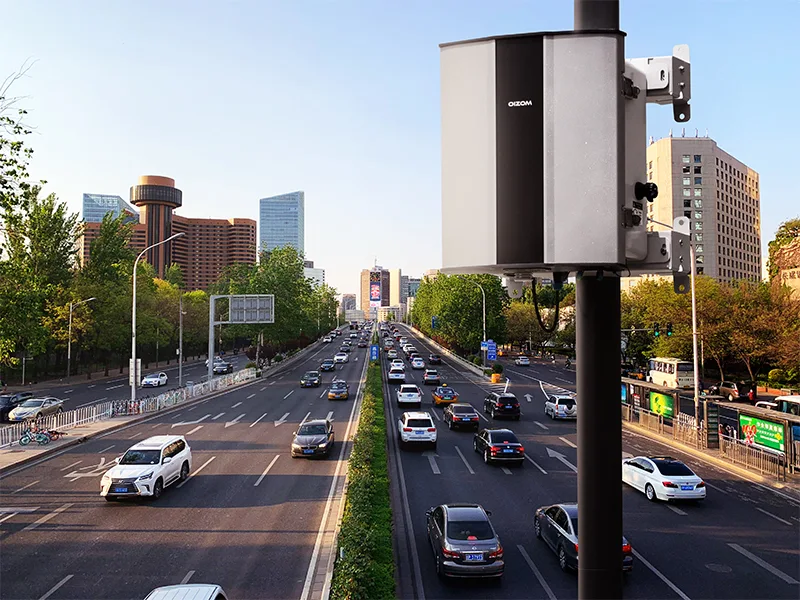
Noise pollution, a persistent challenge in high-density environments, is another area where AI contributes significantly. Acoustic sensors deployed throughout the urban fabric capture audio data that is then analyzed by neural networks capable of distinguishing between different sound sources such as traffic, construction, or nightlife. This data is spatially and temporally mapped to reveal acoustic hotspots and patterns of sonic disturbance. Urban planners can then use these insights to design noise mitigation strategies, such as acoustic zoning, green buffer installations, or revised construction schedules. Policymakers, in turn, can rely on this evidence to establish enforceable, data-backed regulations tailored to local contexts.
Beyond observation and diagnosis, AI is becoming instrumental in environmental control and response automation. Intelligent infrastructure can now react autonomously to detected anomalies. For instance, if elevated levels of particulate matter are registered in a tunnel, the ventilation system may adjust airflow dynamically. If industrial sensors detect the release of volatile compounds, containment and filtration systems may activate instantly. In smart traffic networks, AI can modify signal timing to reduce vehicular congestion and emissions during peak hours or under adverse meteorological conditions. In these scenarios, AI operates as the cognitive core of the urban nervous system, continuously processing sensory input and executing adaptive outputs to maintain ecological balance.
Nevertheless, the deployment of AI in environmental monitoring raises critical concerns related to data governance, privacy, and ethics. The granularity of environmental data, especially when linked to geolocation and behavioral patterns, can inadvertently expose sensitive information about individuals or communities. Transparency in algorithmic decision-making, data anonymization protocols, and open-access platforms are essential to ensure that these technologies serve the collective interest. Furthermore, the models themselves must be subjected to regular auditing to avoid systemic biases or errors that could undermine public trust or lead to inequitable outcomes.
Equity is, in fact, one of the most pressing dimensions of smart environmental governance. Urban pollution rarely affects all residents uniformly. Marginalized, low-income, and racialized communities are often situated in areas with poorer air quality, contaminated water, and limited access to green infrastructure. AI must be intentionally designed to identify and prioritize these zones of environmental vulnerability. By disaggregating data and emphasizing spatial justice, cities can allocate resources where they are needed most, design targeted interventions, and ensure that the benefits of smart city development are distributed inclusively. Ethical AI in this context is not merely about technical accuracy but about social responsibility and environmental justice.
Another frontier in the application of AI is the integration with digital twin technology. Digital twins are virtual replicas of physical urban systems that dynamically simulate environmental processes and human interactions. When combined with AI, these models allow urban managers to test the impact of proposed interventions, such as the construction of green corridors, the regulation of industrial zones, or the expansion of public transit, before they are implemented in the real world. These simulations support long-term sustainability planning and climate resilience by anticipating unintended consequences and optimizing resource use. They also enhance interdepartmental coordination by offering a unified, data-driven view of environmental dynamics across municipal domains.
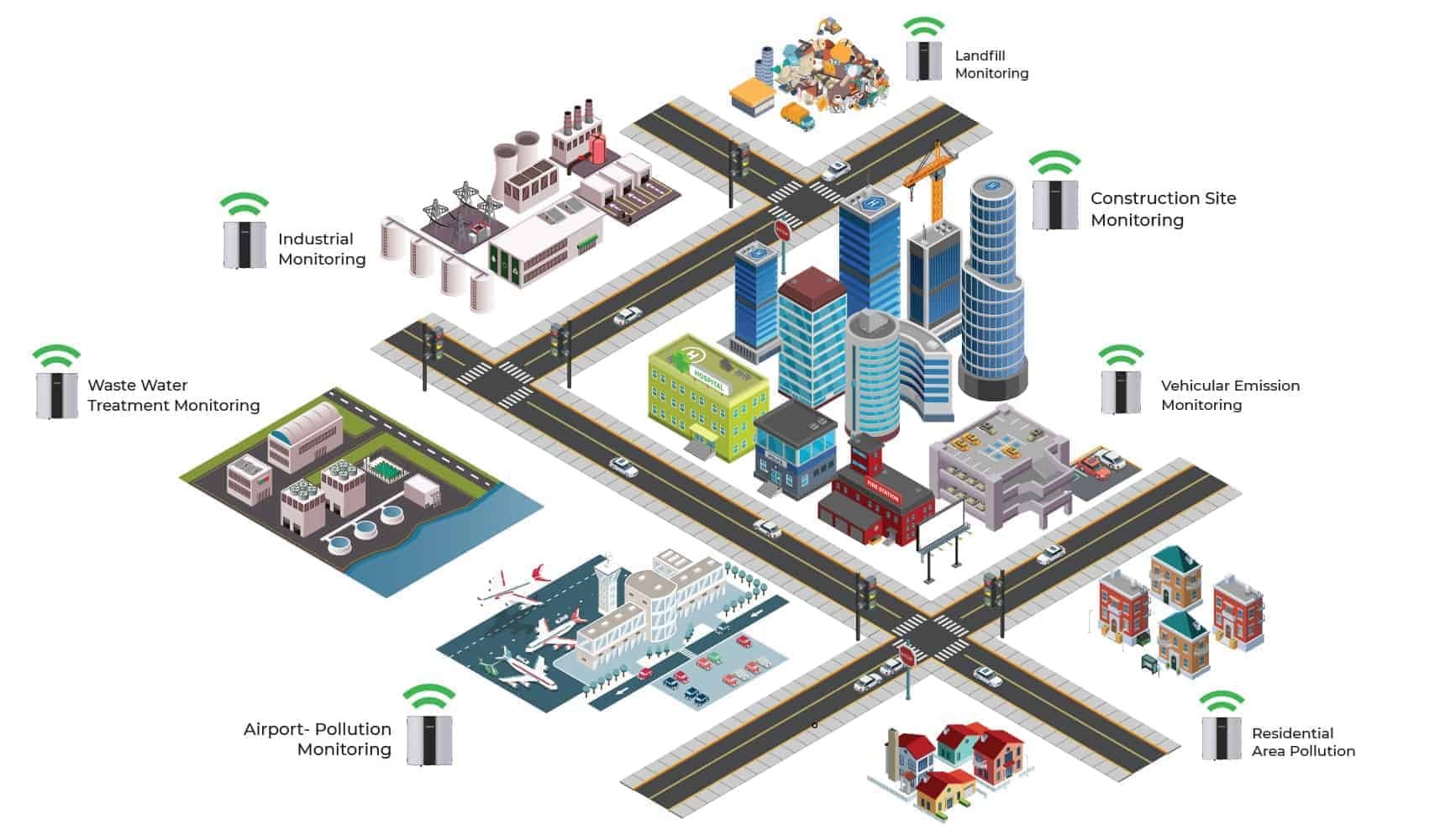
The strategic deployment of AI in environmental monitoring is thus not a peripheral enhancement, but a core enabler of the smart city paradigm. It transforms cities from passive observers of degradation into active agents of ecological stewardship. This technological shift redefines how urban ecosystems are managed, from reactive compliance to anticipatory governance. The city becomes not only a place that consumes and emits but one that senses, learns, and responds.
Ultimately, the vision of the smart city is not limited to digital connectivity or automated services. It is about creating urban environments that are resilient, adaptive, and aligned with the principles of sustainable development. In this vision, environmental intelligence, driven by AI, is foundational. It allows cities to monitor the health of their ecosystems with the same rigor they apply to mobility, energy, or security. It empowers citizens with real-time information, enabling informed choices and participatory governance. And it ensures that urban growth does not come at the expense of planetary well-being, but rather evolves in harmony with the natural systems upon which life depends.