
 The IDHUS Institute is an independent research organisation dedicated to developing the emerging discipline of Institutional Cognition and applying its principles to governance, public administration, public policy and the future evolution of intelligent public institutions.
Founded in 2019, we hold the conviction that the future of governance depends not only on technological innovation but also on the cognitive capacity of institutions. On that basis, the Institute develops original scientific research at the intersection of governance, public administration, artificial intelligence, systems thinking and organisational intelligence.
Rather than approaching these fields as separate domains, the IDHUS Institute reconstructs them within a unified architectural framework that seeks to explain how institutions organise knowledge, coordinate intelligence and continuously adapt to changing environments.
Our History and Background
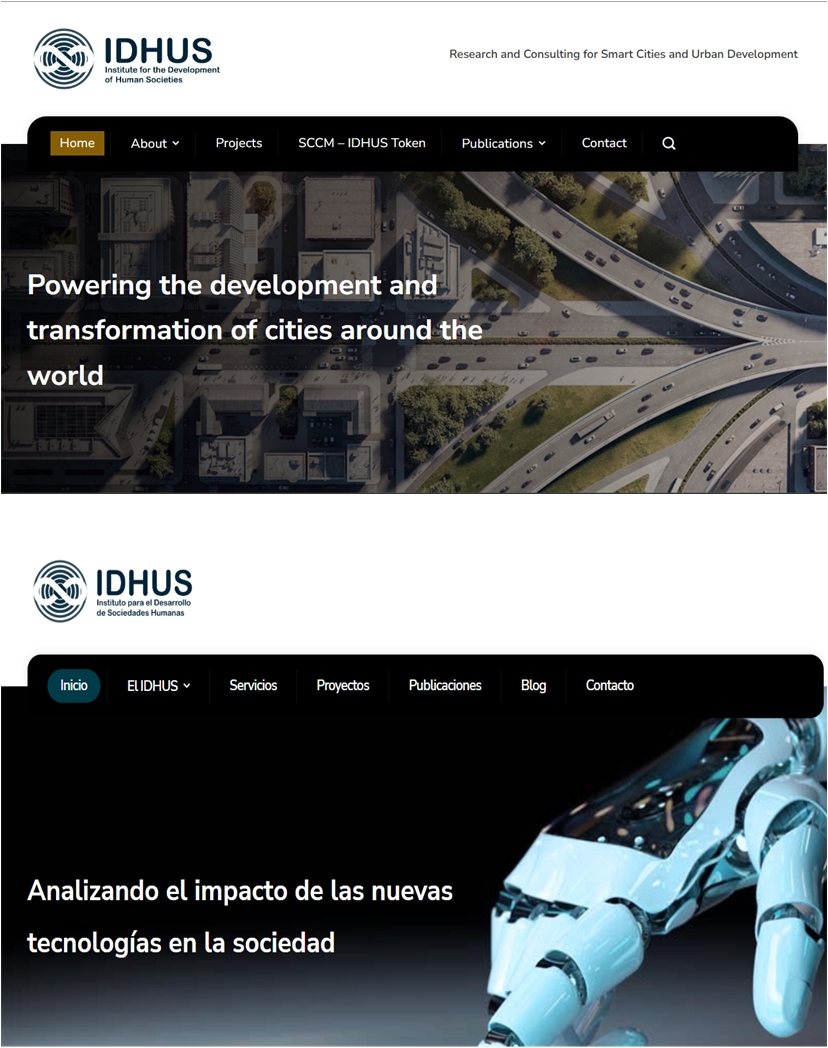 The IDHUS Institute was founded as a consultancy and research organisation specialising in the development of Smart Cities. As new technologies such as artificial intelligence were rapidly being applied across a wide range of environments and sectors within our society, we began working on research projects exploring how AI could support urban development, the management of services in our cities, and urban governance.
From that point onwards, our work focused on analysing the impact that AI and parallel technological innovations were beginning to have on human progress and on our society, leading us to realise that, within a few years, artificial intelligence would be the driving force behind the complete and total transformation of all institutions, organisations, companies and businesses across the globe.
This vision has driven us to focus on how artificial intelligence can be responsibly integrated, utilised and developed for public governance and for the development of organisational management processes that combine the potential of AI with human cognitive abilities.
Our research, publications, internal processes and analyses have ultimately led us to realise that we are facing an almost entirely new scientific and social field, which we have termed ‘Institutional Cognition’ and which, in short, aims to help us understand how institutions think, learn, manage themselves and evolve in the age of AI.
Our Logo and Brand

Our logo is a symbol of humanity’s evolution.
Just as each ring in the trunk of a tree represents a year of accumulated experience, knowledge, and wisdom in its evolutionary process, The IDHUS Institute embodies this philosophy, helping society grow and evolve through continuous learning, constant change, and steady development, learning from all that has been lived to create, with each new cycle, a better humanity.
Our purpose and raison d’être
The IDHUS Institute understands itself not simply as a research centre, an educational organisation or a policy think tank. It exists as the constitutional home of Institutional Cognition, committed to developing the conceptual, methodological and educational foundations of a scientific discipline designed to serve both present and future generations of institutions.
Our mission is to advance the science of Institutional Cognition and to contribute to the development of more intelligent, adaptive and responsible public institutions capable of responding to the increasing complexity of the twenty-first century.
We pursue this mission through the systematic development of scientific knowledge, methodological innovation, interdisciplinary research and the responsible application of AI technologies to governance, public administration and public policy. Our work seeks to deepen the understanding of how institutions perceive reality, organise knowledge, coordinate intelligence, preserve institutional memory, learn from experience and continuously evolve while remaining aligned with democratic principles and the public interest.
Our vision and underlying rationale
 The institutions that will shape the future of society will not be defined solely by their legal frameworks, administrative structures or technological capabilities. They will be distinguished by their ability to understand increasingly complex realities, to organise knowledge intelligently, to learn continuously from experience and to adapt responsibly while preserving democratic legitimacy, public trust and human accountability.
As societies become more interconnected, more data-rich and more technologically sophisticated, governance itself is entering a new stage of evolution. Public institutions will be expected not only to deliver services more efficiently, but also to anticipate emerging challenges, coordinate distributed expertise, integrate human judgement with Artificial Intelligence and continuously improve their own capacity to make informed decisions. Institutional intelligence will become one of the defining characteristics of effective governance.
This transformation cannot be achieved through technology alone. Artificial Intelligence, advanced analytics and digital infrastructures provide unprecedented opportunities for enhancing institutional capabilities, yet their long-term value depends upon the cognitive architectures within which they operate. Intelligent institutions will emerge not because they possess more advanced technologies, but because they develop more mature forms of organised cognition, collective learning and responsible Human–AI cooperation.
The future of governance therefore lies beyond the traditional distinction between administration and technology. It requires a new generation of public institutions capable of thinking systemically, learning recursively and evolving continuously while remaining firmly grounded in constitutional principles, ethical responsibility and the public interest. Such institutions will be better equipped to navigate uncertainty, respond to complex societal challenges and build long-term resilience in rapidly changing environments.
The IDHUS Institute envisions a future in which Institutional Cognition provides the scientific foundations for this transformation. By advancing the understanding of how institutions think, learn and evolve, the Institute seeks to contribute to the emergence of public organisations that are not only more efficient, but also more intelligent, more adaptive and more deeply aligned with the societies they serve.