Cities are no longer defined solely by their architecture, infrastructure, or economic output, but by their ability to respond intelligently to the complex challenges of contemporary life. Climate change, rapid urbanization, social inequality, and resource scarcity are forcing urban systems to evolve beyond traditional models of growth and governance. Within this landscape, artificial intelligence is emerging as a decisive force capable of reshaping how cities are planned, managed, and experienced. At the intersection of technology, sustainability, and human-centered design, AI is redefining the very concept of urban intelligence, transforming neighborhoods and districts into adaptive environments that learn, anticipate, and evolve alongside the communities they serve
In recent years, artificial intelligence has undergone a decisive evolution, transitioning from an emerging technological concept into a structural component of contemporary societies. Its progressive integration into everyday life is particularly evident within the real estate sector, where AI has moved beyond theoretical experimentation to become a strategic instrument capable of reshaping the way cities are conceived, developed, and managed. Artificial intelligence is no longer an auxiliary technology but a transformative force that redefines urban environments by making them more sustainable, efficient, and deeply centered on human needs.
Within this context, the real estate industry represents one of the most fertile grounds for innovation, as it sits at the intersection of technological advancement, environmental responsibility, and social well-being. According to Ferruccio Resta, President of the Fondazione Politecnico di Milano, the Bruno Kessler Foundation, and MOST, the National Center for Sustainable Mobility, as well as independent board member at COIMA REM, the adoption of artificial intelligence in real estate constitutes a clear break from traditional paradigms. This shift is not limited to improved operational efficiency but represents a systemic transformation that affects design methodologies, urban governance models, and the relationship between individuals and the built environment.
From a cultural and strategic standpoint, the application of AI to urban development must be understood as a driver of profound change rather than a purely technical solution. While data analysis, automation, and predictive modeling undoubtedly enhance performance and reduce inefficiencies, their true value lies in their ability to foster a more resilient, adaptive, and inclusive urban ecosystem. Smart cities emerge not simply from the accumulation of advanced technologies but from the capacity to align innovation with quality of life, social cohesion, and long-term sustainability.
Market data confirms the growing relevance of this transformation. In 2023, the global market for AI applied to real estate reached an estimated value of €220 billion, marking a significant year-on-year increase. Although this figure still represents a relatively small share of the overall global real estate market, which exceeds €4 trillion, its trajectory indicates rapid and sustained growth. Projections outlined in the Scenari Immobiliari 2025 Report further suggest that the integration of advanced technologies will enable the Italian real estate sector alone to generate more than €535 billion in wealth by 2035, with the potential to reach €800 billion by 2050. These figures reflect not only economic expansion but also a structural reconfiguration of the sector driven by digital intelligence.
Central to this evolution is the digitalization of construction and asset management processes, which extends far beyond the mere introduction of digital tools along the value chain. Instead, it involves a comprehensive rethinking of the entire building lifecycle, from initial concept and design to operation and long-term management, within an integrated, transparent, and interconnected framework. Artificial intelligence enables predictive and adaptive models that fundamentally reshape decision-making processes by placing data at the core of urban interventions. Through applications such as predictive maintenance, energy optimization, and intelligent asset administration, AI enhances operational resilience while simultaneously supporting environmental objectives.
At the foundation of this transition lies Building Information Modeling, a technology that allows for the creation of three-dimensional, data-rich representations of buildings and infrastructure. When integrated with artificial intelligence, the Internet of Things, and Digital Twin technologies, BIM evolves into a dynamic platform capable of simulating real-time scenarios related to energy consumption, user behavior, system performance, and potential criticalities. This convergence of technologies transforms buildings and districts into responsive systems capable of learning, adapting, and improving over time.
However, technological innovation alone is insufficient without an integrated governance framework. The intelligent city requires multidisciplinary collaboration among property managers, sustainability managers, digital specialists, and district managers, all operating within a shared vision and a unified data ecosystem. Urban intelligence emerges when data is not siloed but collectively interpreted to guide strategic decisions that enhance both operational performance and social value. In this scenario, designers assume the role of interpreters of complex information systems, clients become active and informed stakeholders in defining sustainability and adaptability goals, and construction professionals translate data-driven insights into tangible quality and long-term value.
Despite its vast potential, the adoption of artificial intelligence presents a series of challenges that must be addressed with clarity and responsibility. The effectiveness of AI systems depends fundamentally on the availability, quality, and reliability of data, which remains uneven across organizations and territories. Issues related to cybersecurity, data privacy, and interoperability between platforms further complicate implementation, while disparities in digital skills risk creating technological asymmetries within the sector. Without a coherent strategic vision, artificial intelligence risks remaining confined to isolated pilot projects rather than generating systemic and scalable impact.
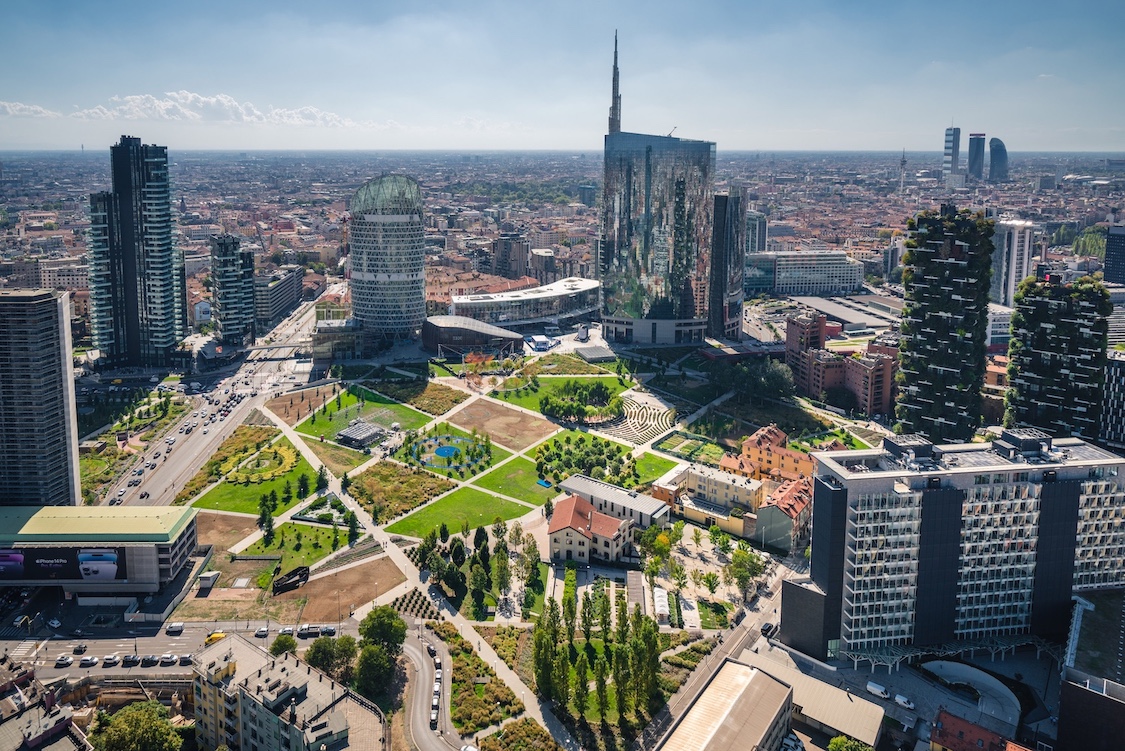
An emblematic example of a holistic and forward-looking approach to smart city development can be found in the Portanuova district in Milan. Here, artificial intelligence functions as a catalyst for deep transformation by improving real estate valuation processes, optimizing building operations, and enabling advanced monitoring of energy systems, mobility flows, maintenance cycles, and environmental quality. Real-time data analysis from sensors, images, and video feeds allows for predictive interventions that enhance safety, operational continuity, and user experience. In this context, AI becomes an invisible yet essential infrastructure supporting both efficiency and livability.
When extended to the urban scale, this model reveals its full potential. Regenerated neighborhoods can evolve as intelligent organisms capable of adapting to social, environmental, and economic changes over time. Artificial intelligence enables objective and real-time assessment of environmental, social, and economic impacts, making it possible to identify vulnerable areas with precision and prioritize interventions accordingly. Data-driven urban management thus becomes a powerful tool for promoting equity, resilience, and informed public policy.
Beyond technical and operational dimensions, artificial intelligence plays an increasingly central role in shaping urban experience. By analyzing behavioral patterns, spatial flows, and digital interactions, AI-driven user experience applications allow public spaces to be redesigned around the actual needs of citizens. This approach supports the creation of intuitive services, accessible information systems, and environments that foster comfort, safety, and inclusivity. The intelligent city is defined not only by how it functions, but by how it is experienced by those who inhabit it.
Sustainability represents another domain in which artificial intelligence demonstrates transformative capacity. When embedded within corporate and institutional processes, AI translates ESG principles into measurable, traceable, and actionable outcomes. It enables real-time monitoring of carbon footprints, optimization of energy consumption, improvement of environmental quality, and the design of more inclusive and equitable spaces. Artificial intelligence thus acts not merely as a performance enhancer, but as a guarantor of strategic coherence between declared values and concrete actions.
Governance structures equally benefit from AI-driven insights, particularly in the context of ESG accountability. By automating data analysis and integrating it into auditing, reporting, and strategic planning, artificial intelligence enhances transparency, responsiveness, and decision-making accuracy. Organizations that adopt these tools in a structured and consistent manner are better equipped to demonstrate their commitments to investors, institutions, and communities in a credible and comparable way. In this sense, AI strengthens trust by transforming complex data into clear and verifiable evidence of responsibility.
Ultimately, the true challenge of smart cities lies in aligning technological innovation with human-centered values. Artificial intelligence is not an end in itself, but a means through which cities can improve quality of life, foster sustainable growth, and reinforce social cohesion. Truly intelligent cities are those that leverage technology to serve people, ensuring that progress remains deeply rooted in human well-being and collective responsibility.