
China’s push to introduce autonomous flying taxis in Africa marks a turning point in the evolution of urban and regional mobility across emerging markets, where infrastructure gaps and rapid urbanization create fertile ground for disruptive transport solutions. The successful deployment of the EH216-S in Kigali not only demonstrates technological maturity, but also signals the beginning of a broader strategy to integrate low-altitude aviation into the continent’s economic and logistical systems
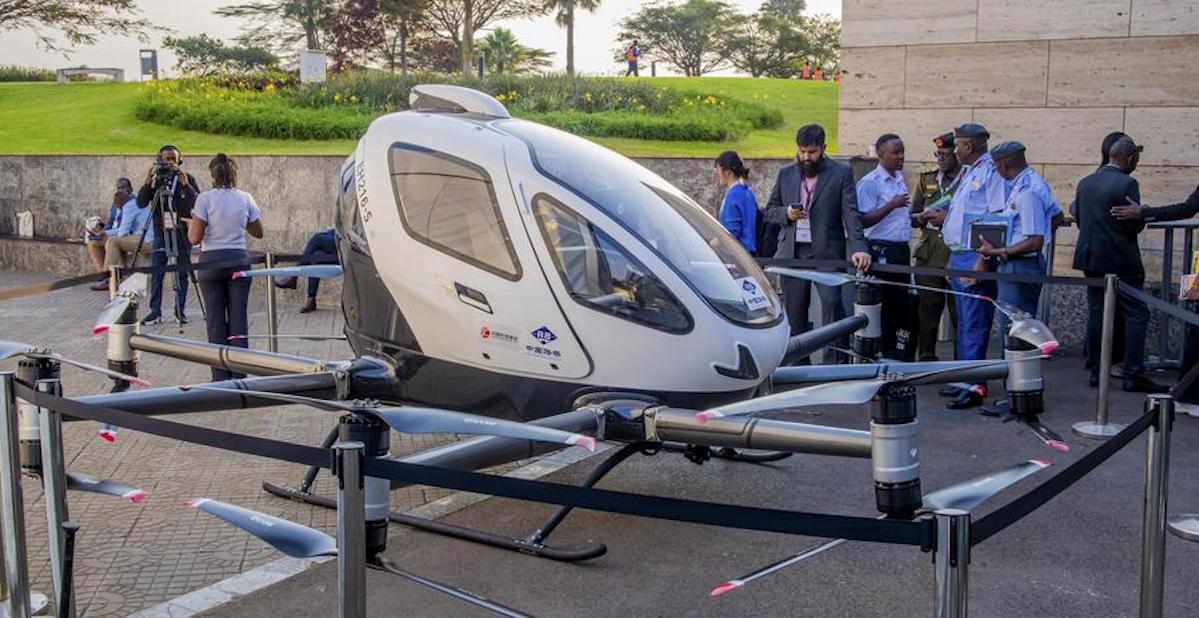
The successful flight of an unmanned electric aerial vehicle in Kigali in September 2025, carried out during the 9th Aviation Summit in Africa, cannot be understood merely as an isolated technological milestone, but rather as a carefully orchestrated entry point into a rapidly evolving global market in which urban air mobility is beginning to redefine the spatial and economic logic of transportation systems, particularly in regions where traditional infrastructure remains unevenly developed and often insufficient to meet growing demand.
The EH216-S and the Emergence of Scalable Urban Air Mobility
At the center of this development stands the EH216-S, an electric vertical take-off and landing aircraft designed by the Chinese company EHang, whose strategic positioning as a global leader in urban air mobility platforms reflects a broader shift in the aviation sector toward autonomous, lightweight, and infrastructure-flexible solutions that are capable of operating without the need for conventional airport systems. The aircraft, which is designed to carry two passengers autonomously over distances of approximately 30 kilometers with a flight time of around 25 minutes, represents a new paradigm in which short-distance aerial transport becomes both operationally feasible and commercially scalable, particularly in urban and peri-urban environments where congestion and geographical barriers limit the efficiency of ground transport.
This technological proposition is especially relevant in the African context, where the combination of rapidly expanding urban populations, fragmented transport networks, and large rural hinterlands creates conditions in which low-altitude aviation can function not as a luxury innovation, but as a structural solution to longstanding mobility challenges, enabling faster connections between urban centers, regional hubs, and isolated communities.
Africa as a Strategic Frontier for Low-Altitude Aviation
The choice of Kigali as the site for this first demonstration is not incidental, as Rwanda has increasingly positioned itself as a regulatory and technological testing ground for advanced mobility solutions, particularly in the field of drone logistics, where companies have already deployed medical delivery networks across rural areas. In this sense, the introduction of passenger-oriented eVTOL systems can be seen as a natural extension of an ecosystem that has already demonstrated the viability of aerial logistics in real-world conditions, thereby reducing both technological uncertainty and regulatory resistance.
From a market perspective, the African continent presents a unique combination of challenges and opportunities, as the vast territorial scale, coupled with limited road and rail connectivity in many regions, creates a structural demand for alternative transport modalities that can bypass traditional infrastructure constraints, while at the same time offering governments the possibility of leapfrogging directly into next-generation mobility systems without the need for decades of incremental investment in legacy infrastructure.
For EHang, this translates into a strategic vision in which Africa is not merely a secondary market, but rather a potential early adopter of integrated low-altitude aviation ecosystems, where passenger transport, cargo logistics, emergency response, and agricultural monitoring can be combined within a unified technological framework.
Industrial Partnerships and the Geopolitics of Infrastructure Expansion
The involvement of the China Road and Bridge Corporation, a major state-owned enterprise with extensive experience in large-scale infrastructure projects across Africa, adds a critical dimension to this initiative, as it signals that the deployment of flying taxi systems is not being approached as a standalone technological export, but as part of a broader ecosystem of infrastructure development, financing mechanisms, and long-term strategic partnerships.
This integrated approach reflects a pattern that has already been observed in other sectors, such as railways, ports, and energy, where Chinese companies have combined technological solutions with financing and construction capabilities in order to secure a durable presence in emerging markets. In the case of urban air mobility, however, the dynamics are more complex, as the success of such systems depends not only on physical infrastructure, but also on regulatory frameworks, public acceptance, and the development of operational standards that ensure safety and reliability in autonomous flight environments.
The statements made by EHang’s Chief Engineer, Lu Rucheng, during the Kigali summit underscore this strategic intent, as the company explicitly framed the demonstration flight as the beginning of commercial operations on a new continent, while also emphasizing the importance of ongoing dialogue with local stakeholders, including airlines, airports, civil aviation authorities, and sectoral organizations.
From Demonstration to Application: Use Cases Across Multiple Sectors
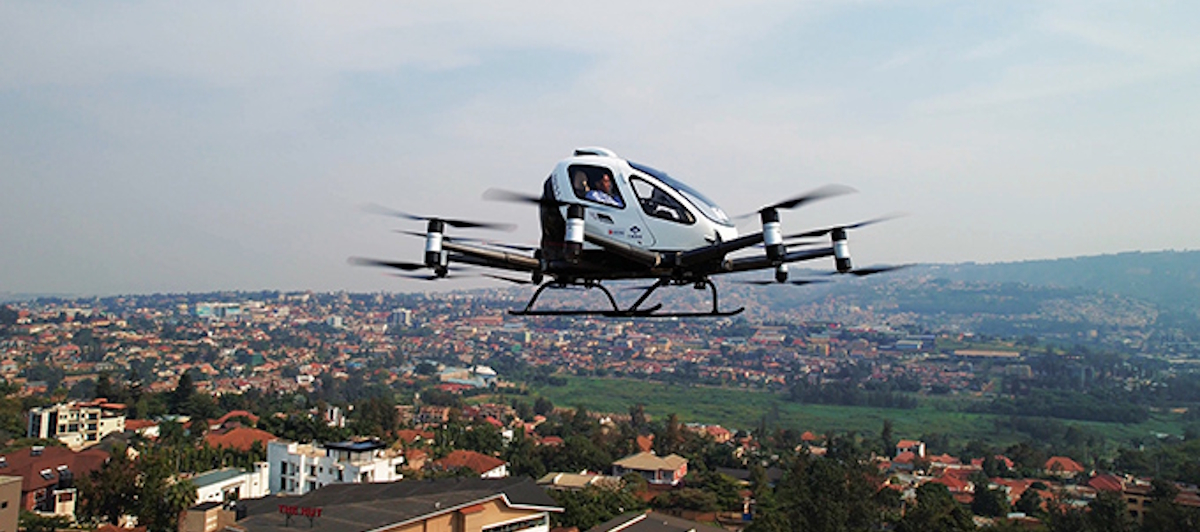
Beyond passenger transport, the potential applications of the EH216-S and related technologies extend into a wide range of sectors that are particularly relevant in the African context, including cargo delivery, emergency response, firefighting, precision agriculture, and even tourism, where aerial sightseeing experiences could generate new revenue streams in regions with high natural or cultural value.
A practical example of this multi-sectoral approach can be found in the possibility of deploying eVTOL systems to connect secondary cities or remote tourist destinations that are currently accessible only via long and often unreliable road journeys, thereby reducing travel times from several hours to a matter of minutes, while simultaneously improving safety and accessibility, which in turn could stimulate local economies and attract new investment.
Similarly, in the field of healthcare logistics, the integration of passenger-capable aerial vehicles with existing drone delivery networks could enable a hybrid system in which both medical supplies and personnel are transported rapidly across difficult terrain, significantly enhancing the responsiveness of health services in rural areas.
Regulatory Readiness and the Role of Government Commitment
The interest expressed by Rwandan authorities, particularly by the Minister of Infrastructure, Dr. Jimmy Gasore, highlights the critical role of government support in enabling the deployment of such technologies, as the establishment of a robust regulatory framework is a prerequisite for the safe and scalable integration of autonomous aerial systems into national airspace.
In this regard, Rwanda’s proactive stance suggests that certain countries may position themselves as early adopters and regulatory pioneers, creating environments in which companies can test, refine, and commercialize their solutions before expanding into larger and more complex markets. The emphasis on reducing traffic congestion, improving access to remote areas, and strengthening connectivity between communities reflects a policy perspective in which urban air mobility is not viewed merely as an innovation, but as a tool for addressing concrete socio-economic challenges, particularly in rapidly urbanizing regions where traditional transport systems are under increasing strain.
Toward a New Layer of Urban and Regional Mobility
Ultimately, the introduction of flying taxis in Africa, as exemplified by the Kigali demonstration, points toward the emergence of a new layer of mobility that operates above existing transport networks, complementing rather than replacing them, and enabling a more flexible and resilient system of movement for both people and goods. This vertical expansion of mobility infrastructure, which transforms airspace into an operational domain for everyday transport, represents a profound shift in how cities and territories are organized, connected, and experienced, and raises important questions about governance, equity, and the long-term sustainability of such systems in diverse socio-economic contexts.
In this sense, the African market may play a pivotal role in shaping the future of urban air mobility, not only as a recipient of imported technologies, but as a testing ground in which new models of deployment, regulation, and integration are developed, refined, and eventually exported to other regions of the world.