
New US restrictions on remote access to advanced computing show why the location of a data centre is only part of the sovereignty question. Control also depends on suppliers, ownership and the conditions under which customers can use its machines.
A data centre can stand firmly inside one country’s borders while supplying computing power to customers elsewhere. That separation between the location of a machine and the location of its user is becoming a fault line in the geopolitics of artificial intelligence. On 16 November, the US Bureau of Industry and Security announced restrictions aimed at remote access to advanced computing through third-country data centres. The stated purpose is to prevent arrangements that Washington considers a route around existing technology controls. The policy makes an increasingly consequential distinction: possessing infrastructure, hosting infrastructure and deciding who may use infrastructure are different kinds of power.
The interim final rule published on 19 November, effective that day, makes that distinction operational. It introduces controls involving overseas facilities supplying significant volumes of compute to companies headquartered, or with an ultimate parent headquartered, in Macau or Country Group D:5. It also adds destination-based licensing requirements for covered advanced semiconductors going to Indonesia, Malaysia, Singapore, Thailand and Brazil, subject to specified exceptions. These are targeted requirements with conditions, rather than a universal prohibition on international cloud services. Their broader significance is the attempt to extend strategic control from the movement of hardware to the relationships through which its computing capacity becomes available.
The border follows the service
The underlying problem is straightforward even if the regulatory details are not. Stopping a physical shipment does not necessarily stop a potential customer from obtaining the computational service that the shipment would have provided. Renting access can separate economic use from legal possession. In geopolitical terms, that makes a cloud provider more than an intermediary selling processing time: it can become a point at which a state’s technology policy is implemented. The customer relationship, the identity of the organisation behind an account and the way capacity is allocated acquire strategic importance alongside the server itself.
This is also why an export-control announcement should not be read as a declaration that every foreign user faces the same restrictions. Skadden’s analysis of the new requirements describes an access-based regime involving covered hardware, specified customers and significant computing allocations, including direct and indirect access through linked facilities. It highlights customer due diligence and a 90-day authorisation requirement for certain existing arrangements. Those details matter politically because enforcement depends on information flowing through commercial relationships. The practical question is not simply whether a government has announced a rule, but whether suppliers and operators can establish enough about customers and ownership to apply it consistently.
The mechanism creates a potential tension within the cloud model. Customers value the ability to obtain capacity without owning the entire underlying system; governments increasingly want the system’s operators to understand who ultimately benefits from that capacity. Neither objective automatically cancels the other. Yet reconciling them can require more scrutiny, documentation and judgement at precisely the point where businesses expect services to be easy to acquire. The resulting friction is part of the policy’s economic effect, even when a transaction is ultimately permitted.

A host country gains assets, but not every decision
For a government hoping to attract AI infrastructure, the distinction is uncomfortable. A new facility can bring investment and create opportunities for domestic users, but the presence of equipment is not identical to authority over the technology embedded in it. A host can control aspects of land use, electricity connections and local operations while a foreign technology supplier’s home jurisdiction imposes conditions on supply. An operator may simultaneously answer to the host state’s rules, its own corporate commitments and restrictions associated with its hardware. The building sits in one place; the relevant decisions can be distributed across several.
The five newly named destinations illustrate why this is a third-country issue rather than a bilateral dispute contained neatly between Washington and Beijing. Their appearance in the US rule does not establish that every operator there has diverted technology. It establishes that Washington is imposing additional conditions on a category of supply to those markets. For host governments, the analytical challenge is therefore wider than defending a national reputation. They must consider how an investment strategy built around internationally sourced compute would behave if licensing decisions, customer eligibility or supplier relationships changed during the facility’s operating life.
A hypothetical investment proposal makes the distinction clear. A government could secure a large data-centre commitment and still need to ask whether local researchers can obtain meaningful access, whether operators can serve the intended customers and how dependent expansion is on future foreign approvals. Announced capital expenditure would answer none of those questions by itself. The policy lesson is to evaluate the rights and relationships around infrastructure alongside its physical size. An impressive campus may be an economic asset without being an instrument of independent technological choice.
Sovereignty is a chain of dependencies
This broader reading is consistent with the OECD’s account of evolving AI compute markets. It describes a mix of hyperscalers, specialised GPU-service providers, privately operated systems and government-funded capacity. It also identifies the possibility of strong dependencies arising from capital investment, software integration, developer ecosystems and hardware relationships. Changing the country in which a workload runs therefore cannot, on its own, remove every dependency. Location is one layer of the system, while the tools required to operate it and the conditions governing continued access form others.
From that starting point, technological sovereignty is more usefully analysed as room for manoeuvre than as a label attached to a national facility. Can an organisation move an important workload without rebuilding everything? Can a country maintain a useful service if a supplier changes its commercial or legal terms? Does domestic expertise extend beyond purchasing capacity to operating and adapting it? These are questions for evaluating resilience, rather than claims that any jurisdiction can become entirely self-sufficient. Pursuing complete independence could itself impose costs that reduce access to useful technology.
There is a strategic trade-off here. Integration with a leading technology ecosystem can offer capabilities that would be difficult to reproduce domestically, while also exposing users to decisions made elsewhere. Diversification can create alternatives, but an alternative is valuable only if it works for the intended task and can be sustained. The geopolitical importance of interoperability follows from that tension. Where switching remains feasible, dependence need not become absolute vulnerability. Where software, contracts and infrastructure bind customers tightly together, a seemingly commercial choice can acquire a much longer political shadow.
What can change for businesses outside the dispute
Smaller companies are unlikely to negotiate semiconductor export licences themselves, but they can still depend on infrastructure whose availability is shaped by those rules. The connection is often indirect: a business uses an application, the application depends on a model service, and that service relies on computing arrangements further upstream. This does not mean the November rule will interrupt an ordinary company’s tools. It means that evaluating an AI supplier solely through a product demonstration leaves out a category of dependency that may become important when a critical workflow relies on continued access.
An illustrative example would be a small engineering consultancy incorporating an AI service into its project process. Its immediate concerns might be accuracy, confidentiality and price. A more durable assessment would also ask what happens if the provider changes hosting arrangements, restricts an account or withdraws a model. The useful response would be proportionate: preserve the ability to retrieve work, understand contractual terms and maintain a fallback for essential tasks. None of that requires predicting which geopolitical disagreement will produce the next restriction. It requires recognising that a remotely delivered capability still has a physical and institutional supply chain.
The same reasoning should temper claims about the economic effects of the new measure. Tighter access could change incentives for providers and customers, encourage alternative suppliers or complicate some investments. Those are plausible pathways, not established outcomes from a rule that has only just taken effect. The scale and distribution of any effect would depend on implementation, licensing decisions, commercial responses and the availability of substitutes. Treating every announced control as either decisive containment or inevitable failure would obscure the intermediate mechanisms through which policy actually influences technical development.
The contest is over conditions of access
Washington presents the measure as a national-security safeguard; that is the government’s rationale, not proof that its intended results have already been achieved. A restriction can be legally operative while its strategic effectiveness remains uncertain. Relevant evidence would include how consistently it is applied, whether affected arrangements obtain authorisation or change, and whether access shifts to other systems. The challenge for analysis is to keep those stages separate. An announcement establishes intent, a rule establishes obligations, and subsequent behaviour provides evidence about consequences.
For countries outside the principal strategic rivalry, the deeper issue is how to preserve useful connections without allowing any single dependency to dictate their choices. That need not mean choosing isolation or reproducing an entire chip industry. It could mean assessing supplier concentration, supporting technical competence, negotiating clearer access arrangements and cooperating with partners on capacity that domestic institutions can actually use. The OECD’s warning that compute commitments are not the same as completed infrastructure reinforces the point: investment headlines need to be followed through into operating systems, accessible services and durable capabilities.
The November rule reveals a change in the geography of technological power. A border remains important, but it no longer tells the whole story of who can benefit from a machine. Ownership, remote access and the rules attached to a supplier can connect that machine to several political jurisdictions at once. The central question for the next phase of AI competition is therefore not only where computing infrastructure is built. It is who can use it, under which conditions, and how much freedom remains when those conditions change.
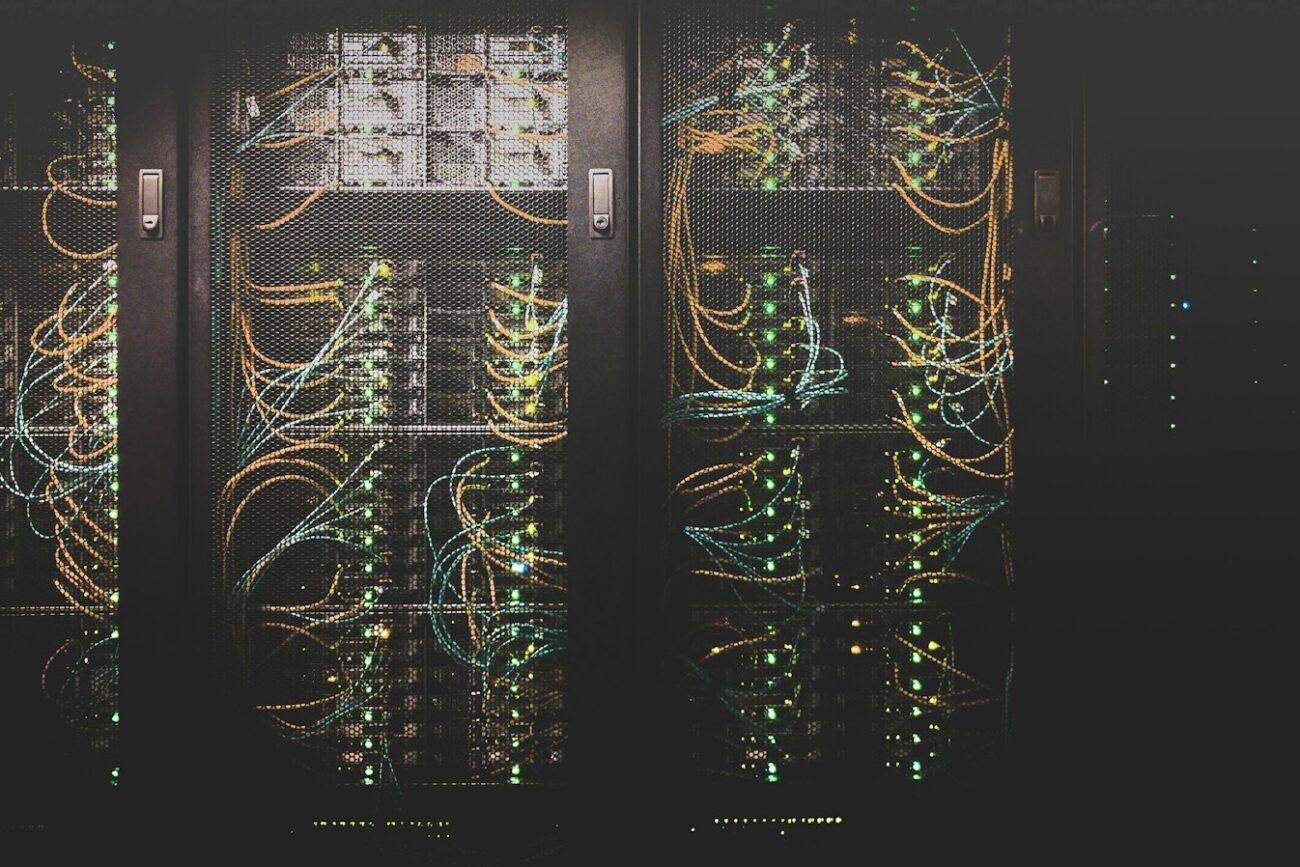
Featured image: “cable network” by Taylor Vick, photographed at the University of Washington, Seattle, in 2019; used under the Unsplash License. Illustrative photograph, not a facility identified in the November 2026 rule. Resized for web display; no other editorial modifications. Diagram: original IDHUS illustration.