
Smart waste collection is one of the most frequently cited examples of smart city technology delivering measurable returns. Fill-level sensors fitted to bins transmit real-time data to a central platform, which then generates optimised collection routes, dispatching vehicles only when containers are approaching capacity rather than on a fixed schedule. The result, in theory: fewer unnecessary collections, lower fuel costs, reduced emissions, and cleaner streets.
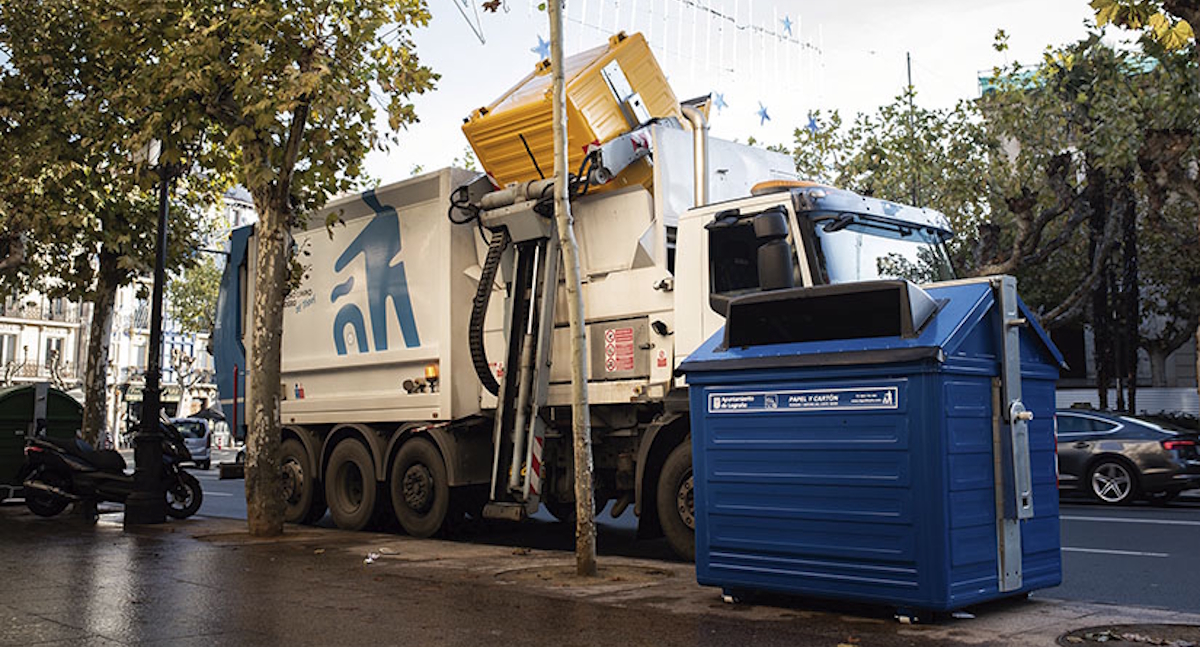
In practice, the technology works. The question is not whether smart waste collection is technically viable — it is. The question is whether it is viable for a specific city, with its specific infrastructure, fleet, budget, and operational context. And that is a very different question.
What the technology actually involves
Before assessing viability, it is worth being precise about what “smart waste collection” means at the implementation level, because the term covers a wide range of technical configurations. The core components of a typical system are:
Fill-level sensors. Ultrasonic or infrared sensors installed inside bins measure the fill level at regular intervals (typically every 1–6 hours) and transmit the data via a low-power wireless network (most commonly NB-IoT or LoRaWAN). Battery life for modern sensors ranges from 5 to 10 years without replacement.
Connectivity infrastructure. The sensors need a network to transmit data. NB-IoT uses existing mobile network infrastructure; LoRaWAN requires dedicated gateways deployed across the city. The choice between them is one of the first viability questions — it depends on existing network coverage and the municipality’s willingness to own or rent gateway infrastructure.
A data platform. The sensor data feeds into a software platform that aggregates fill levels across the entire bin network, generates collection alerts, and — in more sophisticated implementations — produces optimised routing recommendations for collection vehicles.
Fleet integration. For the routing optimisation to deliver value, collection vehicles need to receive and follow dynamic route instructions. This requires either a mobile interface for drivers or integration with existing fleet management systems.
Each of these components has its own cost, its own implementation complexity, and its own set of prerequisites. A feasibility assessment needs to evaluate all four — not just the sensors.
The economic case: where it works and where it doesn’t
The business case for smart waste collection rests on one core claim: by eliminating unnecessary collections (bins that are collected before they are full), the system reduces operational costs enough to justify the investment in technology.
This claim holds — but only under specific conditions.
Fleet size and collection frequency are the primary variables
The economic return from dynamic routing is directly proportional to the number of unnecessary collections currently being made. A city that collects bins on a daily schedule, regardless of fill level, has a large pool of inefficiency to recover. A city that already optimises its routes manually — or that has low collection frequency — has much less to gain.
As a rough benchmark: cities with high-density bin networks (above 1,000 managed containers) and frequent fixed-schedule collection (daily or every two days) tend to see cost reductions of 20–40% in collection trips within the first year of deployment. For smaller networks or lower-frequency collection, the savings are proportionally smaller and the payback period longer.
Distance and fuel costs amplify the return
In cities where collection routes are long — either because of geographic spread or because bins are dispersed across a large area — the savings per avoided collection are higher. Urban fuel and vehicle costs in Western Europe typically make each avoided collection trip worth €15–40 in direct costs. Multiply that across a fleet operating 250 days a year, and the numbers become significant quickly.
In denser cities with shorter routes, the per-trip saving is lower, and the economic case needs to be built on a larger volume of avoided collections to reach the same return.
The investment cost varies enormously by configuration
A basic deployment — sensors only, with a SaaS platform subscription and no fleet integration — can be implemented for as little as €30–60 per bin per year (sensor amortisation plus platform fee). A full deployment with custom platform development, fleet management integration, and dedicated connectivity infrastructure can cost five to ten times more.
This range means that the configuration choice is itself a feasibility decision. The right question is not “can we afford smart waste collection?” but “which configuration delivers a positive return given our specific fleet size, route structure, and existing infrastructure?”
The five conditions that determine feasibility
Based on the economic and technical dimensions above, five conditions consistently determine whether a smart waste collection project is viable in a given context:
- A bin network of sufficient scale
Below approximately 300–400 managed containers, the fixed costs of platform deployment and connectivity infrastructure are difficult to amortise through operational savings alone. Smaller municipalities can address this through shared deployments — pooling with neighbouring municipalities to reach a viable aggregate scale — or through SaaS-only configurations that eliminate upfront platform investment.
- Current collection inefficiency
If the municipality already has a well-optimised manual routing system, the headroom for improvement is limited. A preliminary audit of current collection patterns — how often bins are collected below 50% capacity — is the fastest way to quantify the actual saving potential before committing to any technology investment.
- Connectivity coverage
NB-IoT coverage in the deployment area needs to be verified before sensor selection. In areas with gaps, LoRaWAN is a viable alternative, but it requires upfront gateway investment. In some rural or peri-urban contexts, neither network achieves adequate coverage without infrastructure investment that materially changes the economics.
- Fleet management compatibility
If collection vehicles already use a fleet management system, the value of dynamic routing can be unlocked with relatively low integration effort. If there is no existing system, either a new one needs to be introduced alongside the sensors (which adds cost and change management complexity) or routing optimisation needs to be delivered through a simpler driver-facing mobile app, which reduces the sophistication of the optimisation.
- Institutional and operational readiness
This is the condition most frequently underestimated in technology assessments. Smart waste collection changes how collection teams work. Drivers accustomed to fixed routes need to adapt to dynamic ones. Dispatchers need to trust algorithmic routing recommendations. Operations managers need to interpret platform data and act on it. The technology is only as effective as the organisation’s willingness and capacity to use it. A deployment that technically succeeds but operationally fails — because drivers ignore the dynamic routes, or because the platform data is never reviewed — delivers no return at all.
When the answer is “not viable” — and what to do instead
Not every municipality will meet these conditions. A small city with a well-managed manual collection system, limited bin density, and no existing fleet management infrastructure may find that the economic case for full smart waste collection simply does not hold at its scale.
This is not a failure of the technology. It is a valid feasibility conclusion — and it is exactly the conclusion that should be reached before investing, not after.
In these cases, there are typically two productive paths:
Partial deployment for high-priority zones. Rather than city-wide deployment, sensors are installed only in the highest-density or most problematic areas — city centres, markets, tourist zones — where collection inefficiency is highest and the return per sensor is greatest. This reduces upfront investment, validates the system locally, and creates a data-based case for wider rollout if the results justify it.
Shared infrastructure models. Several smaller municipalities joining a shared platform and connectivity infrastructure can reach the scale needed for a viable business case that none of them could achieve independently. This model is increasingly common in Spain, France, and the Netherlands, often facilitated by regional government or through shared service agreements.
What a feasibility study for smart waste collection should cover
If you are a municipality or waste management operator considering this technology, a rigorous feasibility assessment should address the following questions before any procurement process begins:
- Current collection audit: What percentage of collections are made with bins below 50% capacity? What is the current cost per collection trip?
- Network sizing: How many managed containers are in scope? What is the density distribution across the city?
- Connectivity assessment: What is the NB-IoT coverage in the deployment area? Is LoRaWAN a viable alternative, and at what cost?
- Platform options: What SaaS platforms are available at your scale, and what is the total cost of ownership over 5 years?
- Fleet integration: Is there an existing fleet management system? What is the integration cost and timeline?
- Economic modelling: Given current collection frequency and route costs, what is the projected saving per year under different deployment configurations? What is the payback period?
- Operational readiness assessment: What change management process is needed to ensure the technology is actually used as designed?
These questions do not require a technology vendor to answer them — they require independent analysis. A vendor will answer them in the way that supports the sale of their product. An independent feasibility study answers them in the way that supports your decision.
The bottom line
Smart waste collection with IoT sensors is a mature, proven technology. For cities and operators with the right conditions — sufficient bin network scale, meaningful collection inefficiency, adequate connectivity, and operational readiness — it delivers measurable returns and a positive economic case within 3–7 years depending on configuration.
For cities that do not meet those conditions, the right answer is not to deploy anyway and hope for the best. It is to understand exactly which conditions are missing, what it would take to address them, and whether a partial or phased approach changes the viability picture.
That is what a feasibility study is for. And it is a conversation worth having before the procurement process starts — not after.
IDHUS conducts smart city feasibility studies for municipalities and urban operators. If you are evaluating a smart waste collection system for your city, we can provide an independent assessment of whether the conditions for viability exist in your context — and what the options are if they don’t. Get in touch.