
China is entering a decisive phase in its modern development, one in which the future of its cities will largely determine the country’s economic resilience, social cohesion, and environmental sustainability. At a moment when the limits of rapid growth are becoming increasingly visible, urban policy has emerged as one of the most strategic instruments of national transformation. The 15th Five-Year Plan captures this shift by redefining how space, population, and productivity are organized across the world’s most populous nation, offering a vision that goes far beyond construction and expansion. What is at stake is not only the redesign of China’s urban map, but the attempt to align modernization with balance, efficiency, and long-term stability in an era of profound economic and technological change
China is embarking on one of the most far-reaching territorial and urban transformation efforts in its modern history, signaling a decisive shift in how the country conceives development, space, and social balance. The 15th Five-Year Plan, which will shape China’s economic and social trajectory in the coming years, places urban development, land-use governance, and regional integration at the core of the national modernization strategy. This agenda emerges at a critical juncture, defined by the transition toward a more innovation-driven economic model, the accumulated pressures of rapid urban expansion, and the strategic need to address structural imbalances that have taken shape over decades. In response, Chinese policymakers have articulated a long-term urban vision centered on efficiency, sustainability, technological sophistication, and systemic coordination between cities and regions.
Since the late twentieth century, China has experienced one of the fastest and most extensive urbanization processes ever recorded, transforming a predominantly rural society into a largely urban one within a few decades. This transformation has generated extraordinary economic growth, lifted hundreds of millions out of poverty, and positioned cities as engines of industrialization, trade, and innovation. However, the spatial distribution of this growth has been deeply uneven, with the eastern coastal corridor from the Pearl River Delta to the Yangtze River Delta consolidating its role as the primary driver of national prosperity, while vast inland and northeastern areas lagged behind. These disparities have become entrenched in infrastructure quality, employment opportunities, income levels, and access to public services, creating long-term developmental challenges that now require systemic correction.
The 15th Five-Year Plan explicitly seeks to rebalance this trajectory by promoting a more rational distribution of productive forces and by activating the latent potential of regions that have historically played a secondary role in national development. The guiding principle articulated in official policy documents is complementarity, an approach that emphasizes functional differentiation among regions rather than direct competition, encouraging each area to develop according to its comparative advantages while remaining deeply interconnected with the broader national system. In this framework, territorial cohesion and interregional connectivity are not viewed as constraints on growth, but as essential conditions for sustainable and resilient modernization.
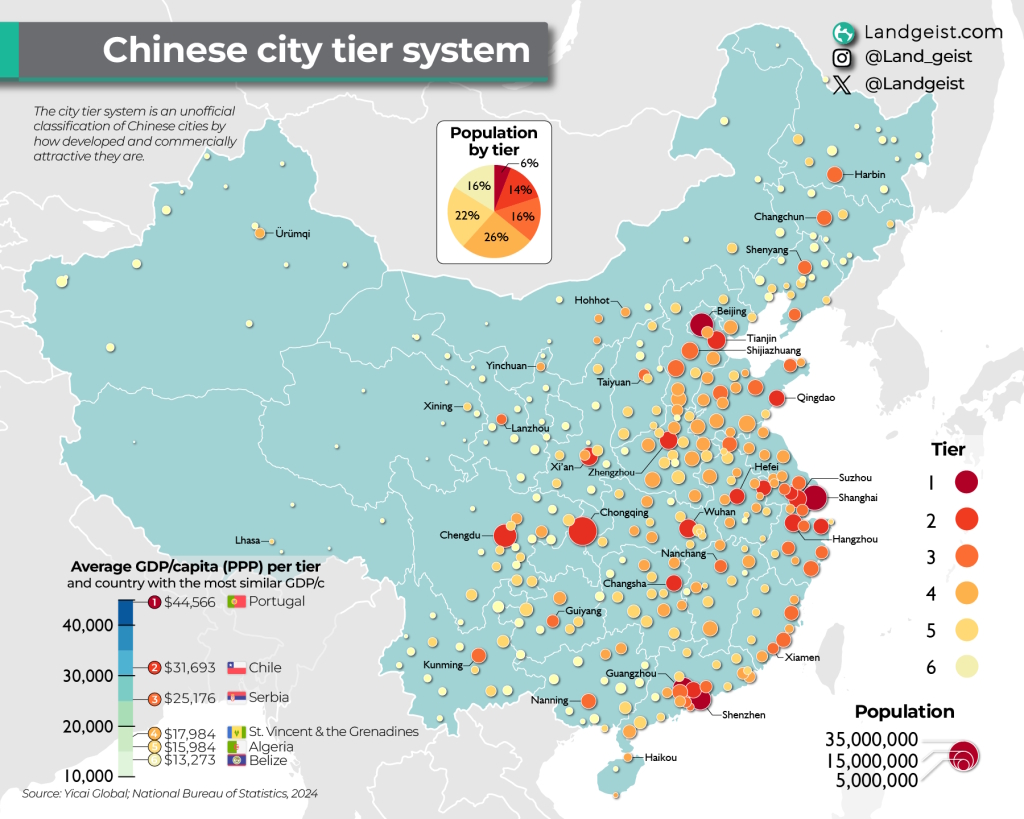
Cities occupy a central position within this reorganization of space and development priorities. They are conceived not merely as population centers, but as strategic platforms that concentrate innovation, logistics, advanced services, and industrial upgrading. Urban areas are expected to function as nodes that link domestic economic dynamics with global networks, facilitating the flow of capital, technology, talent, and information while anchoring regional development strategies. The plan therefore reinforces the idea that urban policy is inseparable from national economic governance.
At the regional level, the plan outlines differentiated development pathways aligned with the specific characteristics of China’s major macro-regions. The western regions, endowed with abundant natural resources but historically constrained by limited infrastructure and connectivity, are set to receive substantial investment aimed at improving transport networks, energy systems, and industrial foundations. The northeastern region, once the industrial backbone of the country, is targeted for deep technological restructuring and industrial renewal in order to overcome stagnation and adapt to new production paradigms. The central region, benefiting from its geographic position, is expected to strengthen its role as a strategic corridor linking the dynamic coastal economy with the interior. Meanwhile, the eastern region, long established as China’s growth engine, is encouraged to move decisively toward higher value-added activities, greener production models, and more sustainable urban forms.
In parallel, the Chinese government continues to consolidate several major urban clusters that already operate as national economic locomotives, recognizing their role in driving innovation, productivity, and international engagement. The Beijing Tianjin Hebei region is tasked with rebalancing functions between the capital and surrounding cities while strengthening advanced services and governance capacity. The Yangtze River Delta, with Shanghai at its core, is positioned as a global hub for finance, technology, and high-end manufacturing. The Guangdong Hong Kong Macao Greater Bay Area is envisioned as a frontier zone for innovation, cross-border cooperation, and integration with global markets. These clusters are complemented by emerging projects such as the Xiong’an New Area, designed as a model of future-oriented, ecological urbanism, and the Chengdu Chongqing economic circle, which aspires to anchor a new center of growth in western China.
Urban expansion under the 15th Five-Year Plan is subject to far stricter territorial discipline than in previous decades. China’s leadership has made clear that the era of unchecked spatial growth is coming to an end, replacing it with a framework that prioritizes land efficiency, ecological protection, and long-term resource security. Agricultural land is to be safeguarded as a strategic asset, urban sprawl is tightly constrained, and ecologically sensitive zones receive reinforced protection. This shift reflects a broader reassessment of the costs associated with extensive urbanization and acknowledges the environmental and social limits of past development models.
The objective is to promote a more compact, efficient, and resilient pattern of urban growth. To achieve this, the central government plans to grant provincial and local authorities greater autonomy in land-use management, allowing decisions to be better aligned with local conditions while remaining consistent with national priorities. This recalibration of governance seeks to balance flexibility with control, ensuring that development remains responsive without sacrificing strategic coherence. It also responds to growing concerns about the interaction between urbanization, industrial expansion, and environmental sustainability.
A defining feature of the new plan is its emphasis on a people-centered model of urbanization. Urban development is no longer measured solely by physical expansion or economic output, but by its capacity to improve living standards and social inclusion. Central to this approach is the reform of the household registration system, known as hukou, which for decades has limited the access of rural migrants to full urban public services. The plan commits to integrating these populations more fully into city life, granting access to education, housing, healthcare, and social security in the cities where they actually live and work, thereby addressing a major source of social inequality.
Large metropolitan areas such as Beijing, Shanghai, and Shenzhen are also required to modernize their governance structures in order to manage congestion, housing affordability, mobility, and environmental pressures more effectively. At the same time, the plan promotes the development of medium-sized and smaller cities, as well as district-level urban centers, in order to create a more balanced and resilient urban network. This multi-tiered approach aims to reduce excessive concentration while enhancing the overall functionality of the national urban system.
Urban regeneration emerges as a key priority within this strategy. Rather than relying on outward expansion, cities are encouraged to renew existing neighborhoods, upgrade aging infrastructure, modernize public services, and deploy digital and smart technologies to improve spatial management and service delivery. The shift from extensive to intensive development reflects an effort to restore the human scale of urban life, improve efficiency, and enhance environmental performance.
Taken as a whole, the 15th Five-Year Plan articulates a comprehensive and forward-looking vision of China’s urban future. Cities are positioned as fundamental pillars of a more balanced, equitable, and sustainable national development model, and the unprecedented scale of China’s urbanization is reframed as an opportunity to secure long-term prosperity rather than a source of systemic risk. The plan underscores a commitment to modernization that integrates economic dynamism with social cohesion and environmental responsibility, redefining the country’s urban landscape for the decades ahead.