

Z.ai’s new GLM-5.4 explores greater computational depth through shared model layers. For smaller businesses, the release offers a useful way to distinguish architectural progress from proven improvements in the speed, reliability and cost of everyday work.
A new AI model is often introduced through a larger number: more parameters, a longer context window or a higher benchmark score. GLM-5.4, announced by Z.ai on 23 November 2026, invites attention to a different dimension: how much processing a model performs with the parameters it already has. Its defining idea is to run a shared group of layers more than once. For a small business evaluating AI services, this is useful context even if the architecture remains hidden behind a subscription. The same apparent model size can conceal different amounts of computation, and a shorter response need not mean that less work happened inside the system.
The immediate availability is more specific than the phrase “new model release” might suggest. Z.ai’s ZCode release notes for version 4.0.0, dated 23 November, confirm GLM-5.4 in the Coding Plan and describe added vision capability. The current Coding Plan documentation, checked on 25 November, also lists it among supported models. Those records establish a route to use the service; they do not establish that every integration, workload or deployment option is ready. Understanding the release therefore requires separating the architectural proposal, the product through which it is delivered and the evidence needed to judge its practical value.
A deeper computation without a second copy of the weights
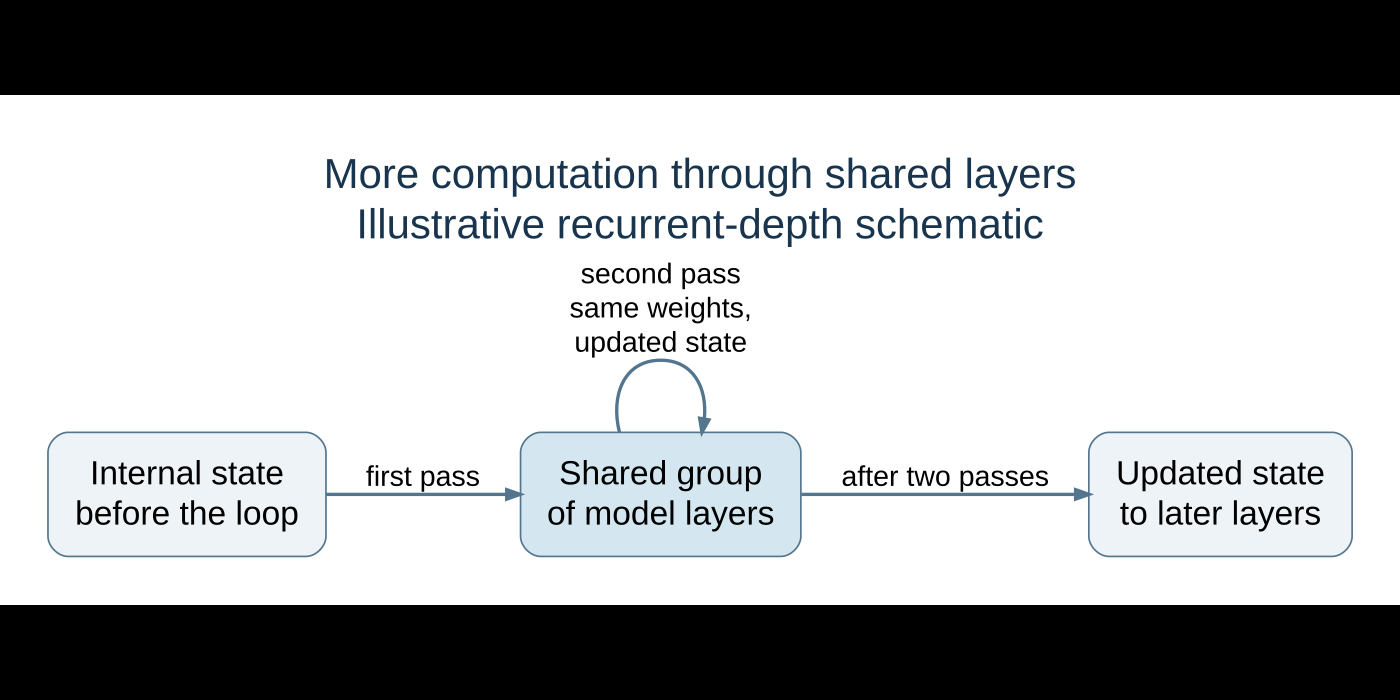
According to Z.ai’s technical announcement, GLM-5.4 runs 28 layers of the GLM-5 base model for two iterations, reusing their weights while updating internal representations. An intuitive distinction is between a set of learned instructions and the changing material those instructions process. Reusing the instructions does not mean feeding the second pass exactly the same information: the internal state has already been transformed. Equally, it does not mean that the model learns a fresh set of permanent weights each time someone submits a request. The loop concerns computation during use, rather than a new round of ordinary model training on each customer’s task.
The principle has a longer history. The Universal Transformer research introduced in 2018 explored recurrent processing depth and shared transformations, including a mechanism for varying how long different positions were processed. That work provides a conceptual predecessor, not an interchangeable specification for GLM-5.4. Its importance here is the distinction it helps readers make: storing more learned parameters and applying transformations more times are different ways to increase a model’s computational capacity. Neither description alone tells us how well a particular commercial system will solve a particular business problem.
The diagram below deliberately reduces the idea to one shared block. It shows a changing internal state passing through the same group of layers twice, rather than two separate groups containing different weights. It is not a complete wiring diagram of GLM-5.4 and does not show its attention mechanisms, surrounding layers or serving infrastructure. This simplification is useful because it isolates the central trade-off. Parameter reuse can avoid adding another copy of those learned weights, while the repeated execution still requires work. An architectural economy in stored parameters should not be read as a promise of free computation or a proportional reduction in a customer’s bill.
Internal depth is different from a longer conversation
A coding assistant can also appear to “think again” by writing more text, running a test or asking another model to review a proposal. Those are observable steps in a larger workflow. A recurrent-depth model adds processing within the model itself. The two approaches can coexist, but they are not the same mechanism. This distinction matters when interpreting a demonstration: a successful result might depend on the model’s internal computation, the tools around it, repeated attempts or information supplied by a person. Observing the final answer alone does not identify how much each component contributed.
Theoretical work makes the attraction of repetition clearer without proving a product claim. In Looped Transformers as Programmable Computers, published at ICML in 2023, researchers constructed looped networks with specific weights to emulate computational operations and iterative algorithms. That is evidence about what deliberately constructed networks can represent, rather than a measured guarantee about a large pretrained assistant. The distinction is essential. A mechanism can be computationally expressive and still require effective training, suitable data and robust implementation before it produces dependable answers on unfamiliar tasks.
For a business reader, the practical consequence is to stop treating visible verbosity as a reliable measure of effort or quality. An answer could become shorter because a system performs more useful work internally; it could also become shorter because it omits necessary detail. Conversely, a long explanation might contain a genuine investigation or merely repeat an error. The appropriate judgement concerns the result and its verification. For an illustrative invoice-import script, that means whether the transformation preserves identifiers, handles missing fields and reports exceptions correctly, rather than whether the assistant produces an impressive account of its reasoning.
The engineering must make repetition affordable
Z.ai’s launch explanation describes gated updates to stabilise repeated processing, a hybrid cache design and reuse of sparse-attention indices. These are supplier-described engineering choices, not independently reproduced performance findings. Their wider significance is that looping cannot be assessed in isolation from the machinery that supports it. Repeated computation has to move information through hardware and manage the state required by the model. A promising mathematical idea can become impractical if its implementation creates excessive memory traffic, waiting time or operating cost.
That observation changes how efficiency claims should be read. Parameter count concerns learned weights; the time needed to complete a request also depends on the work performed, the length of the input and output, and how the service is operated. A buyer cannot infer that a model with fewer unique parameters will necessarily respond faster than a larger one. Nor can a reported output-generation rate establish how long a complete task will take, including waiting for the first response, calling tools, reviewing failures and making corrections. These are different measurements and should remain separate when a company compares services.
The provider’s announcement also acknowledges a tendency towards excessively long reasoning and describes further adaptive computation as an area being explored. That qualification should remain attached to the promise of greater depth. More processing is valuable when it improves an outcome enough to justify its cost; it can be unhelpful when a straightforward request becomes a prolonged exercise. For small teams, the meaningful question is whether difficult tasks become more dependable without making routine work inconvenient. That balance needs observation under actual operating conditions, rather than an assumption that additional internal steps are always beneficial.
Availability and evidence need separate checks
At the time of writing, the launch page lists a general API as coming soon and says a weights release is planned after safety hardening. Neither statement should be converted into a claim that a business can already download the model or integrate that API into production. A subscription route is a different access arrangement. The plan documentation describes usage credits, rolling five-hour and weekly limits, and different charges for input, cached input and output. Consequently, a headline allowance does not by itself specify how much useful work a particular customer will complete.
The architectural evidence requires similar care. The launch discusses a controlled comparison using a smaller model; it should not be treated as a direct measurement of the flagship against every competing commercial system. A controlled experiment can help isolate a mechanism, while a product comparison asks a broader question involving training, configuration and the surrounding workflow. No independent reproduction of the flagship’s claimed superiority was established in the sources checked for this article. That is a limit on the conclusions available here, not proof that the design lacks merit. It leaves room for a technically interesting release without declaring a universal winner.
What a smaller company can learn from the release
A useful evaluation would connect a model change to a bounded task with an answer that can be checked. For example, a small software supplier could compare proposed fixes against the same existing tests, record the time to a reviewed solution and examine whether new regressions appear. This is an illustrative evaluation approach, not a reported deployment or a claim that GLM-5.4 will outperform the incumbent. Keeping the task and acceptance criteria stable would make any difference easier to interpret. It would also reveal whether a convincing demonstration survives contact with the company’s own dependencies and unusual cases.
GLM-5.4 matters because it makes another dimension of model progress visible: the organisation of computation inside a network. Reusing layers can deepen processing without simply duplicating their parameters, but that mechanism does not settle questions of reliability, availability or commercial value. Those depend on training, implementation and evidence from use. Readers following AI developments can therefore take two things from this release at once: an architectural idea worth understanding, and a reason to ask more precise questions about what improvements have actually been demonstrated. For a smaller business, that combination is more useful than choosing a model solely because its launch claims a new category of intelligence.
Featured image: Coding, by Christopher Gower, published 21 June 2017, under the Unsplash License. Resized for web. Historical illustrative photograph, not a screenshot of GLM-5.4.