

FreshBooks' new ChatGPT connection lets owners question live business records without changing them. For small firms, its promise lies in clearer financial reviews—provided the company, period, evidence and responsibility for decisions remain explicit.
For a small-business owner, understanding the accounts can be a separate job from keeping them. The information may already exist in an accounting system, yet answering a practical question still requires finding the relevant report, choosing a period and interpreting what the figures include. On 19 November, FreshBooks announced its connection to ChatGPT for Accounting, offering owners a conversational route into their own financial records. The important detail is a limit: the connection retrieves information but does not change the FreshBooks account. It brings the possibility of a different relationship with the books—more frequent questions and explanations—without making the conversation the place where the official records are maintained.
That boundary gives the launch particular relevance to smaller organisations. A sole trader or a business with a small administrative team may want help understanding overdue invoices or identifying missing documentation before considering broader automation. A read-only connection could support that work, but it does not establish that an answer is complete, that a suggested interpretation is correct or that a decision should follow automatically. The opportunity is to make financial information easier to examine. The organisational challenge is to preserve the connection between an accessible explanation and the records, context and judgement that make it trustworthy.
A conversation is an interface, not a second ledger
The FreshBooks support documentation says the plugin can answer questions about live account data, with access limited by the user’s role. It also explains that connecting a login connects the active businesses associated with it. That is an important practical distinction for anyone who manages more than one organisation. A prompt that asks how “the business” is doing may be natural in conversation but insufficiently precise in a shared or multi-business environment. Naming the organisation, period and question should become part of the working habit rather than something left for the system to infer.
The easiest way to understand this arrangement is as another route to information held elsewhere. An owner may ask a question in everyday language; the connected service retrieves permitted information; the AI constructs a response. The source system remains the place to inspect the underlying transactions and correct the books. This interpretation is different from imagining that a chatbot has become the accountant or that every accounting workflow is now autonomous. It also makes mistakes easier to locate: a problem may concern missing records, the scope of retrieval, a calculation or the explanation built around the result.
FreshBooks describes examples including questions about missing receipts and overdue invoices. The useful next step is not to treat those examples as proof that every query will be answered reliably, but to select a narrow question whose answer can be checked. An owner who already knows which invoices remain outstanding could compare the response with the source report. That small exercise would reveal whether the question identifies the right business and date, whether the returned items are relevant and how much effort verification requires. It is a test of a working process, not a demonstration of general financial intelligence.
Better questions begin with the records
A conversational interface can lower the effort of asking a question while leaving the difficulty of defining it intact. Consider an illustrative design studio whose owner wants to know why recent work has not produced the expected cash. The studio could have unpaid invoices, payments recorded in a different period or work that has not yet been invoiced. A broad request for an explanation might produce plausible commentary without establishing which of those situations applies. A more useful enquiry would specify the relevant dates and ask for the records supporting each part of the answer, followed by a discussion with the person who knows the business.
This distinction is especially important when an answer moves from description to explanation. A change in a reported amount may be visible in the records; the reason for that change may require knowledge of a contract, a delayed project or an arrangement with a customer. The AI should not be allowed to fill that gap with a confident business story. An owner can instead ask it to separate what the available records show from what remains unknown. That approach makes the missing context visible and gives a bookkeeper or adviser a more focused question to resolve.
The same principle applies to preparation for recurring reviews. OpenAI’s guidance for accounting work describes drafts grounded in records and templates, with checks on calculations, assumptions and commentary before reports are shared. It distinguishes the permissions needed to read information from those needed to enter records. For a small firm, that suggests a useful division of labour: use AI to organise an initial view and identify items requiring attention, while keeping the responsible person close to the original evidence. A well-written summary is valuable only if it makes that evidence easier to examine.
Read-only access still deserves a deliberate choice
Read-only is a meaningful restriction on what this connection can do, but it does not make the information unimportant. Financial records may contain customer identities, supplier details and commercially sensitive information. The relevant question is therefore not only whether the AI can change the books. It is also which person has connected the account, what their role permits, which organisations are included and whether the resulting use fits the firm’s arrangements with its staff, clients and advisers. Those questions are manageable for a small business when access is treated as an ordinary operational decision rather than a minor installation step.
The Australian Cyber Security Centre’s small-business guidance on AI recommends considering how information is stored and used, verifying important outputs and limiting the authority given to tools. Applied here, the practical implication is to understand the connection and its permissions before relying on it. That does not require assuming that every AI service handles data in the same way. It requires checking the actual provider, account settings and current terms instead of transferring expectations from an unrelated product. The ability to retrieve live information and permission to use it for a particular purpose are different questions.
Availability is also specific to the product rather than implied by a global launch headline. FreshBooks lists supported regions in its documentation, including Europe, the United Kingdom, North America and several Asia-Pacific markets. A firm should still confirm its own eligibility and the access offered by its account before building a recurring process around the feature. Subscription charges, usage limits and the time spent reviewing results belong in an assessment of cost. The announcement is not evidence of a particular saving, and no return on investment can be inferred from the existence of the connection alone.
The real test is the quality of the review
For a small organisation, the first useful experiment could be deliberately modest. In an illustrative pilot, the owner and bookkeeper might choose one completed period, ask the same limited questions they normally answer and compare the output with the existing reports. They could record which answers were correct, where information was missing and how much checking or correction was needed. The aim would be to learn whether the conversational route makes a familiar task easier without reducing confidence in the result. Starting from work that can already be verified gives the firm a reference point.
The comparison should include the whole task. A response that appears quickly may still require considerable effort to trace its figures or rewrite its explanation. Conversely, a response that does not automate a single entry could be useful if it helps an owner arrive at a meeting with clearer questions and the relevant records already identified. These are different forms of value and should be assessed separately. The meaningful outcome is not the amount of text produced, but whether the process improves understanding, reduces avoidable searching or helps resolve an issue more reliably.
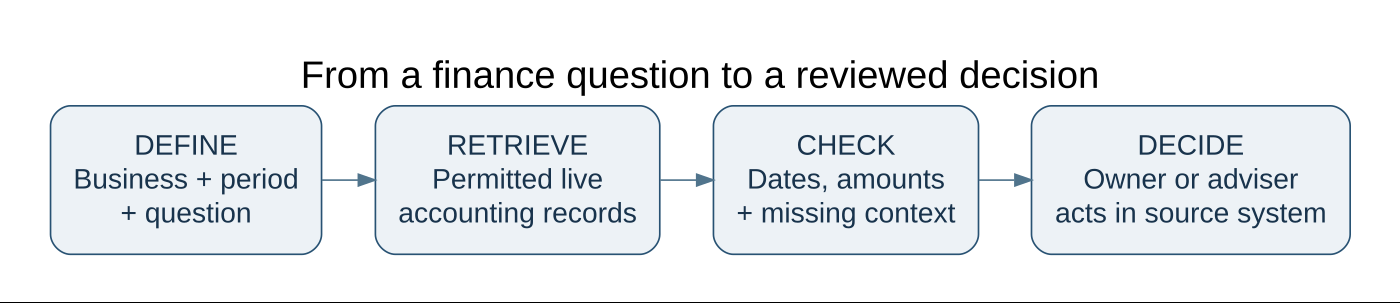
That is also why human review needs a defined purpose. Asking someone to approve a polished summary without the time or source material to examine it creates a weak control. A stronger arrangement gives the reviewer the relevant company, period, supporting records and explicit uncertainties. The diagram below is an original editorial model of that workflow, not a claim about an automatic product feature. It keeps the decision in the source business process rather than allowing a conversational answer to become an unofficial instruction to change the accounts.
A smaller step can be the more useful one
The wider significance of the FreshBooks launch is not that small businesses can stop understanding their finances. It is that access to an explanation may become less dependent on knowing which screen or report to open first. That could help an owner participate more actively in a discussion with an adviser, provided the explanation remains open to challenge. It may also change what the adviser is asked to do: less time locating an obvious item, potentially more time explaining an exception or deciding what the records fail to capture. These are possibilities to test, not outcomes established by the announcement.
The boundary between assistance and authority remains central. A tool can help retrieve information, organise a question and prepare a first interpretation while leaving corrections and decisions to the people responsible for them. For a resource-constrained business, that is a substantial application of AI even if it never posts a transaction. The best reason to adopt it would be evidence that it improves a real routine at an acceptable cost, with clear access and review arrangements. The conversation should bring the owner closer to the books, rather than make the underlying records harder to see.
Featured image: accounting paperwork and a smartphone by Kelly Sikkema, published 2 April 2019, under the Unsplash License. Illustrative photograph, not a screenshot or endorsement of FreshBooks or ChatGPT. Resized for web display; no other editorial modifications.