
The IEA’s latest outlook brings the electricity system into the centre of AI infrastructure planning. Understanding the difference between capacity, consumption and a usable grid connection reveals why buying accelerators is only one part of making computing available.
The expansion of artificial intelligence is often pictured as a succession of more powerful chips and larger clusters. Yet a computing facility becomes useful only when the equipment can be supplied with electricity reliably, at the place and time it is needed. The International Energy Agency’s World Energy Outlook 2026, published on 19 November, makes that physical dependence difficult to overlook. Its discussion of data centres puts existing aggregate capacity across all types at 120 gigawatts, with another 120 GW built by the end of the decade in its Stated Policies Scenario. More than three-quarters of that addition is intended for AI-optimised servers. These are different categories: the existing total is not exclusively AI, and the additional capacity is a scenario outcome rather than completed infrastructure.
The implications extend across the AI value chain. An accelerator shipment, a completed building and an energised site are different milestones. Each can advance while another remains constrained. For a reader following AI services rather than constructing a data centre, this explains why a product announcement cannot establish future computing availability on its own. The analysis here concerns that chain of dependencies: how electrical capacity becomes operating capability, what demand figures do and do not measure, and why planning a connection is as consequential as planning a cluster.
A gigawatt is not an annual electricity bill
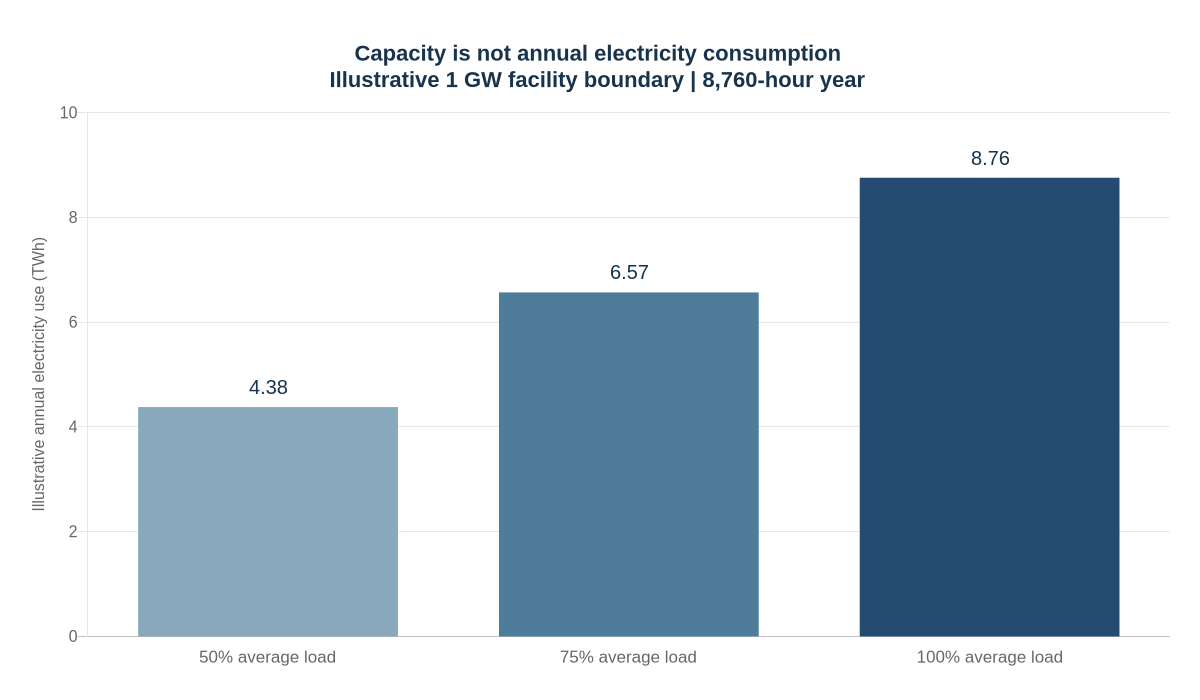
Power and energy answer different questions. A gigawatt describes a rate of electricity use or supply; a terawatt-hour describes an accumulated quantity over time. A facility capable of drawing a given amount of power does not necessarily draw that amount continuously. Equipment may be installed progressively, demand may vary and operations may spend time below their maximum. The illustrative calculation below holds the facility boundary constant at 1 GW and varies only its average draw over an 8,760-hour year. It is arithmetic to clarify the distinction, not a measurement of three real facilities or an estimate of the global fleet.
At an average draw equal to half that capacity, annual consumption is 4.38 TWh. At three-quarters it is 6.57 TWh; at continuous full draw it is 8.76 TWh. The formula is capacity in GW multiplied by hours and the average-load fraction, then divided by 1,000 to convert GWh to TWh. Here the boundary covers the whole facility, including its supporting systems, so no further multiplier for cooling or power delivery is added. The percentages are not GPU utilisation rates: the relationship between a processor’s workload and a whole building’s electrical demand is more complicated than that.
This distinction also limits comparisons between announcements. One developer may quote a planned electrical connection, another an IT-equipment allocation and another a site’s ultimate build-out. Those numbers cannot safely be treated as equivalent without examining their definitions. The Electric Power Research Institute’s discussion of annual and peak data-centre use notes the limited public reporting of actual electricity consumption. Capacity can therefore be useful evidence without being a substitute for operating data. Converting every announced gigawatt into a full year of maximum consumption would build an assumption into the result and disguise it as an observation.
The connection is a chain of physical dependencies
Electricity has to reach the equipment through an operating system of generation, networks and site infrastructure. At the facility, power conversion and distribution support the servers, while cooling removes the heat their operation produces. The US Department of Energy’s guide to energy-efficient data-centre design treats IT equipment, electrical systems and environmental control as related design concerns. The practical lesson is that installing one component does not establish readiness of the others. A project can possess valuable computing equipment and still lack a usable route from the electricity system to productive operation.
A power purchase arrangement and a physical connection also perform different functions. A commercial commitment concerning electricity supply cannot, by itself, create missing network capacity at a particular site. Conversely, an available connection does not settle every question about supply costs, emissions or resilience. Keeping these questions separate helps explain why several announcements may be necessary before a project becomes operational. In an illustrative development, the building could be ready before a network reinforcement is complete; a supply arrangement could be signed before all on-site equipment is commissioned. Neither sequence should be reported as completed computing capacity simply because one milestone has been reached.
The IEA’s explanation of its Stated Policies Scenario is relevant here. STEPS explores a pathway based on policies and the conditions surrounding their implementation; it is not a guarantee of what will be built. Interpreting its data-centre expansion therefore requires attention to the conditions that could enable or constrain delivery. The value of a scenario is to expose those dependencies, rather than remove uncertainty from them. For infrastructure analysis, the question is not only how much capacity appears in a projection, but what has to happen for that capacity to become usable.
A connection queue is not a construction forecast
The IEA’s earlier Powering Artificial Intelligence report describes a planning problem behind the headline demand figures: connection queues can contain speculative or duplicate projects. Overestimating eventual demand risks underused network investment; underestimating it risks delays and bottlenecks. A queue is thus evidence of requests and potential pressure, not a reliable sum of future operating sites. This does not make requests meaningless. It changes the questions planners and readers should ask about project maturity, credible timelines and the point at which a request becomes an obligation to deliver.
The economics are consequential because network decisions extend beyond a single building. A reinforcement justified by expected demand may serve several users and outlast the first tenant. If projects are delayed or abandoned, decisions about who bears the resulting cost become important. If necessary investment is postponed, a credible project may wait alongside less mature applications. These are possible planning consequences, not findings that every jurisdiction faces the same outcome. They explain why the quality of demand information matters: a large total of applications can be less useful than a smaller set of well-understood commitments with realistic construction and operating schedules.
For anyone assessing an AI infrastructure announcement, a more informative account would connect the milestones. It would distinguish a requested connection from an agreed one, a planned building from an energised facility and installed equipment from equipment serving workloads. Commercial confidentiality may limit what is disclosed, so uncertainty should remain visible. The absence of detail is not proof that a project will fail, but it is a reason to avoid presenting its ultimate capacity as already available. This discipline makes infrastructure reporting more useful than simply adding together the largest numbers announced by competing developers.
Flexibility helps only when the work can accommodate it
Demand need not always be treated as completely fixed. The IEA’s analysis of integration policies identifies approaches involving contributions to generation adequacy, network stability and flexibility, including arrangements described as bring-your-own-power. Those approaches address different constraints. Additional generation does not automatically remove a local network restriction, and reducing demand at a difficult time is not the same as permanently reducing annual consumption. The relevant benefit depends on where and when the electricity system is constrained, and on whether the operator can deliver the promised response.
An illustrative computing operator might defer a batch job within its delivery deadline, while another service must respond immediately to customers. Even a workload that can be delayed in principle may face practical dependencies on data, storage, network transfers or the availability of the same computing resources later. It would therefore be misleading to label all AI training flexible and all inference inflexible. The useful assessment concerns the actual workload and service commitment. Flexibility has value when it can be provided reliably without undermining the work the infrastructure exists to perform; it is not a universal escape from the need for adequate electrical systems.
Efficiency must retain a clear boundary
Facility efficiency requires another distinction. The Department of Energy guide defines power usage effectiveness, or PUE, as total annual facility energy divided by annual IT-equipment energy. It measures the relationship between the building’s total demand and the equipment it supports. It does not measure whether a model’s answers are correct or whether a computation was necessary. A lower ratio can be useful evidence about supporting infrastructure, while leaving the absolute amount of electricity consumed and the usefulness of the resulting work as separate questions.
For smaller businesses using hosted AI, these distinctions offer a way to understand the services behind the interface. They do not establish that any particular provider will raise prices, become unreliable or deliver promised capacity on time. They explain why availability and cost depend on more than model design. The grid connection, site systems, workload and operating arrangements must function together. The infrastructure story behind the latest IEA outlook is therefore a story of coordination: chips become useful computing capacity through a chain of physical and institutional commitments, and each link needs evidence before an announced future can be treated as an operating present.
Featured image: Power pylons at sunset, by Matthew Henry, published 8 September 2016, under the Unsplash License. Resized for web; historical illustrative photograph, not a specific data-centre project discussed in the report.