

Google's new model aims to balance demanding reasoning with practical task completion. Its results show why smaller firms should examine thinking settings, tool environments and review effort alongside benchmark scores before deciding what a model upgrade can deliver.
The next useful AI model for a business may not be the largest one a laboratory can build. It may be the model that can handle difficult recurring work with a more practical balance of reasoning, time and cost. Google introduced Gemini 4 Neon on 18 November around that proposition, emphasising software engineering, analytical work and the completion of complex tasks. The launch sits within a broader change in model development: progress is increasingly described through what a system can finish with tools, rather than only the quality of a single response.
For readers in smaller firms, that is a meaningful shift, but it creates a more demanding comparison. A model’s reasoning ability, its settings and the surrounding application all influence the result. A strong score does not establish that every product exposing that model will behave identically. Neon’s launch is therefore useful both as a technology update and as an example of how to read one: distinguish the model from its agent environment, distinguish an advertised capability from a tested workflow, and ask which part of an improvement would remain available in the product a business can actually use.
A new position between speed and depth
The Gemini 4 Neon model card says the model is adapted from Gemini 4 Carbon and positions it between Carbon’s demanding long-horizon work and Hydrogen’s faster everyday execution. That establishes a relationship within the family without explaining every detail of how the adaptation was performed. It would be unwarranted to turn that statement into a precise account of training, parameter counts or compression methods that the documentation does not disclose. The practical proposition is a different operating balance, not proof that one architectural technique alone produced the result.
Such a balance matters because enterprise work is uneven. Some requests are straightforward; others involve a long chain of interpretation, file inspection, revision and checking. Paying for the deepest available reasoning on every step may be unnecessary, while sending every step to a fast model may create more correction work. As an analytical interpretation, the value of a middle option is that it broadens the range of tasks that might be completed without immediately escalating to the most demanding configuration. Whether that happens in a particular firm remains an empirical question.
The developer documentation exposes four thinking levels—low, medium, high and xhigh—with high as the default. These are controls over how the service approaches a task, not four guarantees of correctness. The relevant experiment is whether a more intensive setting produces a better accepted result often enough to justify its additional time or resource use. A setting that performs well on a benchmark should be recorded as part of the model’s configuration, rather than silently treated as the performance of every request bearing the same model name.
The agent environment is part of the machine
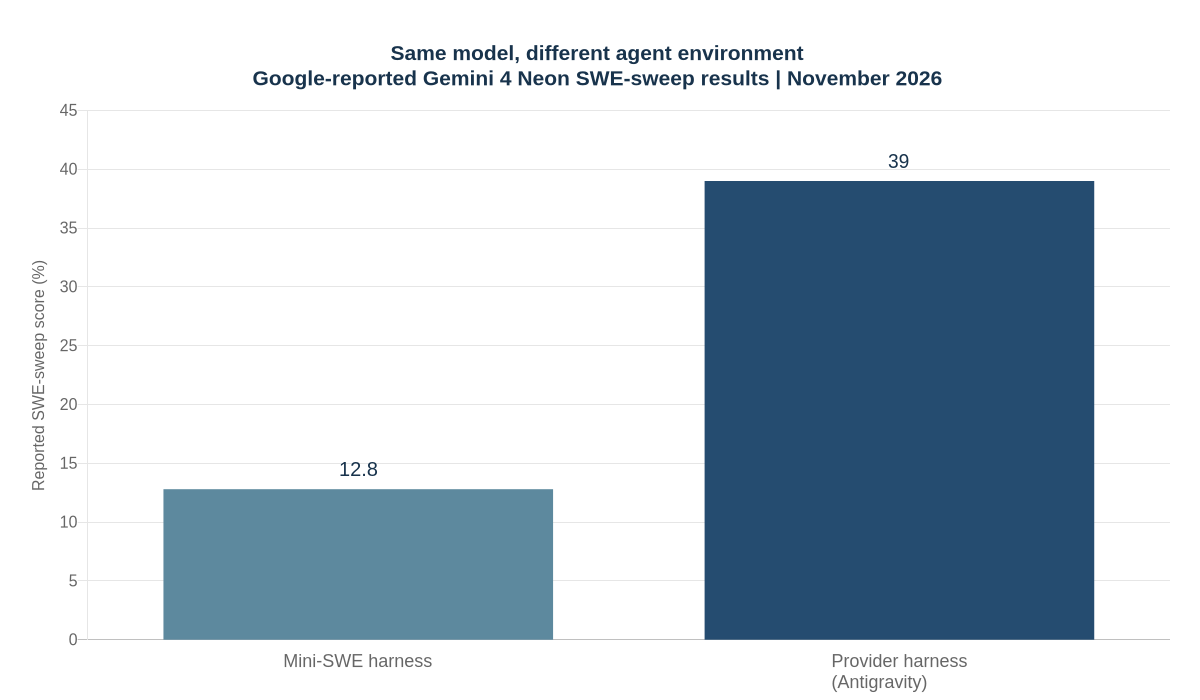
One of the most revealing results concerns the same model in different software environments. In Google’s published SWE-sweep table, Neon records 12.8 per cent with the Mini-SWE harness and 39.0 per cent with the provider harness. A harness is the surrounding software that gives an agent tools, instructions and an execution environment. Those numbers should not be read as a controlled experiment proving that one isolated model component became three times better. The environment changed, and the published result belongs to the combination of model and environment.
Google’s evaluation methodology identifies the provider setup as Antigravity-CLI 1.5.9 and describes a default tool that can delegate work across a codebase. It reports SWE-sweep using a subtask-weighted reward, while the Mini-SWE setting uses a different agent harness. This is precisely the kind of detail that can disappear when a benchmark table is reduced to a ranking. Tool access and orchestration are not incidental packaging around a pure intelligence score; they can change how the work is attempted and what resources the system brings to it.
The chart below shows that environment dependence without claiming an independent reproduction. For a small firm, the implication is concrete: buying API access to a model is not necessarily buying the behaviour demonstrated inside a specialised coding application. Building an equivalent workflow may require file access, a controlled execution environment, task management and a way to evaluate outputs. A model upgrade can improve the reasoning available to that system, but it does not automatically supply the rest of the system.
A large context window still needs a well-defined task
Neon’s API specification lists text, image, video, audio and PDF inputs with text output. Its context window is shared between input and output, with a maximum of 1,048,576 tokens. This is capacity for information within a request, not evidence that every item in a large collection will be understood equally well. Nor does multimodal input imply that this particular model generates every kind of media it can read. Those distinctions matter when a product description uses a broad term such as “multimodal” to cover very different capabilities.
An illustrative small engineering consultancy could want an assistant to compare a specification, diagrams and project notes before preparing a technical summary. A wider context window could make it possible to supply more relevant material together. Yet the business would still need to identify current versions, explain which document takes precedence and specify the output it wants. Otherwise the model may be given more information without a clearer basis for resolving contradictions. Context capacity can remove a constraint on the amount of material supplied; it does not remove the need to organise the question.
The useful technological advance is consequently broader than remembering a longer conversation. It concerns the possibility of working across several kinds of evidence while maintaining an extended task. But usefulness depends on whether the model preserves the important relationships, identifies uncertainty and produces something that can be checked. A firm evaluating long-context work should deliberately include conflicting revisions or missing information in its test set. Success should mean that the system handles the ambiguity appropriately, not merely that it accepts the files without an error.
Independent evidence helps, but the settings still matter
There is independent evaluation alongside the provider’s results. Artificial Analysis’s 18 November changelog reports Intelligence Index scores of 44, 55, 60 and 61 for Neon’s low, medium, high and xhigh settings respectively. That is evidence that reasoning configuration materially affects the observed score in that evaluation. It is not a scale on which a model scoring 60 is a fixed percentage more useful to a business than one scoring 44. An index combines particular tests, and an organisation’s own workload may emphasise a different mixture of abilities.
The methodological qualifications also extend across providers. Google says its Neon evaluations generally use the highest thinking settings unless an exception is noted, and that many competitor results come from the respective providers’ published numbers. Some benchmark results use external evaluators; others are self-computed. A careful reading therefore preserves the source, harness and effort level of each figure. The objective is not to reject comparisons altogether, but to avoid treating a mixed table as though every model had been independently tested under identical conditions in a single laboratory.
Limits remain even when performance improves. The model card acknowledges the possibility of hallucinations and gives a March 2026 knowledge cutoff, with some domains potentially less current. A connection to tools or current documents may help supply newer evidence, but that evidence still has to be interpreted correctly. For a business, the distinction between a model’s stored knowledge and information retrieved during a task is useful. It explains why a polished answer about a recent development needs a traceable basis rather than confidence inferred from the model’s release date.
The practical comparison is a completed, checked task
Access is distributed across several products rather than a single uniform experience. Google’s launch describes availability through the Gemini API, AI Studio, business channels, Antigravity and paid Gemini-app plans. The developer guide lists API pricing of US$3 per million input tokens and US$15 per million output tokens, with separate treatment for cached input. Those are published token rates, not the cost of a completed business task. Actual expenditure depends on the amount of work performed, the selected settings, repeated attempts and any surrounding services. Eligibility and current terms should be checked in the channel being considered.
A sensible evaluation would consequently compare a small collection of representative tasks using the environment the firm expects to operate. For an illustrative software team, that might include a known bug, a small change crossing several files and a case where the right response is to ask for clarification. Record the model version, thinking level, tools, elapsed time, charges and the review needed before accepting the output. This is an editorial proposal for testing, not a claim that Neon has already produced a particular saving. The same discipline helps identify whether a result comes from the model, a better workflow or an easier task.
Gemini 4 Neon illustrates an important direction of travel: laboratories are trying to make strong reasoning usable in frequent, extended work, with more explicit control over the resources devoted to it. The evidence is encouraging enough to justify evaluation, while still too specific to justify universal claims about productivity. For smaller firms, understanding that distinction is more valuable than memorising the latest ranking. The model is one component; the tool environment gives it a way to work, and the business’s checks determine whether the result is ready to use. Progress becomes practical when those three parts improve together.
Featured image: “Coding” by Christopher Gower, published 21 June 2017, under the Unsplash License. Historical illustrative photograph, not a screenshot of Gemini or Antigravity. Resized for web display; no other editorial modifications.