
The Geneva weapons conference has agreed to draft an international instrument over 2027–2028, while leaving its legal form unresolved. The compromise reveals how military competition, humanitarian concerns and consensus diplomacy shape the limits governments are willing to place on AI.
Governments have agreed to write an international instrument on autonomous weapons, but they have not agreed that it must become a binding treaty. That distinction is the central result of the November review conference of the Convention on Certain Conventional Weapons in Geneva. In its 21 November account of the outcome, Switzerland’s Federal Department of Foreign Affairs said the work would proceed in 2027–2028, with the instrument’s legal form left to be specified later. The agreement preserves a diplomatic process. It does not establish a new prohibition, settle the scope of future restrictions or guarantee that a treaty will emerge.
The result exposes a geopolitical tension that extends beyond the development of any individual weapon. States can agree that a technology requires international attention while disagreeing over how much freedom they should retain to develop and use it. In AI, the competition concerns rules and institutions as well as technical capability. A mandate to continue work may keep major powers in the room, yet its wording also determines which questions remain open and how long they remain open. Understanding the Geneva outcome therefore requires looking at the relationship between technological change, military incentives and the design of collective restraint.
Two readings of the same agreement
The Swiss government welcomed the mandate as progress achieved despite geopolitical tensions. It also acknowledged that consensus had not been possible on an immediate mandate for a legally binding instrument. The International Committee of the Red Cross’s statement of the same day emphasised the other side of that compromise: the conference had failed to launch clear and immediate treaty negotiations. These are different assessments of a shared procedural outcome, rather than contradictory descriptions of a treaty that was somehow both adopted and rejected. One stresses the continuation of cooperation; the other stresses the distance between cooperation and the legal limits sought.
That distinction matters because diplomacy can create several kinds of result. A shared discussion can establish concepts, a political instrument can articulate expectations, and a treaty can create legal obligations for its parties. None automatically ensures compliance. Nor are they interchangeable. A process that clarifies common ground may have value before legal agreement is possible, but it should not be presented as if the unresolved obligations already exist. Conversely, judging a mandate only by what it failed to achieve can obscure the practical importance of maintaining a forum in which states with conflicting interests still negotiate.
The political question is what that continued process makes possible. If the next two years produce clearer limits, more specific commitments and a credible route to implementation, the mandate could become a foundation for stronger restraint. If the work repeatedly returns to questions already examined without resolving them, the same mandate could function mainly as a way of postponing choices. Those are conditional paths, not predictions. The evidence to watch is the substance of subsequent proposals and agreements, rather than the frequency with which delegations reaffirm that the issue matters.
The important autonomy is in the use of force
The terminology can otherwise make the debate needlessly confusing. The ICRC’s explanation of autonomous weapon systems focuses on systems that, after activation, select and apply force without further human intervention. A drone flown remotely by a person who chooses the target and decides when to fire is not the same thing. Neither autonomous navigation nor the presence of AI somewhere in a military system is sufficient to resolve the classification. Some autonomous weapons use rule-based systems rather than machine learning, while a system using AI for another function need not select targets autonomously.
This functional distinction is essential to analysing the AI connection responsibly. The issue is not whether a machine resembles a human intelligence or whether its software belongs to the same category as a commercial chatbot. It is where decisions are made within the chain that leads to force being used. An increasingly capable system can change the relationship between a person’s initial instruction and the circumstances in which an action occurs. The policy problem is to make that relationship understandable and governable, including when circumstances change after activation.
Human involvement should consequently be examined as a practical condition rather than a label. A person may authorise an activity in advance without having an opportunity to judge every later event. The analytical questions are what that person understands, which constraints govern the system and what ability remains to intervene. Those questions do not require disclosing operational details or assuming that all systems are equally unpredictable. They require resisting the idea that a single human action at the beginning of a process settles every question about control and accountability throughout it.
A coalition for rules is also a coalition about power
The push for a clearer legal mandate was not limited to the largest military powers. A working paper submitted by Austria, Belgium, Brazil, Ireland, New Zealand, Panama and Mexico proposed negotiations on a new CCW protocol. It called for specific prohibitions and restrictions, preservation of human judgement and accountability, and measures addressing implementation and compliance. This was a negotiating proposal, not an adopted legal instrument. Its authorship nevertheless matters: states from several regions were trying to shape the conditions under which a technology might spread, rather than waiting for its leading developers to define those conditions alone.
Before the conference concluded, Reuters reporting published by Defense News described opposition by the United States, Russia and Israel to binding rules, with the argument that existing humanitarian law provided the necessary framework. It reported a US preference for a non-binding instrument. That position should be understood as a position about the form and adequacy of regulation, not as proof that those governments reject every limit on warfare. The disagreement concerns whether existing obligations need a new, specific legal framework and which institution should define it.
As an interpretation, this is a contest over who bears uncertainty. A state expecting benefits from an emerging military capability may be reluctant to accept restrictions before its potential is fully understood. A state more concerned about exposure to the capability may prefer limits before practices become entrenched. That does not establish any particular government’s private motivation. It explains a structural problem common to arms-control negotiations: the expected advantages of preserving flexibility and the expected advantages of collective restraint are not distributed equally. Technical uncertainty therefore becomes a political bargaining issue.
Consensus keeps participation—and constrains ambition
The Swiss account identifies consensus as the reason an immediate treaty mandate could not be agreed. In such a setting, numerical support and the ability to adopt a collective decision are different forms of influence. A large coalition can make a case, develop language and raise the political cost of delay, while a smaller number of governments can still prevent agreement on the proposed route. The resulting compromise may preserve participation by important military actors, but it can also leave the central obligation unresolved. That institutional design is part of the geopolitics of AI, not an administrative footnote.
There is no simple way to escape the trade-off. A process involving more willing states could potentially move faster, but an agreement’s practical reach would depend on who joined and how others responded. A forum retaining reluctant major powers may have greater potential coverage while moving more slowly. These are analytical considerations rather than claims that an alternative negotiation has already been launched or would necessarily succeed. The choice is not merely between talking and acting. It concerns the relationship between participation, legal ambition, legitimacy and the ability to influence actual behaviour.
Smaller and middle-sized states can still exercise agency within that problem. The seven-country proposal shows one route: use coordinated diplomacy to put a specific negotiating objective on the table. Switzerland’s account also identifies cooperation with Peru in developing the compromise. Neither activity amounts to control over the final policy of a major power. Both show that international AI governance is shaped by coalition-building and mediation as well as by the countries producing the most advanced systems. The distribution of diplomatic capability is not identical to the distribution of computing or military resources.
The next test is whether words constrain choices
For global stability, the concern is not only the characteristics of an individual system. It is also how governments interpret one another’s intentions and capabilities as technology develops. If each assumes that others will deploy with fewer constraints, pressure to preserve national freedom of action could intensify. Clearer shared expectations might reduce some uncertainty, but a document without credible implementation would leave important questions unanswered. Neither an arms race nor successful restraint is an inevitable consequence of the Geneva mandate. They depend on decisions that remain to be made.
The ICRC continues to call for human control over the use of force and a legally binding response. The immediate diplomatic record is narrower: states have agreed to draft an instrument while leaving its form open. Future progress should be assessed through the specificity of the commitments, the treatment of human judgement and responsibility, and the arrangements proposed for implementation. A headline announcing agreement should prompt those questions, rather than close them. So should a headline announcing failure, when some institutional work has in fact been preserved.
The Geneva outcome captures a defining problem of AI geopolitics. Governments are attempting to establish common limits while competing to retain the advantages of a technology whose future applications remain uncertain. The ability to keep negotiating is valuable, but it is not a substitute for the decisions negotiations are supposed to produce. Over 2027–2028, the consequential question will be whether the process converts shared concern into constraints that states are prepared to accept—and whether those constraints are clear enough to shape conduct before political and technological expectations harden around their absence.
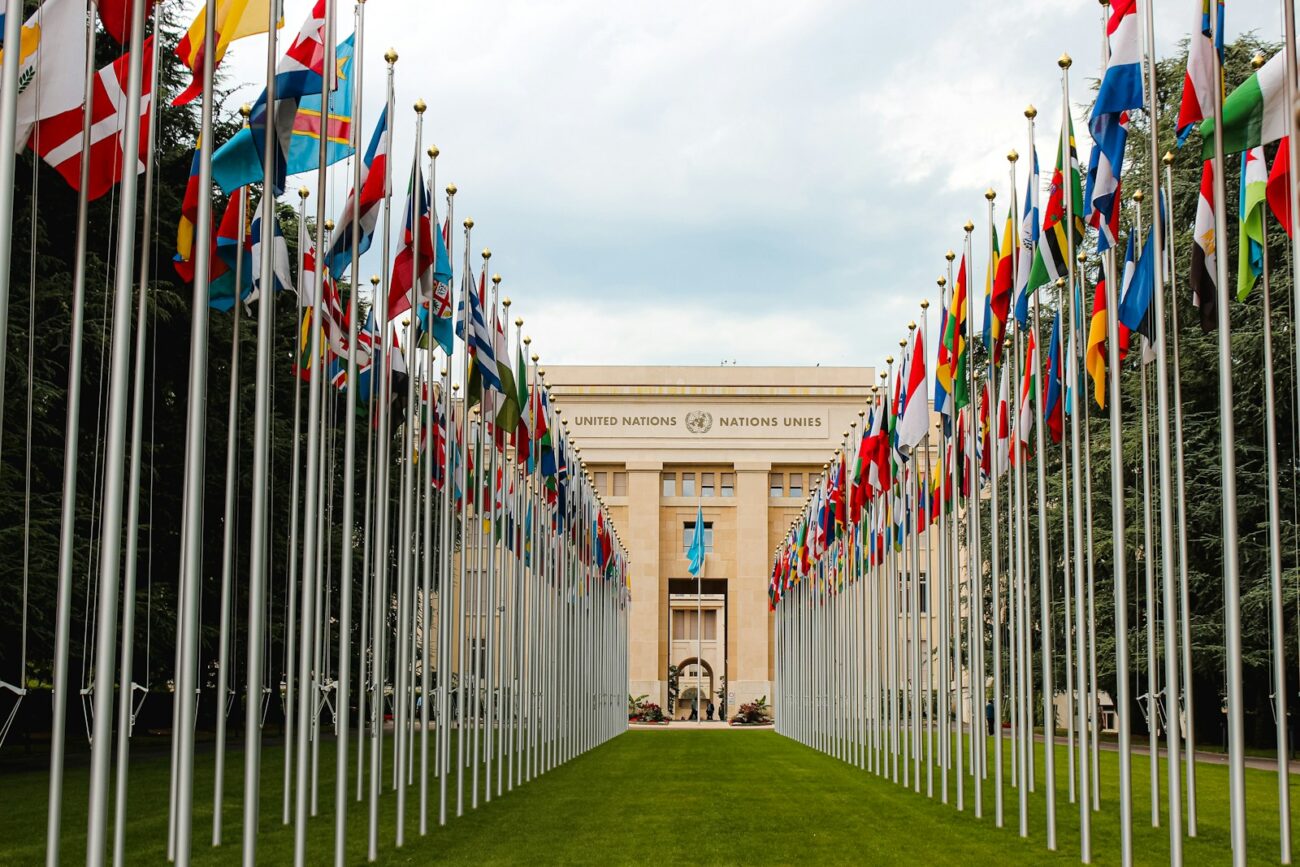
Featured image: United Nations flags in Geneva by Mathias Reding, published 23 May 2020, used under the Unsplash License. Historical illustrative photograph, not a photograph of the November 2026 conference. Resized for web display; no other editorial modifications.