
A large deployment of co-packaged optics in Quebec highlights a less visible part of AI progress: keeping thousands of processors connected. The engineering change helps explain how networking, packaging and maintenance shape useful computing capacity—and why benchmark gains need careful interpretation.
An AI cluster is often described by the number of accelerators it contains. That is a convenient inventory, but an incomplete account of what the system can do. Processors working on a shared task must exchange information, and the connections between them can determine how much of their computing capacity becomes useful work. On 16 November, Lambda announced a deployment of NVIDIA co-packaged optics switches connecting more than 10,000 Blackwell Ultra GPUs at its Quebec campus. The announcement concerns an installation rather than a future purchase commitment, although its performance claims remain company-reported. Its significance lies in a small physical change with potentially large systems consequences: moving the conversion between electrical signals and light closer to the switch chip.
Co-packaged optics, usually shortened to CPO, does not make the AI processor itself calculate faster. It changes part of the machinery through which many processors cooperate. That makes it a useful way to understand the AI value chain: a semiconductor package, optical components, a cooling arrangement and network software all contribute to the productivity of a service that its eventual user may experience simply as an answer on a screen. The relevant question is not whether light is intrinsically impressive. It is whether a different arrangement of components can reduce the overhead of keeping an expensive distributed system working together.
Why an AI machine needs a network
Distributed computing involves coordination as well as arithmetic. For an accessible example, NVIDIA’s documentation for collective communication describes AllReduce, an operation that combines values from participating devices and returns the combined result to every participant. Imagine several teams calculating different contributions to a shared total: each team needs the agreed total before proceeding with the next part of the work. That illustration does not describe every AI workload, but it captures why adding processors is not sufficient on its own. If the participants cannot exchange the required information efficiently, their theoretical computing power does not translate automatically into faster completion.
Two network properties are particularly easy to confuse. Bandwidth describes how much data a connection can carry per unit of time, while latency describes the delay involved in communication. A wide road and a short journey solve related but different problems. A system moving large amounts of information can be constrained by available bandwidth; one coordinating many small exchanges can be sensitive to delay. The mixture depends on the workload, the way it is divided and the network arrangement. As an engineering interpretation, a networking improvement becomes economically useful when it reduces a delay or constraint that the application actually encounters.
That qualification matters for readers comparing infrastructure announcements. A faster link specification is not a measurement of training time, and an improvement in one communication test is not a guarantee that an application will improve by the same percentage. Processors may also be waiting on storage, memory, software or other parts of the job. The cluster is a chain of interacting resources. Improving one link can remove a bottleneck, expose a different bottleneck or make little visible difference if that link was not limiting the work in the first place.
Moving the light closer to the chip
In NVIDIA’s explanation of the Lambda installation, optical engines sit beside the switch chip on its package, bringing electrical-to-optical conversion much closer to the source of the signals. The shorter electrical path reduces signal loss and removes the need for retimer chips in that path. Retimers are components used to restore signal timing; eliminating an unnecessary stage can reduce both component count and power overhead. Light still carries information through fibre between parts of the cluster. CPO changes where that optical journey begins, rather than turning the entire computer into an optical machine.
The distinction helps explain why packaging has become part of networking design. A switch chip does not operate in isolation from the surrounding connections. The electrical route between the chip and an optical interface has its own physical constraints. Bringing the interface closer means that the package, the attachment of fibres and the management of heat must be considered together. An architectural improvement therefore shifts engineering work as well as removing it. The useful comparison is between complete implementations that can be manufactured, operated and maintained, rather than between an ideal optical component and an inconvenient cable.
The OIF’s Co-Packaging Framework Document, published in 2022, shows that these are longstanding industry questions. Its discussion of laser placement distinguishes light sources integrated into optical engines from external sources. The latter can support replacement at the faceplate and a more favourable thermal separation, but introduce additional optical loss that must be compensated. This is a trade-off, not a free improvement in every dimension. For the value chain, it means progress depends on several suppliers and interfaces working together: the optical engine, the laser, the package and the surrounding system must be designed as an operating whole.
Reading the deployment figures carefully
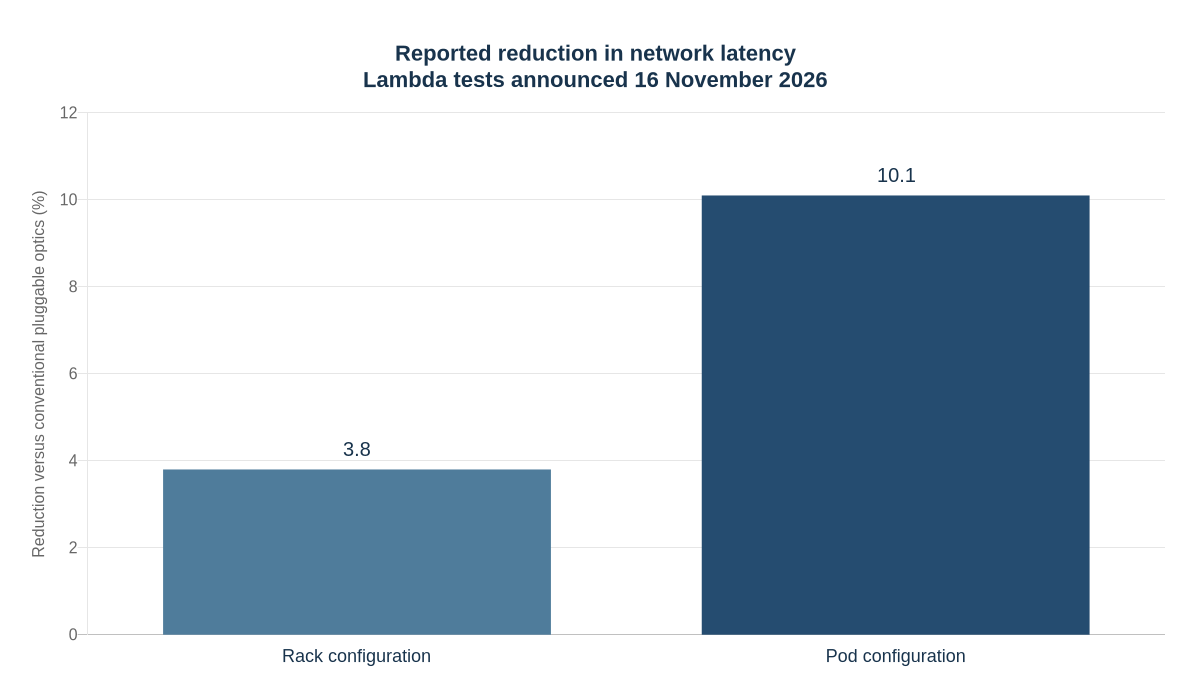
In Lambda’s reported comparisons with conventional pluggable optics, network latency was 3.8 per cent lower in the rack configuration and 10.1 per cent lower in the pod configuration, while throughput remained the same across the configurations discussed. Those two endpoints are shown below without inventing a value for the intermediate configuration. They are networking results reported by the operator, not an independent demonstration of an equivalent improvement in model training or an AI application’s response time. The announcement does not provide a complete reproducible benchmark protocol alongside those headline figures.
The appropriate conclusion is consequently narrower than a claim of a universally faster AI service. The results support examining CPO as a practical way to improve the network in a large installation. They leave open how different workloads, message sizes, software settings and traffic patterns would behave. An operator assessing a deployment would need the conditions of comparison and measurements of the intended jobs, including variation rather than just a headline improvement. This is not a reason to dismiss the result; it is how a component-level observation becomes a defensible systems decision.
A simple illustrative calculation makes the distinction concrete. Suppose communication that cannot overlap with other work accounts for one fifth of a job’s elapsed time. If that portion becomes 10 per cent shorter and everything else remains unchanged, total time falls by only 2 per cent: 0.20 multiplied by 0.10. These are hypothetical assumptions, not measurements of Lambda’s installation, and real jobs can behave differently because computation and communication may overlap. The example explains why the percentage attached to a network benchmark should not be copied directly into an estimate of training savings or business productivity.
Keeping the system running is part of performance
The design also changes how reliability and maintenance should be discussed. NVIDIA describes liquid cooling and removable external light-source modules in the deployed switches. That makes the light source a serviceable part, while the optical engines remain close to the switch chip. It would be misleading to infer that every component inside a co-packaged system is equally easy to replace. A maintenance assessment has to distinguish what can be exchanged in the field from what requires a more substantial intervention. The operating procedure matters alongside the component specification.
For a large shared computation, interruptions can be costly because the useful unit of work is larger than one device. The economic question is therefore not merely how many bits a switch moves in a successful second, but how reliably the entire job progresses over time. Fewer interruptions could improve utilisation, yet the size of that benefit depends on failure patterns, recovery procedures and the application. Reliability multipliers in supplier material should not be treated as a measured multiplier of annual cluster availability without the relevant definition, observation period and comparison. Completing more useful work is the outcome to measure.
This places cooling, maintenance access and software behaviour in the same discussion as networking performance. A component that performs well in isolation must still fit the facility’s operating model. The analytical lesson extends beyond optics: tighter integration can reduce some overheads while making coordination between disciplines more important. A procurement decision therefore needs evidence about operation and recovery as well as peak capability. The best arrangement for a new, purpose-built cluster may not be the best upgrade for a facility with different constraints or support practices.
The value reaches users through the service
A small business using an AI application will rarely choose the optical architecture of its provider’s switches. Even so, the underlying infrastructure helps determine which services can be offered economically and at what scale. Better networking could contribute to productive use of installed processors, but a lower provider cost does not automatically become a lower customer price. Nor does it remove model errors, improve an organisation’s data or guarantee better integration with its work. Infrastructure creates conditions for a service; the usefulness of that service still has to be assessed separately.
The Quebec announcement is valuable because it moves the discussion from a component roadmap to an operator’s reported installation and comparisons. It does not settle which networking architecture every AI facility should adopt. What it demonstrates more clearly is why the AI value chain cannot be reduced to the accelerator. Useful computing emerges from the coordination of processors, links, packaging, light sources, cooling and software. Moving an optical engine a short physical distance can matter when that distance is repeated throughout a large system. Understanding where the gain occurs, and where it stops, is the difference between reading an infrastructure headline and understanding the machine behind it.
Featured image: network cables by Scott Rodgerson, published 5 May 2023, used under the Unsplash License. Illustrative photograph of network cabling, not the Lambda installation or co-packaged optics hardware. Resized for web display; no other editorial modifications.